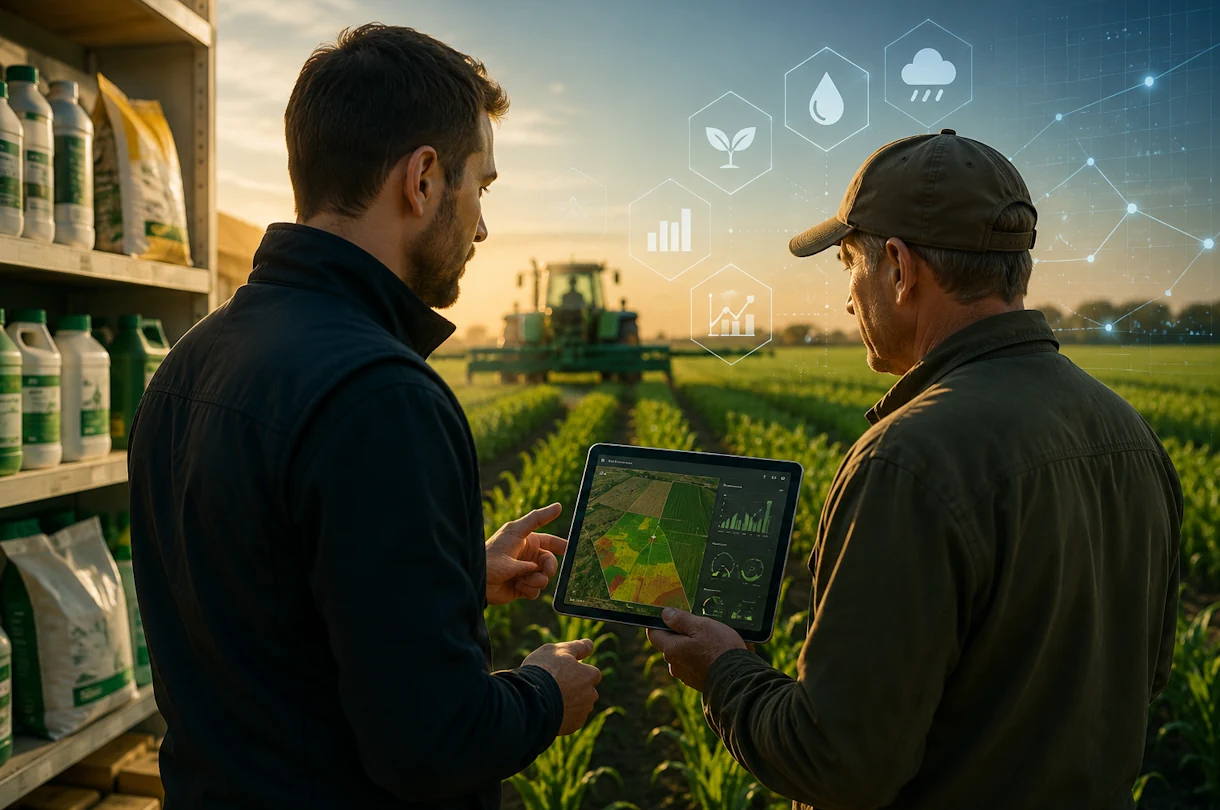
Advisory sales of agricultural inputs is a collaboration model in which an agri-business company recommends fertilisers, crop protection products, seed material and services based on farm data, production objectives, risk and profitability.
In brief
- A traditional agri-input salesperson mainly competes on price. A data-supported adviser competes on the quality of decisions.
- Eurostat estimates that in 2023 there were 8.8 million farms in the EU, and 62.8% of them had less than 5 ha.
- According to Eurostat, the value of EU agricultural output in 2025 was EUR 562.5 billion, while intermediate consumption reached EUR 310.8 billion.
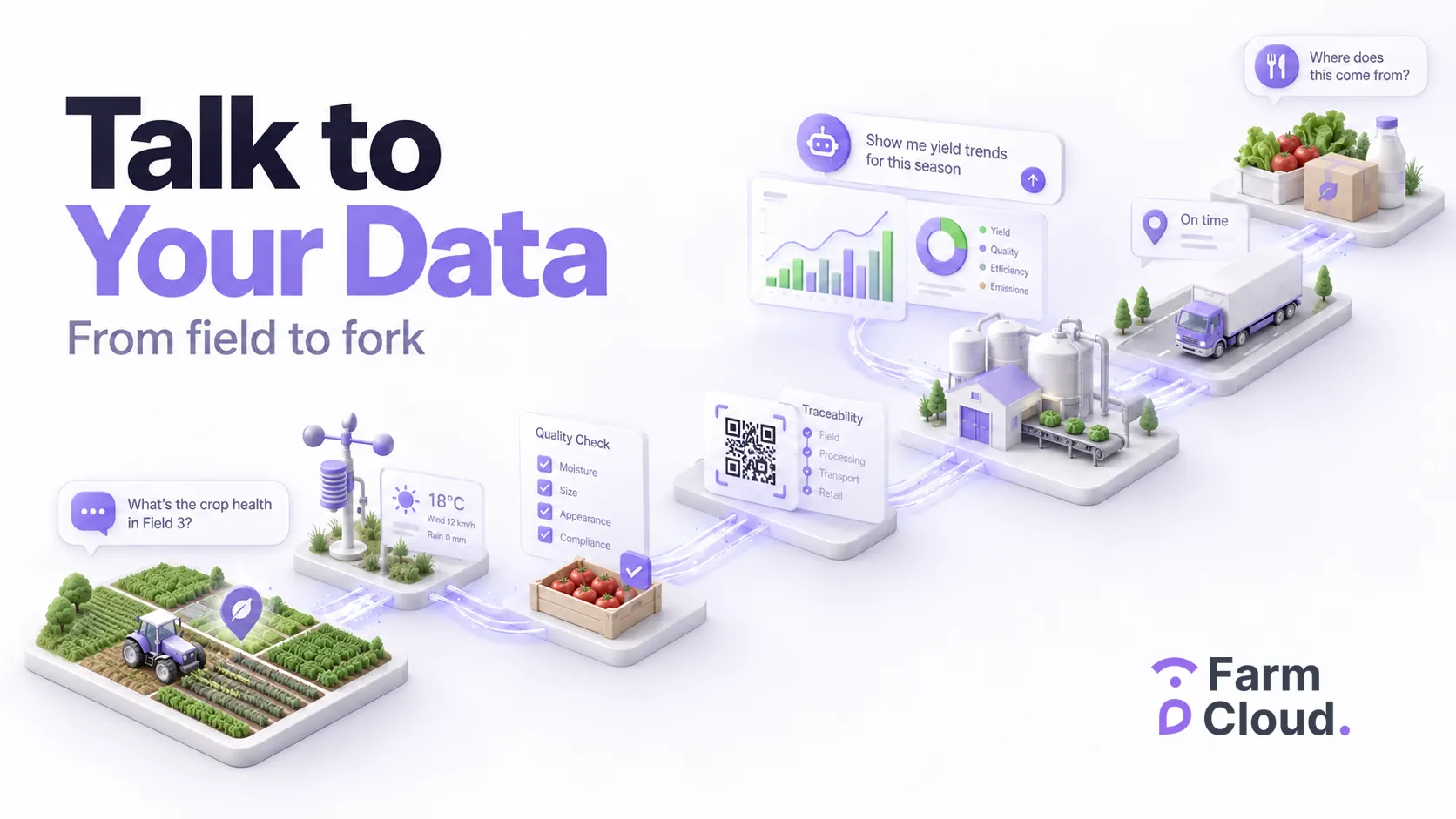
- FarmCloud connects FarmPortal, FoodPass and AgroSell in a model where field data, recommendations, offers, documentation and traceability work as one process.
- An app alone will not turn a salesperson into an adviser. Data, process, agronomic competence and consistent work with the farmer are required.
Why has selling agricultural inputs stopped being a simple transaction?
Selling agricultural inputs has stopped being a simple transaction because the product is now only part of the decision. The farmer wants to know whether a given dose, technology, variety or treatment makes sense on a specific field, under specific weather conditions, disease pressure, soil history and the current farm-gate price.
This is a major shift. In the past, product availability, a relationship with the salesperson and a good discount could create an advantage. Those elements still matter, but they are increasingly insufficient to retain a customer over several seasons.
If a sales representative only talks about the price list, the farmer can easily compare the offer with another supplier. If the conversation covers production technology, treatment risk, cost per hectare, field history and buyer requirements, the discussion moves from price to the value of the decision.
An agri-business company that in 2026 still operates mainly through catalogues, discounts, seasonal promotions and field visits without a shared database is not building a lasting advantage. In that model, customer knowledge remains in the salesperson’s notebook, in text messages, in a spreadsheet or in the adviser’s memory.
Data needs to work.
What does a farmer expect from an agri-business company today?
Farmers expect agri-business companies to provide recommendations that combine agronomy, economics and documentation. They no longer ask only “how much does the product cost”, but increasingly “why should I use it, what will it cost per hectare and how will I document this decision”.
In professional farms, purchasing decisions are linked to fertilisation plans, crop protection, crop rotation, treatment timing, workforce availability, machinery fleets and buyer requirements. A fruit grower, vegetable producer or 200 ha farm does not buy a crop protection product in isolation from residue risk, harvest schedules and batch quality.
Expectations towards advisers rise especially where weather pressure is high. Drought, local frosts, heavy rainfall, disease pressure and short treatment windows mean that the farmer needs a quick response, not a general sales conversation held once every few weeks.
Farmers want decisions that can be verified. They want a history of recommendations, access to field data, comparisons between options and clarity on whether a recommendation is based on the real situation on the farm or only on the supplier’s sales plan.
Salesperson or agricultural adviser: what is the real difference?
The difference is that a salesperson starts with the product, while an adviser starts with the farm diagnosis. A salesperson asks about demand; an adviser asks about the field, treatment history, yield objective, risk, constraints and buyer requirements.
This is not a difference in job title. It is a difference in workflow, data and responsibility for the recommendation. An agricultural adviser needs to understand the product, but knowledge of the label, fertiliser composition or crop protection price alone is no longer enough.
“In the past, the conversation started with price and product availability. Today the farmer asks why this fertiliser should be applied to this particular field, in this weather and at the current farm-gate price. Without data, that conversation quickly ends in a discount.”
“The biggest difference appears when I can see the field history, previous treatments and observations. Then I am not selling a product from a catalogue; I am recommending a decision that can later be documented.”
| Criterion | Traditional salesperson | Adviser supported by FarmCloud | Meaning for the agri-business company |
|---|---|---|---|
| Starting point of the conversation | Product, availability, discount | Field, crop, treatment history, production objective | The conversation moves from price to decision quality |
| Customer knowledge | Salesperson’s notes and team memory | Farm profile, field data, segmentation, contact history | The company reduces the risk of losing knowledge when employees leave |
| Recommendation | Product offer | Advice linked to field, timing, dose and documentation | It becomes easier to assess the quality of advisory work |
| Relationship with the farmer | Seasonal contact | Continuous collaboration through the app, visits and data | Retention may improve, although this is not a guaranteed outcome |
| Commercial argument | Price and promotion | Profitability, risk, quality and compliance with buyer requirements | The company can reduce its dependence on price wars |
How do production costs change the sales conversation with farmers?
Production costs change the sales conversation because a mistake in product selection, dose or treatment timing hits the farm margin more quickly. The higher the cost of fertilisers, fuel, labour, energy and crop protection, the less room there is for recommendations based only on intuition.
According to Eurostat, in 2025 the value of EU agricultural output was estimated at EUR 562.5 billion, while intermediate consumption, meaning the cost of goods and services used in production, reached EUR 310.8 billion. This shows the scale of purchasing decisions: agricultural inputs are part of a very large cost stream.
Eurostat also indicates that prices of goods and services consumed in agriculture increased by 31.2% in 2022, then fell by 4.7% in 2023 and by 6.1% in 2024, before rising by 0.4% in 2025. In the same year, 2025, prices of fertilisers and soil improvers increased by 5.5%.
These figures do not mean that farmers will stop buying. They point to something more important: farmers will filter recommendations more strictly, ask for justification and compare suppliers not only by price, but also by the quality of advice.
A discount cannot replace diagnosis.
Why is first-party data becoming a new advantage for agri-business companies?
First-party data creates an advantage because the agri-business company builds it directly in its relationship with the farmer, with the farmer’s consent and through day-to-day work. It includes data on the farm, fields, crops, purchases, recommendations, treatments, production issues and communication preferences.
Traditional field sales often creates fragmented knowledge. One adviser knows that the farmer has a disease pressure problem in wheat. Another remembers that the farm has changed its cropping structure. A third has field photos on their phone, but they are not in the system.
In a data-based model, an agri-business company can segment customers by crop, area, region, treatment history, production type and seasonal needs. This changes the quality of campaigns, offers and advisory conversations because communication is no longer sent to everyone in the same way.
First-party data also has strategic value. When the relationship with the farmer is based only on the sales representative and a seasonal promotion, the company has weak control over its own channel. When the relationship is based on a farm profile, collaboration history and an app used in daily work, the company builds a more durable operational layer.
How are retailers and large buyers changing requirements for smaller suppliers?
Retailers, processors, exporters and large buyers are increasing the importance of documentation, traceability, consistent quality, timeliness and procedural compliance. This does not mean that every large buyer abuses its position, but it does mean that a smaller supplier without data has a weaker argument than an operator with well-documented production.
The European Commission describes the food supply chain as vulnerable to unfair trading practices due to the imbalance between small and large operators. The UTP Directive protects farmers and small and medium-sized suppliers against selected practices such as late payments, unilateral contract changes or shifting certain costs onto the supplier.
In the European Commission report of 23 April 2024, the most frequently detected unfair trading practices concerned late payments for agricultural and food products: 50% and 13% of detected cases. The report also indicated that around 41% of detected practices occurred at retail level and 36% at food industry level.
For agri-business companies, the practical conclusion is clear. An agricultural input supplier that helps the farmer keep production documentation, record treatments and connect recommendations with buyer requirements increases the value of its offer across the supply chain.
How does FarmCloud support the shift from sales to advisory work?
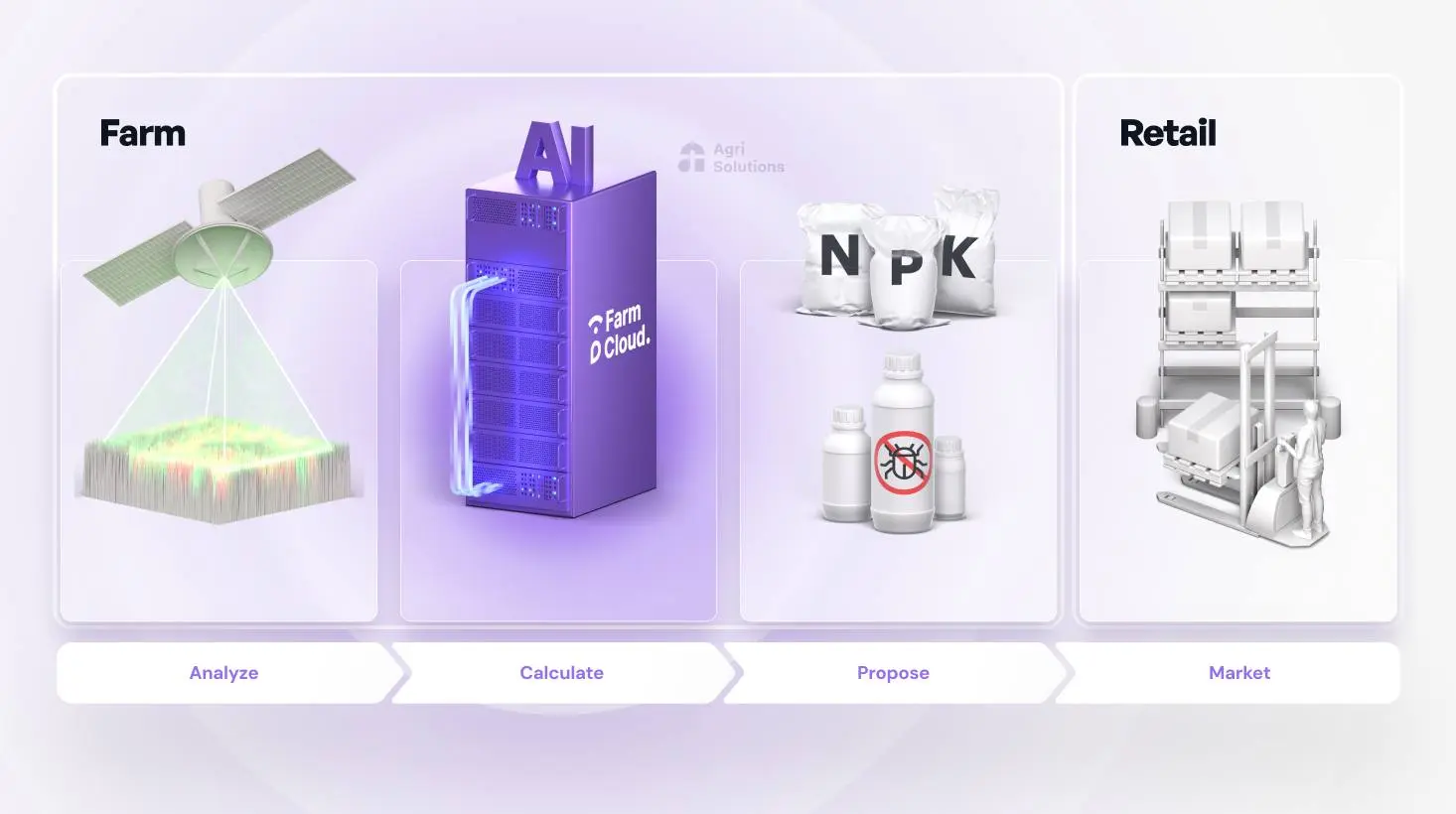
FarmCloud supports the shift from sales to advisory work by connecting farm data, advisory processes, communication, offers, quality and traceability into one process model. It is not just a CRM, nor just an app for farmers.
FarmPortal acts as the operational layer of the farm. The farmer can manage field and crop records, register treatments, observations, costs, stock, machinery, employees, harvests, GPS data, sensors, weather stations and soil moisture sensors. The public description of FarmPortal features for farm management and production documentation shows that the application is close to the farmer’s daily work.
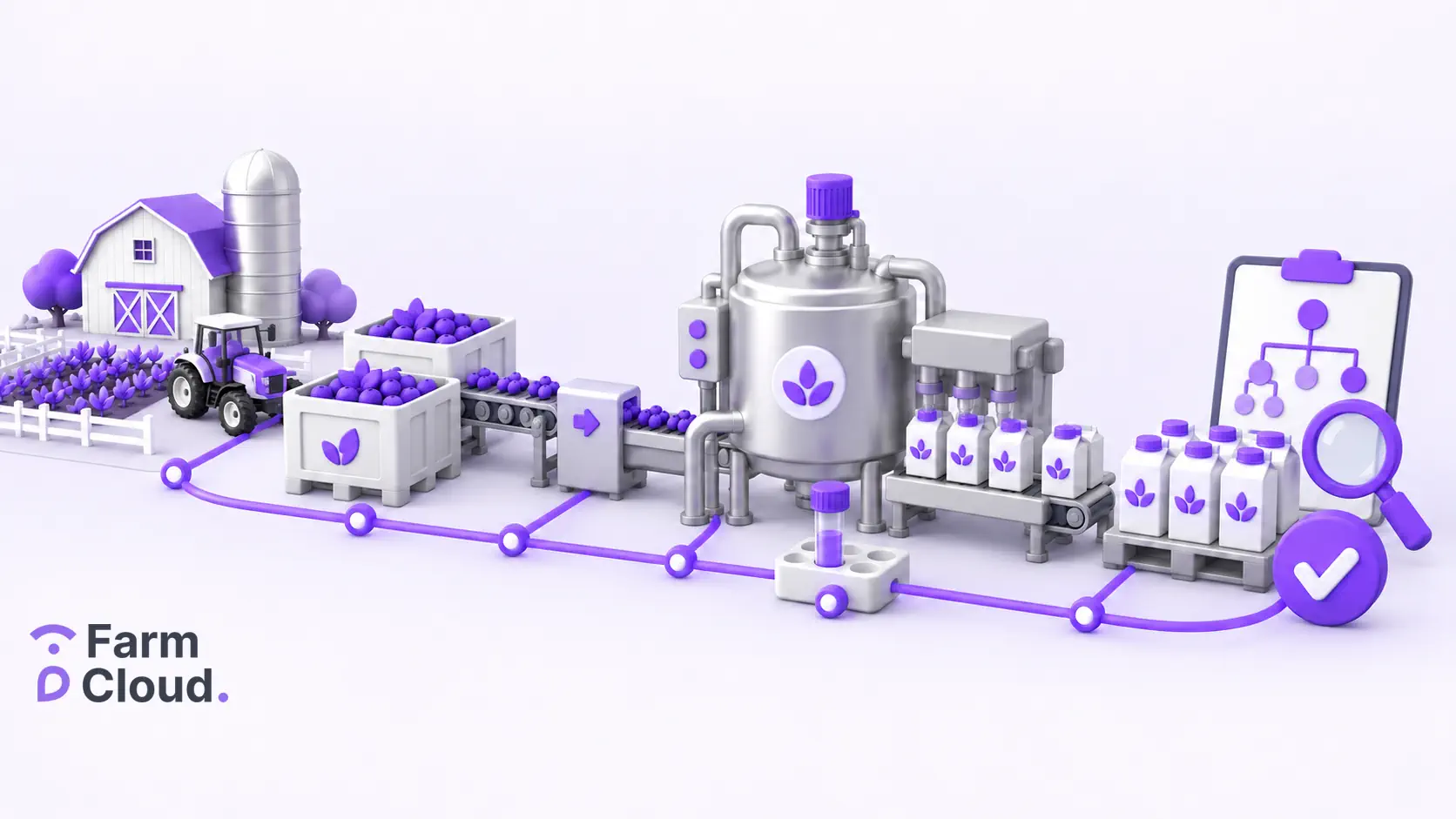
FoodPass connects production data with quality, audits, suppliers, samples, documents and batch tracking from field to buyer. For companies contracting raw materials or working with processors, FoodPass for traceability, quality and supplier collaboration matters because agronomic recommendations can be linked with production documentation.
AgroSell adds the sales, campaign, offer, loyalty programme and segmentation layer. AgroSell as a channel for offers, campaigns and loyalty for agri-business companies can use data on the real needs of the farm instead of sending the same promotion to the entire customer base.
FarmCloud connects these elements as a platform for data, integration and collaboration. The public description of processes supported by the FarmCloud platform includes agronomic advisory, supplier portals, ESG, loyalty programmes and audits. This matters because sales, advisory work and documentation should not operate as three separate worlds.
What data should an adviser see before recommending a product?
An adviser should see data that affects the agronomic, economic and documentation-related decision. At a minimum, this means cropping structure, field history, treatments, fertilisation, observations, weather, soil, stock, buyer requirements and previous recommendations.
The point is not to collect data for reporting alone. The point is to link a product recommendation to a specific problem and a measurable farm context.
| Data type | Source | Decision supported | Module or function |
|---|---|---|---|
| Field history | FarmPortal, treatment records | Selection of fertilisation and crop protection technology | FMS, field documentation |
| Cropping structure | Farm profile | Customer segmentation and campaign planning | AgroSell, CRM for agriculture |
| Weather data | Weather stations, forecasts, alerts | Treatment timing, disease risk, application window | FarmPortal, IoT, alerts |
| Soil moisture | Field sensors | Irrigation, fertilisation, water stress risk | FarmCloud IoT, FarmPortal |
| NDVI and satellite observations | Remote sensing data | Identification of differences in crop condition | Analytics, VRA, variability maps |
| Buyer requirements | FoodPass, documents, audits | Selection of recommendations aligned with quality and traceability | FoodPass, supplier control |
| Purchase and offer history | CRM, ERP, AgroSell | Offer personalisation and retention planning | AgroSell, ERP/CRM integrations |
If the adviser sees only the previous order, the recommendation will be shallow. If they see the field, crop, treatment history, costs, weather and buyer requirements, they can prepare advice that has greater practical value for the farmer.
From sales notes to data-based advisory work
This case study shows how a regional agri-business company can move from transactional sales to data-based advisory work. It is not a publicly confirmed description of a specific customer implementation.
Company context
A regional company sells fertilisers, crop protection products and seed material. It serves 450 farms across three voivodeships, which together manage production on 38,000 ha. The team consists of 12 field advisers.
Before implementation, each salesperson keeps their own notes. The company has no unified farm profile, no recommendation history and no clear information on which offers were based on real field needs.
Solution applied
In the FarmCloud model, the company builds farm profiles and segments farmers by crops, area, region and production issues. FarmPortal organises field data, treatments, observations and documentation, AgroSell handles campaigns and offers, while FoodPass can be used where the farmer works with a buyer that requires production documentation.
Input data includes cropping structure, treatment history, soils, observations, weather, orders, recommendations and campaigns. The pilot uses five main crop groups: cereals, maize, oilseed rape, potatoes and field vegetables.
Pilot KPIs
The company does not measure sales alone. It measures the share of farms with a complete production profile, the number of recommendations linked to a specific field, the number of offers personalised by crop and problem, the time needed to prepare a recommendation and the share of customers active in the digital channel.
Further KPIs include sales linked to segmented campaigns and the number of cases where it is possible to reconstruct the path: observation, recommendation, purchase and treatment execution. This is not a promise of sales growth. It is a way to measure the maturity of the advisory process.
Conclusions from the model
The biggest change is not that advisers receive a new system. The biggest change is that the company starts seeing the customer as a farm with data, history, risk and potential, rather than as a sales point in a region.
Results depend on data quality, adviser discipline and farmer engagement. If the team does not update farm profiles, document recommendations or use the application during the season, digital advisory will remain only a slogan.
Checklist: is your agri-business company still selling, or already advising?
An agri-business company operates as an adviser if it can connect the product offer with the farm profile, field history, recommendation, documentation and process outcome. If most customer knowledge remains in the salesperson’s head, the company is still operating mainly in a field sales model.
- Does every customer have a completed farm profile, including area, cropping structure and key production issues?
- Are recommendations assigned to a specific field, crop, timing and adviser?
- Can the company see the history of contacts, offers, campaigns and farmer responses?
- Does the adviser have access to weather data, observations, treatment history and buyer requirements?
- Are sales campaigns segmented according to real farm needs?
- Does the farmer receive recommendations and documentation through a digital channel used in daily work?
- Does management see KPIs for advisory work, rather than only invoice value?
- Can the company reconstruct the path from crop problem to recommendation, offer, purchase, treatment and documentation?
| KPI | How to measure it | Data source | Interpretation |
|---|---|---|---|
| Share of customers with a complete farm profile | Number of complete profiles / number of active customers | FarmCloud, AgroSell, FarmPortal | Shows readiness for advisory sales |
| Number of recommendations linked to a field | Recommendations with field, crop and timing | FarmPortal, adviser panel | Measures the move away from generic offers |
| Time from problem observation to recommendation | Difference between observation date and recommendation date | FarmPortal, notifications, event history | Shows responsiveness during the season |
| Share of personalised offers | Segmented offers / all offers | AgroSell, CRM | Shows campaign quality |
| Farmer activity in the digital channel | Logins, confirmations, recommendation reads | FarmPortal, AgroSell | Measures practical adoption of the model |
| Batches with complete field history | Number of batches with documentation / total number of batches | FoodPass, FarmPortal | Connects advisory work with traceability |
How to implement an advisory model with FarmCloud step by step
The advisory model with FarmCloud should be implemented in stages because the change affects data, people and the sales process. The worst approach is to launch a system without agreeing which decisions it is meant to support.
- Define farm segments. Start with area, crops, region, production type, purchase history and buyer requirements.
- Set the minimum customer profile. Do not collect everything. Collect the data the adviser needs for recommendations and the salesperson needs to prepare a meaningful offer.
- Connect FarmPortal with advisers’ work. Define which data the farmer enters independently, which data the adviser enters and which data comes from sensors, weather stations or integrations.
- Design campaigns in AgroSell. Build offers by crop, production issue, season and farm profile.
- Use FoodPass where quality and traceability matter. This is particularly relevant for production for processors, exporters, producer groups and buyers with documentation requirements.
- Set advisory KPIs. Measure data completeness, the number of recommendations, response time, offer personalisation and farmer activity.
- Train the team. The adviser needs to understand that the system is not an administrative add-on, but a tool for a better conversation with the farmer.
- Integrate data with ERP, CRM, WMS and BI. Integrations make sense when the company knows which data supports sales, logistics, reporting and management.
What are the limitations of digital agricultural advisory?
Digital agricultural advisory has limitations because data does not replace agronomy, field experience or conversations with farmers. FarmCloud can organise the process, but it should not be treated as a substitute for advisory expertise.
The first limitation is data quality. If farm profiles are incomplete, treatments are not recorded and field observations remain only in advisers’ private messages, the system will not build a reliable basis for recommendations.
The second limitation is farmer adoption. The farmer needs to see a practical benefit: less paperwork chaos, a faster recommendation, better justification for decisions, easier preparation for inspections or simpler contact with the adviser.
The third limitation is organisational discipline within the agri-business company. If management measures only monthly sales, and not the quality of profiles, recommendations, segmentation and seasonal work, the team will quickly return to the old model.
For small farms, the model should be simpler. Excessive administration kills adoption.
FAQ
What is advisory sales of agricultural inputs?
Advisory sales of agricultural inputs is a model in which an agri-business company recommends a product based on farm data, field history, production objectives, risk and profitability. The product is part of the recommendation, not the only subject of the conversation.
Does FarmCloud replace the agricultural adviser?
No. FarmCloud supports the adviser with data, documentation, communication and integrations, but it does not replace agronomic expertise, field assessment or responsibility for the recommendation.
What data is needed for better agri-advisory work?
The most important data includes the farm profile, cropping structure, field history, treatments, fertilisation, observations, weather, soil, buyer requirements, previous recommendations and offer history.
Can a smaller distributor compete with a large retail network using data?
Yes, but not by simply having a system. A smaller distributor can build an advantage through better knowledge of local farms, faster response, offer personalisation and documented recommendations.
How does AgroSell support agricultural input sales?
AgroSell supports CRM, segmentation, campaigns, personalised offers, loyalty programmes and communication with farmers through FarmPortal. As a result, the offer can be based on the real needs of the farm.
Why does an agri-business company need FoodPass?
FoodPass is needed where sales and advisory work connect with quality, traceability, audits, documents, suppliers and buyer requirements. It helps link field data with the product batch and documentation.
Is implementing an advisory model expensive?
The cost depends on the company’s scale, number of advisers, integrations, data scope and model of working with farmers. A safe approach is to run a pilot in a selected region, crop group or customer segment.
What risk does an agri-business company face if it stays with traditional sales?
The main risks are price wars, low customer loyalty, loss of knowledge when a salesperson leaves, weak offer personalisation and lack of recommendation documentation. The company may have sales, but it does not have a durable relationship layer with the farmer.
Should farmer data be shared with an agri-business company automatically?
No. Data should be shared with the farmer’s consent, for a clearly defined purpose and within the scope needed for advisory work, documentation, traceability or commercial service.
Where should a company start when implementing FarmCloud in a sales team?
The best starting point is customer segmentation, a minimum farm profile, a pilot with several advisers and defined KPIs. Only then should integrations, campaigns and automation be expanded.
Glossary
Advisory sales
Definition: a sales model in which the offer results from a diagnosis of the customer’s needs. Meaning: it reduces conversations based only on price. Example: a fertilisation recommendation following analysis of field history and yield objective.
First-party data
Definition: data obtained directly through the relationship with the customer. Meaning: it builds an independent knowledge channel about the farm. Example: crop profile, recommendation history and farmer activity in FarmPortal.
AKIS
Definition: Agricultural Knowledge and Innovation System. Meaning: it shows that advisory work is part of a broader exchange of knowledge. Example: collaboration between advisers, farmers, technology companies and research institutions.
UTP Directive
Definition: the EU directive on unfair trading practices in the agri-food supply chain. Meaning: it protects weaker participants in the chain against selected practices. Example: a ban on late payments beyond defined deadlines.
Traceability
Definition: the ability to trace a product’s origin and production history. Meaning: it supports quality, audits and buyer confidence. Example: linking a batch of vegetables with the field, treatments and documents in FoodPass.
CRM for agriculture
Definition: a system for managing relationships with farmers and farms. Meaning: it organises contacts, segments, offers and sales activities. Example: AgroSell as a tool for campaigns, offers and loyalty for agri-business companies.
FMS
Definition: Farm Management System. Meaning: it organises production, fields, treatments, costs and documentation. Example: FarmPortal as an FMS for the farmer and a data source for advisory work.
VRA
Definition: Variable Rate Application. Meaning: it supports the adjustment of fertilisation or other treatments to field variability. Example: an application map prepared using soil data and crop condition.
IoT in agriculture
Definition: a network of sensors and devices collecting data from the farm. Meaning: it provides current information on weather, soil, microclimate, location and device operation. Example: a weather station or soil moisture sensor connected to FarmCloud.
FarmCloud
Definition: a digital platform for data, processes and integrations in agri-food. Meaning: it connects the farm, advisory work, sales, quality, traceability and analytics. Example: FarmPortal, FoodPass and AgroSell working together in one farmer service model.
Conclusions for agri-business companies
Agri-business companies do not need to stop selling. They need to stop treating sales as a conversation detached from agronomy, costs, quality and documentation.
A modern agricultural adviser combines product knowledge, farm data, production economics, buyer requirements and communication with the farmer. In this model, price still matters, but it is not the only language of the conversation.
FarmCloud supports this direction through FarmPortal as the farm data layer, FoodPass as the quality and traceability layer, and AgroSell as the CRM, campaign, offer and loyalty layer. It is also worth reading the model of moving from salesperson to farmer partner, as it clearly shows how the logic of the relationship with the agricultural producer changes.
If an agri-business company wants to move from transactional sales to data-based advisory work, it should start by organising farm profiles, adviser workflows, recommendations, offers and documentation. FarmCloud, FarmPortal, FoodPass and AgroSell can support this process as a shared infrastructure for collaboration with farmers.
Follow us!
Preview what we are doing and be inspired by positive changes.