Who this article is for and what problems it solves
This article is written for sales and marketing departments of fertilizer, crop protection product, and seed manufacturers and distributors, as well as for key account managers working with farms. Each of these groups operates under pressure from margins, seasonality, growing competition, and increasingly high farmer expectations.
In practice, the challenge is no longer simply “how to reach the customer.” The real issue is how to increase fertilizer, seed, and crop protection sales without weakening the relationship, wasting campaign budget, or undermining trust in farm data.
| Audience group | Most common problem | Key benefit of a relationship-driven approach |
|---|---|---|
| Fertilizer, crop protection product, and seed manufacturers | Low campaign relevance, weak understanding of the real purchase moment, low demand predictability | Better targeting, higher marketing effectiveness, and a stronger brand role in the buying decision |
| Distributors and retail networks | Price pressure, random promotions, lack of tools to retain customers after the season | Higher purchase frequency, larger basket value, and stronger customer retention in agriculture |
| Key account managers serving farms | CRM without agronomic context, scattered information, too many manual activities | Advisory CRM for agro, better contact planning, fewer random conversations, and higher recommendation quality |
| Agro marketing teams | Difficulty linking campaign performance to actual customer activity | Better performance measurement, customer segmentation in agro, and more useful seasonal campaigns |
Table 1. Main problems and benefits for individual audience groups
Why traditional sales in agro are no longer enough
Just a few years ago, many suppliers built results on a simple model: price list, discount, a phone call to the customer, and sometimes an additional pre-season promotional campaign. That model has not disappeared entirely, but it is no longer enough. Farmers increasingly expect suppliers to understand their production reality, not just send another offer.
In practice, this means a change in logic. The advantage no longer goes to the company that sends the most messages, but to the one that can connect commercial contact with the real decision-making moment. In agriculture, the winner is now the supplier who understands when an offer makes agronomic, logistical, and economic sense.
That is exactly why topics such as CRM for agriculture, partner programs for farms, dynamic offers for farmers, and offer personalization in agriculture can no longer be treated as optional extras. They are a response to a structural change in the market.
The key benefits for sales and marketing teams
The greatest value in the digitalization of sales in agriculture appears when data, communication, and commercial activities start working together. From the perspective of an agro company, the point is not automation itself, but greater effectiveness and stronger relationships.
- better alignment of fertilizer offers with crops, region, and stage of the season,
- fewer “one-size-fits-all” campaigns and more campaigns based on real signals,
- shorter time from interest to offer,
- higher purchase frequency and larger basket value,
- stronger customer retention in the agricultural sector,
- better connection between field sales teams and digital channels,
- more predictable sales and marketing results.
Catalogue selling versus a relationship-driven model based on data
The most useful comparison today is not between offline and online sales. The real difference lies elsewhere: between catalogue selling and a relationship-driven model built on first-party data, seasonality, and advisory support. That is where a defensible advantage is created — one that cannot be copied by promotion alone.
| Area | Catalogue selling | Relationship-driven model |
|---|---|---|
| Starting point | Product and price list | Farm needs and decision timing |
| Segmentation | Region, acreage, customer type | Crop, stage of the season, activity, relationship history, purchase potential |
| Role of the sales representative | Offer seller | Advisor managing the relationship |
| Role of marketing | Campaign distribution | Contact orchestration, scoring, personalization, and retention |
| Loyalty | Discount or occasional incentive | Everyday value, convenience, continuity, rewards, and useful services |
| Data | Scattered notes and intuition | First-party data, segments, interaction history, behavioral signals |
| Business outcome | Lower predictability, price pressure | Higher conversion, better retention, greater lifetime customer value |
Table 2. Catalogue selling versus a relationship-driven model in agriculture
First-party data instead of guesswork: the foundation of modern sales
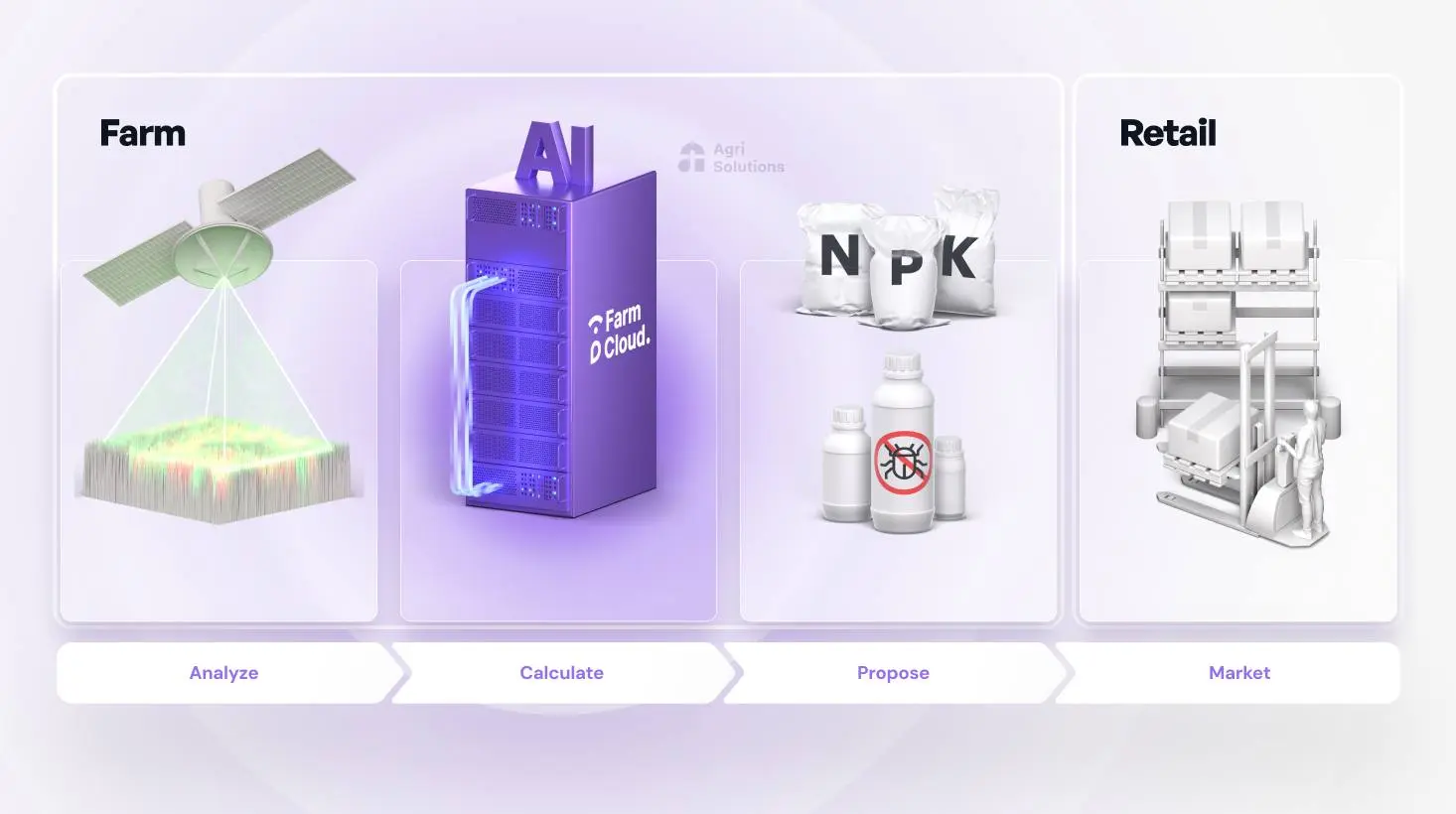
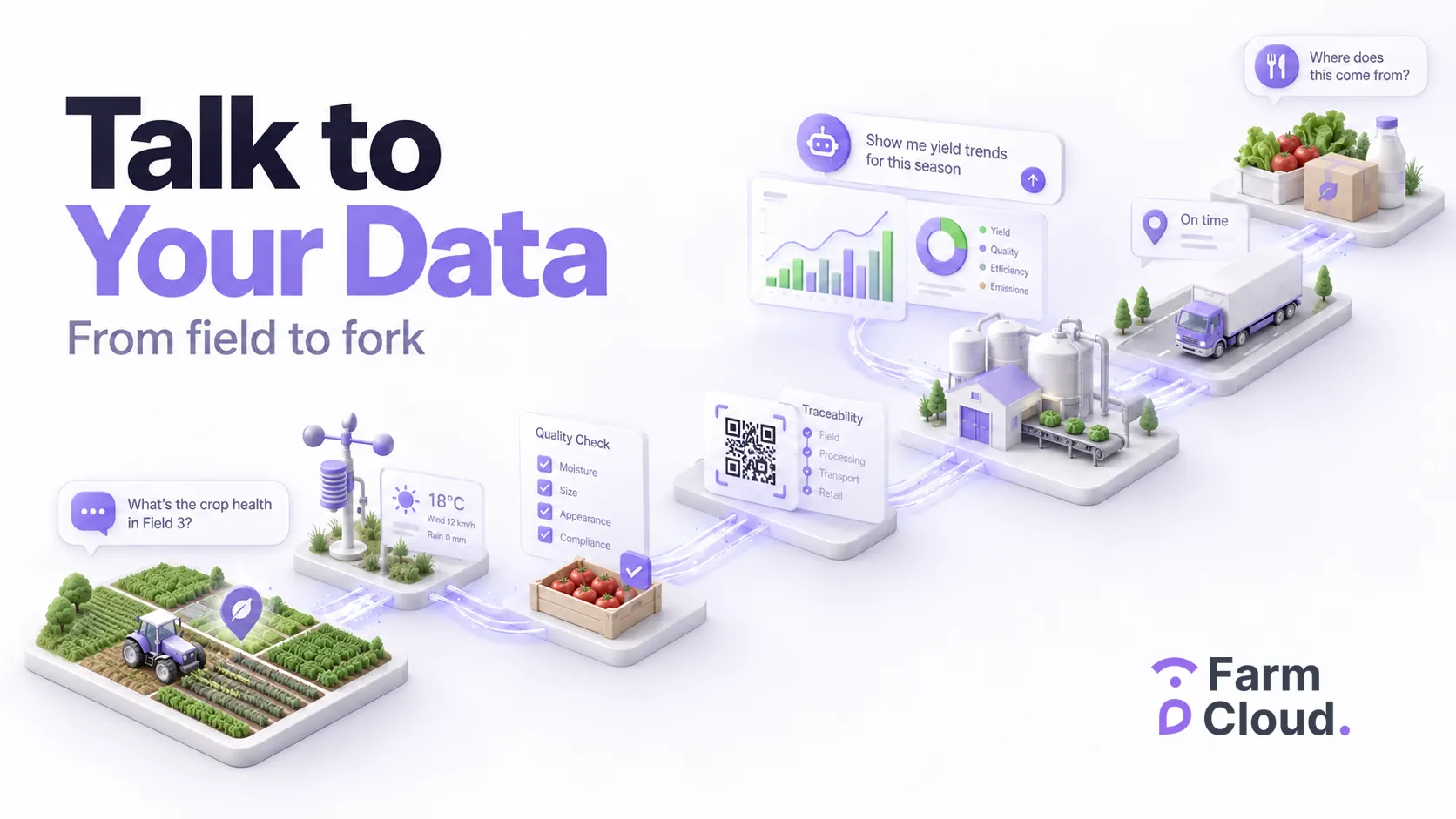
FarmCloud is digital infrastructure for agribusiness that combines three complementary layers of work with farms and the supply chain: FarmPortal as an FMS for day-to-day production management, FoodPass for supply chain monitoring, supplier collaboration, and advisory support, and AgroSell for building digital sales, marketing, loyalty, and relationship channels.
First-party data means information collected in a direct relationship with the system user or customer. In agriculture, this includes activity data, responses to communication, relationship history, production segments, in-system behavior, and purchasing preferences. This is a very different quality level from external contact lists or generic lead databases.
The most important point is that effective personalization does not require giving a salesperson or advertiser access to full farm data. In practice, it is enough to know that a given user segment operates in a specific region, follows a specific production model, returns to certain system functions, or is approaching a typical purchase window.
This is what opens the way to contextual selling. The company does not guess who may buy fertilizer, crop protection products, or seeds. Instead, it acts on signals that appear in the farm’s daily work.
In the FarmCloud ecosystem, this model is clearly visible in the link between FarmPortal and AgroSell. FarmPortal works close to the farmer’s daily operations, while AgroSell — a sales and marketing module integrated with FarmPortal — translates that knowledge into campaigns, offers, loyalty, and relationship management.
Behavioral profiling instead of simple segmentation
Traditional segmentation in agro usually ends with a few spreadsheet fields: farm size, region, and production type. That is still useful, but too limited to drive sales effectively. Much greater value comes from behavioral profiling, meaning the analysis of what the customer actually does.
For a manufacturer or distributor of agricultural inputs, this means moving from the simple question “who is the customer?” to the more valuable question “what does this customer do, when do they do it, and what does that mean for the next sales contact?”
1. RFM scoring
RFM is a simple customer assessment model based on three dimensions: recency, frequency, and monetary value. In agriculture, it can be understood more broadly than just the purchase itself.
- Recency: when the customer last responded to an offer, logged in, sent an inquiry, or opened a message.
- Frequency: how regularly they use the system, return to modules, and interact with the brand.
- Value: not only past turnover, but also basket potential, seasonality, and purchase probability.
2. Progressive profiling
You do not need to know everything at once. Good relationship systems enrich the customer profile gradually. At the beginning, basic data is enough; later, operational and commercial signals are added.
- at the start: region, farm type, operating scale,
- at the next stage: key crops and seasonal priorities,
- later: response history, contact preferences, purchase habits, and participation in the loyalty program.
3. Propensity models
At the most mature stage, a company stops reacting only after an order appears. It starts predicting which customer segment is closest to a decision, who is at risk of churn, who will respond to a new product, and who needs advisory contact rather than a promotional message.
This is where the digitalization of agricultural trade moves from being “a campaign tool” to becoming a real sales decision support system.
How offer personalization works in agriculture
Offer personalization in agriculture is not about inserting a first name into a message. In practice, it means the farmer sees the right product, at the right moment, in a context that makes sense. That is the difference between a promotion and decision support.
In the fertilizer, seed, and crop protection industries, this matters especially because purchasing decisions are rooted in the treatment calendar, weather, local conditions, and production economics. That is why an effective sales platform for fertilizer distributors must account for more than just the product basket.
7 ways that can realistically increase agricultural input sales
- Segment customers by season, not just by region. Region matters, but two farms in the same county can be at completely different stages of work.
- Connect the offer to a production need. The conversation is different with a strawberry grower, a maize producer, or a mixed farm.
- Set contact priorities. Not every lead requires a phone call on the same day. You need order based on scoring.
- Respond to the moment, not only to history. A high-value customer from the previous season does not automatically mean they are ready to buy today.
- Give the sales representative context for the conversation. Contact without context ends with a price question. Contact with context can start with a problem and a recommendation.
- Combine channels. Some customers prefer a conversation, some a quick message, and others self-service. There is no need to choose only one model.
- Measure effectiveness at the segment level. It is worth knowing which groups respond to fertilizer offers, which respond to point-based programs, and which respond to advisory content.
A farmer loyalty program that builds value
Many suppliers still understand loyalty only as a discount or a turnover-based incentive. That is too narrow an approach. A modern loyalty program for farmers works best when it combines economic benefit with everyday usefulness.
Farmers do not return only to where the price is lower. They return to where they can make decisions faster, reduce chaos during the season, receive relevant reminders, enjoy smoother communication, and gain tangible benefits from continuing the relationship.
What works better than a discount alone
- rewards for regular purchases rather than one-off turnover,
- points for activity and engagement,
- benefits that are useful in daily production,
- simplified order and complaint handling,
- priority contact or a faster advisory path,
- access to seasonal campaigns and offers tailored to the farm profile.
In practice, this means moving from the question “how do we give the customer points?” to “how do we make this relationship more convenient and more valuable season after season?” That is what separates a point-based program for fertilizer buyers from a program that truly strengthens the brand and the sales channel.
How a sales representative in agriculture becomes an advisor
The biggest change today does not concern the sales channel itself, but the role of the person on the supplier side. The sales representative stops being only the person responsible for the offer. They become an advisor who can connect the product with the customer’s actual situation.
This does not mean every field sales representative has to take over the full role of an agronomist. It means the conversation should be rooted in crop context, timing, local conditions, relationship history, and the likely issue the customer is facing. That shift increases trust and shortens the path to purchase.
What this looks like in practice
- the sales representative sees the need segment and the relationship history,
- they can schedule contact in the right seasonal window,
- the recommendation no longer starts with “we have a promotion,” but with “this may be the right moment for this type of solution,”
- the CRM records the customer’s reaction and teaches the organization what works,
- the relationship becomes continuous rather than purely campaign-based.
CRM for the agricultural sector: from notes to relationship orchestration
CRM for agriculture cannot be just a list of contacts and notes after meetings. It must include seasonality, production type, region, activity history, buying windows, and agronomic events. Only then does it become a tool that supports sales rather than simply documenting them.
A good CRM system for a fertilizer distributor or crop protection manufacturer should combine at least five layers: customer data, relationship history, behavioral signals, sales action planning, and campaign logic. That allows the team to work proactively, with priorities rooted in business context.
| Area | Generic CRM | Advisory CRM for agro |
|---|---|---|
| Customer model | Company, person, opportunity status | Farm, production profile, season, type of need |
| Contact logic | Based on the sales funnel stage | Based on the sales funnel stage and the rhythm of agricultural production |
| Recommendation | Product or package | Product, timing, application context, and conversation scenario |
| Sales rep work plan | Tasks and follow-up | Tasks, follow-up, and priorities resulting from farm realities |
| Customer assessment | Sales value | Sales value, activity, purchase propensity, churn risk |
Table 3. Features of a generic CRM and advisory CRM for agro
How FarmCloud supports sales, marketing, and customer retention
FarmCloud is not a single application. It is digital infrastructure that connects FarmPortal, FoodPass, and AgroSell into one ecosystem. FarmPortal organizes daily farm work and production data, FoodPass supports supply chain monitoring, supplier collaboration, quality, compliance, and advisory functions, while AgroSell builds digital sales channels, marketing, lead generation, loyalty, and advisory CRM capabilities.
As a result, sales, advisory work, and relationship management do not operate in isolation from data, but on a shared process logic. That is what differentiates FarmCloud from a collection of separate campaign, CRM, and reporting tools.
It is worth starting with the FarmCloud functions overview, and then seeing how this model is developed further in the article on strengthening how agro companies influence farmer decisions.
| Business challenge | How FarmCloud responds | Benefit for the manufacturer or distributor |
|---|---|---|
| Low campaign relevance | Combining operational data with AgroSell’s sales and marketing layer | Better targeting of marketing campaigns in agriculture and higher conversion |
| Weak customer loyalty | Loyalty program for farmers, automatic purchase tracking, rewards, and return scenarios | Higher purchase frequency and greater basket value |
| Sales rep without context | Advisory CRM, relationship history, and need segments | Higher quality customer contact and a stronger advisory role for the sales team |
| No integration with the existing IT environment | Two-way integration with the existing CRM and ERP environment, including Salesforce, SAP, Microsoft Dynamics, and other enterprise systems | The ability to work with the current stack without rebuilding everything from scratch |
| Concerns about farm data | A model based on matching algorithms, segments, and platform logic, without sharing user data | Higher farmer trust and a safer long-term model |
Table 4. How FarmCloud addresses specific sales and marketing challenges
This is also important for companies that already have their own CRM, ERP, or e-commerce environment. FarmCloud integrates with the current IT environment and can enrich the existing stack with agronomic context, loyalty, communication, and relationship data without replacing everything from scratch.
How to implement a relationship-driven model step by step
Most sales projects in agro do not fail because the technology is missing. They fail because the organization tries to implement too much at once or starts with the tool instead of the process. That is why it is worth following a simple sequence of actions.
-
Define priority segments.
Do not start with the entire database. Start with 2–3 segments with the highest potential, for example: intensive farms, berry growers, or customers returning for nitrogen fertilizers.
-
Identify the signals that indicate readiness for contact.
These can be behaviors inside the system, responses to communication, seasonal buying windows, or a combination of several factors.
-
Assign the right channel.
Some customers respond better to a sales rep, some to a message, and some to self-service. A good model does not favor a single channel, but matches the channel to the segment.
-
Design the offer and conversation scenario.
The offer must be rooted in a specific need. The sales representative should know why the contact is happening now and what customer problem it is intended to solve.
-
Connect sales with the loyalty program.
This ensures the purchase is not a one-off transaction. It becomes part of a longer customer retention path.
-
Measure and learn from the data.
After 6–12 weeks, it should already be visible which segments are responding, where the basket is growing, and where a different contact logic is needed.
Quick checklist before implementation
- do we have clearly defined customer segments,
- can we distinguish activity from actual purchase readiness,
- do sales reps have a single view of the relationship,
- does the loyalty program make sense beyond discounts,
- are we measuring not only sales, but also customer retention,
- is integration with the current CRM or ERP planned from the start.
A model case study with KPIs and benchmarks
The following case study was developed for the purpose of this article as a model implementation scenario based on the typical realities of companies selling fertilizers, seeds, and crop protection products. The figures are intended as working implementation benchmarks.
Context
A regional distributor of agricultural inputs serves 1,280 farms across four provinces. The company has 9 field sales representatives, a 3-person marketing team, and a fragmented CRM in which most records are limited to post-call notes. Email and SMS campaigns are mass campaigns, while the incentive program operates only seasonally.
Challenge
The company wants to increase fertilizer and crop protection sales without further reducing margins. It also wants to improve customer retention in the agricultural sector, plan sales contact more effectively, and stop wasting budget on communication that reaches outdated or low-potential segments.
Solution scope
- combining AgroSell’s relationship layer with signals generated by users’ day-to-day activity,
- implementing segment scoring: active, reactivated, high-potential, and at-risk-of-churn,
- launching a year-round loyalty program,
- defining contact scenarios for sales and marketing teams,
- measuring outcomes by crops, regions, and season stages.
Implementation timeline and onboarding model
In the model scenario, the full launch of the core scope takes 8 weeks. The first 2 weeks cover customer segmentation, data mapping, and communication scenario design, weeks 3–5 cover scoring, campaign, and loyalty configuration, and weeks 6–8 cover integration, sales team training, and operational go-live.
No single fixed implementation cost was assumed in this model, because the cost depends on the number of users, the integration scope with the current CRM or ERP, and whether only AgroSell or the full FarmCloud ecosystem is being launched. For distributors, however, the more important point is that value can be rolled out in stages, without replacing all current systems at once.
| Metric | Before implementation | After 9 months | Change |
|---|---|---|---|
| Campaign-to-offer conversion | 14% | 21% | +7 pp |
| Average basket value in the active customer segment | 100 | 112 | +12% |
| Purchase frequency per customer during the season | 1.8 | 2.3 | +28% |
| Time from signal to offer preparation | 72 hrs | 24 hrs | -67% |
| Share of customers inactive throughout the quarter | 31% | 18% | -13 pp |
| Share of customers using the loyalty program | 11% | 38% | +27 pp |
| Administrative time spent by sales reps preparing contact lists | 100 | 70 | -30% |
Table 5. Results of the model implementation after 9 months
Conclusion from the model case
The biggest impact did not come from a single campaign or a single tool. It came from combining three elements: a better signal of customer readiness, more useful sales contact, and a loyalty program that extended the relationship beyond a single transaction. This is a good illustration of how the digitalization of sales in agriculture can improve both commercial performance and relationship quality.
Example user voices
The following statements are example, editorially developed user voices based on typical cooperation scenarios in agriculture.
“I run 186 hectares of maize, wheat, and rapeseed. What bothered me most were mass offers that had nothing to do with what was happening on the farm. When contact from the supplier became more specific and reached me at the right moment, I made decisions faster and compared five similar offers less often. In practice, I saved time and started closing orders through one clear path.”
“On 42 hectares of strawberries and raspberries, timing and simplicity are what matter. I do not need another catalogue. I need contact from someone who understands the stage of the season and does not flood me with pointless messages. The relationship works better when the supplier helps me make a decision instead of just trying to sell something.”
Summary
Agricultural input sales now grow not when a company speaks louder than the competition, but when it is more relevant, more useful, and more credible. That means the end of thinking about the farmer purely as the recipient of a promotion.
A modern agro company builds the relationship on first-party data, advisory CRM, personalization, and a farmer loyalty program. Thanks to that, a sales representative in agriculture can become an advisor, marketing stops operating “in the dark,” and the customer returns more often while making fewer decisions based solely on price.
In this model, FarmCloud acts as a layer that connects the everyday usefulness of FarmPortal, the supply chain and advisory capabilities of FoodPass, the sales and marketing capabilities of AgroSell, loyalty logic, analytics, and integrations with the company’s IT environment. That is why the future of agro sales belongs to relationship platforms, not to more catalogues and one-off promotional campaigns.
If you want to build sales based on trust, first-party data, and real production context, it is worth thinking about FarmCloud as an environment that combines relationships, sales, advisory support, and analytics in one operating model.
FAQ
How can you increase fertilizer sales without constantly lowering prices?
The most effective approach is contextual selling. Instead of cutting prices for everyone, it is better to tailor the offer to the segment, stage of the season, crop type, and relationship history. This increases offer relevance and keeps margin from becoming the only sales tool.
Does CRM for agriculture need to show sales representatives full farm data?
No. In many cases, segments, scoring, activity signals, and matching logic are enough. This makes it possible to manage the relationship more effectively without exposing excessive operational farm data.
How do you build a farmer loyalty program that actually works?
The best approach is to combine economic benefit with usefulness. Points and rewards matter, but so do easier purchasing, better contact, more relevant offers, and services that help the farmer during the season.
How should marketing and sales teams work together in agriculture?
Marketing should provide segments, scoring, and contact scenarios, while sales teams should manage relationships using that context. Without this link, marketing creates noise and sales teams work reactively.
Are farmers ready for a digital and hybrid model?
Yes, but not in a uniform way. Some customers still prefer personal contact, some remote contact, and some digital self-service. That is why the best model does not eliminate the human role, but combines channels according to customer preference and situation.
Can FarmCloud work with existing Salesforce, SAP, or Dynamics environments?
Yes. FarmCloud integrates with existing CRM and ERP systems, including Salesforce, SAP, Microsoft Dynamics, and other enterprise environments. This allows companies to scale sales and marketing in agro without replacing their entire current stack.
Glossary
- First-party data
- Data collected in a direct relationship with the customer or system user, used to improve segmentation, communication, and customer retention.
- CRM for agriculture
- A customer relationship management system tailored to the realities of the agricultural sector, taking into account seasonality, production type, relationship history, and farm context.
- Advisory CRM for agro
- An extended CRM model in which the sales representative not only manages the relationship, but also leads the conversation using production context, needs, and application timing.
- RFM
- A customer assessment model based on three dimensions: recency, frequency, and monetary value.
- Progressive profiling
- A method of gradually expanding customer knowledge instead of collecting everything at the start of the relationship.
- Propensity model
- An analytical model assessing the probability that a customer will respond to an offer, campaign, or sales contact.
- Omnichannel
- A customer engagement model in which personal, remote, and digital contact channels are connected into one consistent experience.
- Customer retention in agriculture
- The ability of a company to maintain regular purchases, activity, and customer trust over a longer period, not just within a single campaign.
Selected sources
The article also refers to the following studies and publications: Stratus Ag Research, How Ag Retailers Gain Influence on Crop Protection Decisions; USDA National Agricultural Statistics Service, Technology Use (Farm Computer Usage and Ownership), August 2025; de Souza Filho et al., Adoption of farm management information systems (FMIS); OECD, The digitalisation of agriculture.
Follow us!
Preview what we are doing and be inspired by positive changes.