1. What blockchain actually does — and what it does not do
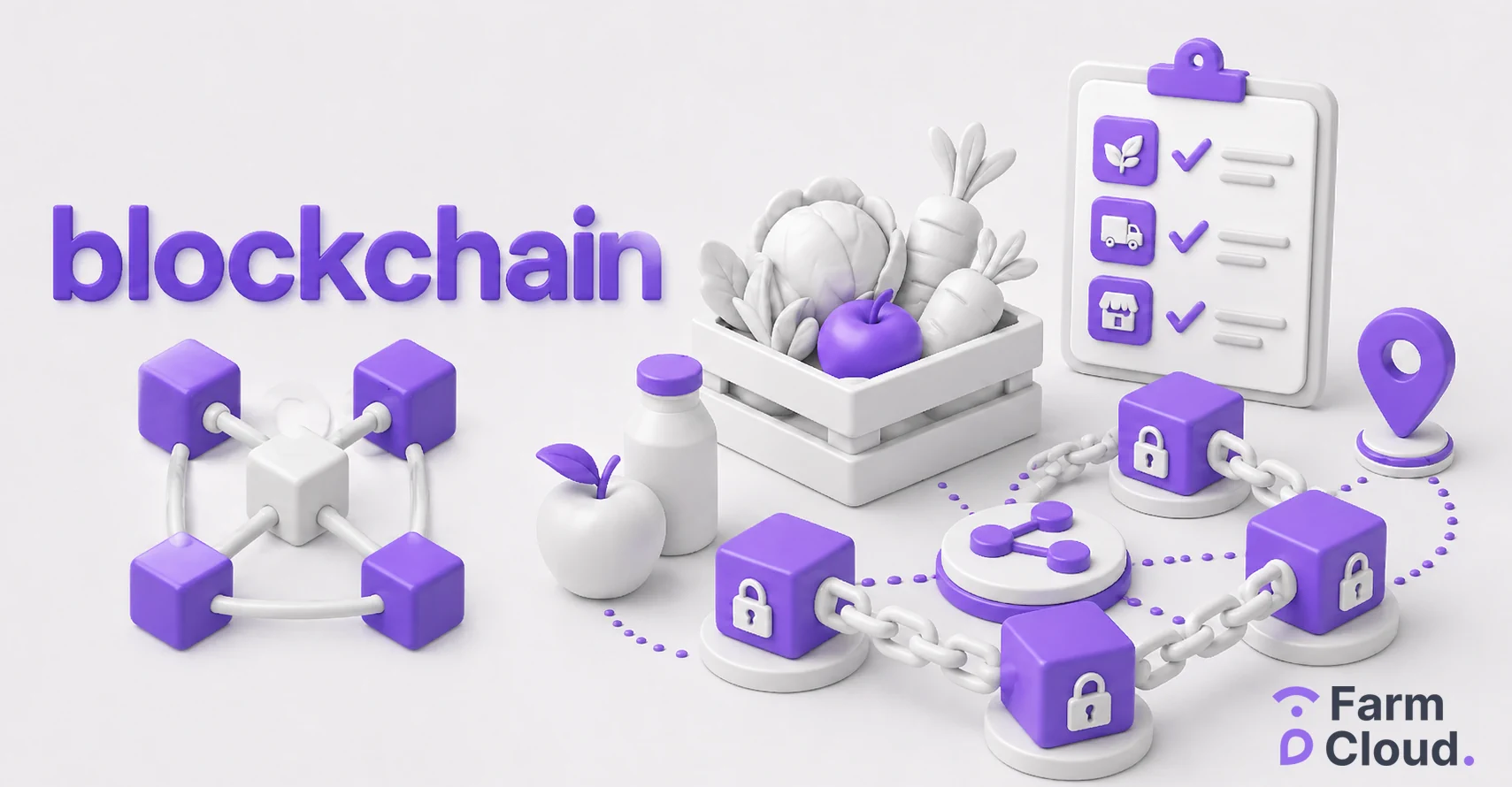
Blockchain is a distributed database. Each block contains a record of transactions, a hash (cryptographic digest) of the previous block, and a timestamp. The only feature that distinguishes blockchain from a classic relational database is immutability of records without a central arbiter. This means that if five parties in the supply chain — a farmer, a buyer, a processor, a distributor and a retail network — enter data, none of them can subsequently alter another party's record or their own historical entry. There is no need to trust a single system operator.
This solves exactly one problem: the mutual lack of trust between parties when no central institution exists that everyone trusts. In practice, the European agri-food market already has such an institution — the EU regulatory framework (EC Regulation 178/2002), certification systems (GlobalG.A.P., IFS, BRC) and national inspection bodies.
2. Four problems with blockchain in food traceability
Problem 1: false input data
The "garbage in — garbage out" principle applies to every database, including blockchain. Immutability of a record does not imply its truthfulness. As Ellahi, Wood and Bekhit demonstrated in a systematic review published in the journal Foods (2023), most proposed blockchain models for food supply chains overlook the problem of data validation at the point of entry. The physical tracking of batches — splitting, combining, sorting — generates discrepancies between the digital and physical state, regardless of the database technology used.
Problem 2: a central arbiter already exists
EU law requires "one step back / one step forward" traceability — every operator must know their immediate supplier and customer. Who enforces these requirements? National inspection bodies, third-party certifiers, and retail networks conducting their own audits. This is, in effect, a central arbiter. In this context, blockchain adds no further value — the regulatory and certification framework has been fulfilling this role for over 20 years.
Problem 3: cost and complexity outweigh the benefits
As early as 2019, Gartner predicted that 90% of blockchain supply chain initiatives would experience "blockchain fatigue" due to a lack of compelling use cases. In 2020, the same analyst firm indicated that 80% of blockchain pilots in logistics would not progress beyond the testing phase. A conventional database with an auditable change log, digital signatures and access controls achieves — according to practitioner estimates — over 95% of the same effect at a fraction of the implementation and maintenance cost.
Problem 4: the physical chain is not the digital chain
Food traceability rests on the physical tracking of batches. Strawberries from a crate go into cold storage, then into a truck, then into a warehouse. At every stage, a batch may be split, combined or re-sorted. Blockchain records digital tokens, but someone must ensure the physical crate corresponds to what appears in the system. This is the same problem as with any other database — and it is solved not by the recording technology but by operational procedures, QR codes, labels and the weight-based linking of physical product to a digital record.
3. Comparison: blockchain vs. a platform with an audit log
The table below sets out the key features of both approaches to traceability in the food supply chain. The comparison covers both technical parameters and business aspects relevant to sales and marketing departments at fertiliser, crop protection product (CPP) and seed manufacturers.
| Parameter | Blockchain (e.g. Hyperledger) | Platform with audit log (e.g. FoodPass) |
|---|---|---|
| Immutability of records | Yes — distributed consensus | Yes — cryptographic hashing + change log |
| Need for a central arbiter | No | Yes — platform operator (auditable) |
| Input data validation | None — data may be false | Verification by adviser / auditor in the system |
| Pilot implementation cost | EUR 200–500k, 12–18 months | SaaS model, low entry threshold, deployment in weeks |
| ERP integration | Dedicated connectors required | Ready integrations (SAP, Optima, Salesforce) |
| Scalability | Limited — growing consensus cost | Scalable cloud — linear growth |
| IoT / sensor support | Requires an intermediate layer | Native integration (weather stations, GPS, soil sensors) |
| EU regulatory compliance | Possible, but over-engineered | Designed for EC 178/2002, GlobalG.A.P., IFS/BRC |
| Accessibility for small farms | Low — technical and financial barrier | High — FarmPortal mobile app, free for the farmer |
| Building trust with buyers | Theoretical — low adoption levels | Practical — product passport with provenance history |
| Fraud detection in product trading | Possible — immutability makes data falsification harder | FarmCloud combines both approaches: blockchain under the hood for fraud detection + SaaS platform for daily work |
Table 1. Comparison of blockchain and a platform with an audit log in the context of food traceability. Own analysis based on market research and FarmCloud deployment experience.
4. The TradeLens case — a $200 million lesson
TradeLens was a joint project between Maersk and IBM launched in 2018. The platform was intended to digitalise global maritime trade using the Hyperledger Fabric blockchain to track containers and shipping documents. After four years of operation, in November 2022, both companies announced the platform's closure due to a lack of commercial viability.
According to Maersk's official statement, TradeLens did not achieve the level of industry-wide collaboration needed to reach critical mass. In practice, Maersk's competitors — despite the platform's technical quality — were unwilling to use a system controlled by a market rival. The platform processed over 70 million containers and published over 36 million documents, but this was not enough to achieve profitability.
5. Market data and statistics
The food traceability market is growing rapidly, but this growth is driven primarily by cloud-based solutions, IoT and artificial intelligence — not blockchain. The figures below illustrate the scale and direction of change.
| Indicator | Value | Source |
|---|---|---|
| European food traceability market value (2024) | over USD 4.1 billion | Global Market Insights, 2025 |
| Projected average annual growth of traceability market in Europe (2024–2030) | 9.3% CAGR | Grand View Research / Wialon, 2025 |
| Global food traceability market (2024) | USD 13 billion | Global Market Insights, 2025 |
| Share of supply chain blockchain initiatives that did not progress beyond pilot (to 2022) | 80% | Gartner, 2020 |
| Forecast "blockchain fatigue" in supply chains (to 2023) | 90% of initiatives | Gartner, 2019 |
| Price premium for products with documented provenance (soft fruit, GlobalG.A.P.) | 10–20% | Industry data, FarmCloud |
Table 2. Key indicators for the food traceability market and blockchain adoption in supply chains. Own analysis based on the sources listed in the table.
It is worth noting that Gartner's Top Trends in Supply Chain Technology for 2024–2025 does not list blockchain as a key trend — the priorities have shifted to artificial intelligence (including generative AI), cyber resilience and advanced data analytics. Blockchain has moved through the supply chain market from the enthusiasm phase to the "disillusionment" phase of the classic Gartner Hype Cycle.
6. What actually solves the traceability problem
Instead of blockchain, the food supply chain needs five elements, none of which require a decentralised infrastructure.
6.1. Digitalising the data collection point
The moment at which a farmer records a harvest — who picked, when, from which field, how many kilograms, which batch — is the moment at which "truth" enters the traceability system. If this step is not digitalised, no technology further down the chain can repair the missing data. The FarmPortal application allows operations, harvests and events to be recorded directly from the field — including in offline mode, with synchronisation once connectivity is restored.
6.2. Data exchange standards
A farmer's system must "talk" to the systems of the buying station, the processor and the retail network. Standards such as GS1, EPCIS and ISOXML form the real interoperability infrastructure — it is these, not blockchain, that underpin data exchange between parties in the chain.
6.3. Audit log with digital signatures
An immutable log in a PostgreSQL database with cryptographic record hashing provides the same data integrity guarantee as blockchain — without the need to build decentralised infrastructure, consensus mechanisms between nodes and costly network administration.
6.4. Physical batch identification
QR codes, labels, weight-based linking to a digital record — these are simple, proven methods of connecting a physical product to system data. Only this layer ensures that what is in the system matches reality.
6.5. Digital Product Passport (DPP)
A digital product passport is a centralised, auditable register of product data that meets EU regulations without the unnecessary complexity of blockchain. This is the direction in which European legislation is heading — and this is precisely where FoodPass fits as a ready-made solution.
"Since I started using FarmPortal, I record every operation and harvest directly from the field. My buyer — a processing plant in Grudziądz — can see the batch history in FoodPass within minutes. We don't need blockchain for that. We needed a simple tool that works even with a weak signal." — Tomasz Witkowski, raspberry grower, 42 ha, Kuyavian-Pomeranian Voivodeship
7. How FarmCloud and FoodPass support traceability
FarmCloud is a data and management platform for the agri-food sector, created by Agri Solutions. It brings together two complementary applications: FarmPortal (for farmers) and FoodPass (for processors, distributors and agricultural advisers). Below we describe specific functions that replace blockchain in traceability practice — more effectively and at lower cost.
For agricultural advisers and sales representatives
Through FoodPass, an agricultural adviser can manage, support and monitor production across multiple farms simultaneously. The CRM system for agricultural advisers enables them to keep their own notes, farm lists, address and registration data. Crop location allows direct navigation to the field — saving time and eliminating misunderstandings. The adviser sends crop recommendations, and the farmer receives push notifications in the FarmPortal mobile app. Soil analysis result review, fertiliser calculations and recommendations based on real sensor data — this is genuine digitalisation of advisory services, not the theoretical "transparency" of blockchain.
For processors and distributors
FoodPass enables delivery contracting and settlement, quality control, and sample collection at various stages of production with laboratory integration. A processor can see in real time what is happening on their suppliers' crops — and eliminate risks before a batch is received. Preparing for audits from retail chains, IFS/BRC and food safety authorities is based on auditable data, not decentralised consensus. The platform integrates with ERP systems such as SAP, Optima and Salesforce — meaning field data reaches the production planning system without manual re-entry.
For fertiliser, CPP and seed manufacturers
FarmCloud offers a farmer loyalty programme and CRM modules for the agricultural sector with an advisory function. A fertiliser or crop protection product manufacturer can build customer loyalty, monitor the effectiveness of their products on clients' crops and run marketing campaigns with product passports. Data from FarmPortal — such as yield results, soil analyses and fertiliser consumption — enables precise offer tailoring and trust-building on data, not promises.
Blockchain and smart contracts in FarmCloud — where they genuinely make sense
The FarmCloud platform has blockchain and smart contract technologies implemented. This is not, however, blockchain for blockchain's sake — we use it where decentralisation of the record delivers real, measurable value. The primary area of application is fraud detection in food product trading. Data recorded on the blockchain allows inconsistencies in the supply chain to be detected — for example, situations where the declared quantity of product leaving a processing plant exceeds the total volume of raw material received from suppliers, or where a product passport indicates a provenance that is not confirmed by production records. Smart contracts automate the validation of these rules — if data fails to meet the defined conditions, the system generates an alert without human intervention.
At the same time — and this is an honest conclusion from our experience — FarmCloud's clients are not today convinced that blockchain should be the foundation of their day-to-day traceability work. In practice, processors, advisers and agricultural input manufacturers value the simplicity and speed of SaaS deployment, native ERP integrations, push notifications and CRM — not the technical aspect of distributed consensus. Blockchain in FarmCloud operates under the hood in the area where it genuinely solves a real problem — validating data integrity for fraud detection — but it is not the element around which we build our marketing narrative. This approach confirms the central argument of this article: blockchain makes sense in narrow, well-defined applications, but it is not a silver bullet for every traceability challenge.
8. Benefits and problems solved — by audience segment
Sales and marketing departments at fertiliser, CPP and seed manufacturers
This article provides arguments for conversations with clients (farms) who ask about blockchain. It allows an expert position to be established and a real solution offered — integration with the FarmCloud platform — instead of a costly and unproven blockchain implementation. Concrete benefits include: verifiable data on product effectiveness in clients' crops, a farmer loyalty programme with measurable retention indicators, the ability to run campaigns with product passports and provenance histories, and data-based trust-building with buyers.
Key Account Managers serving farms
The article serves as client education material — it explains why blockchain is an over-engineered solution and points to a pragmatic alternative. The account manager gains: an agricultural sector CRM tool with an advisory function, the ability to support the farmer remotely using sensor data, faster identification of client needs based on real production data, and a trust-building argument — data privacy controlled by the farmer.
Agricultural advisers and agronomists
The adviser gains a platform for delivering advisory services based on real data. They can send recommendations, analyse soil test results, plan visits and audits, document compliance with standards — all in one system, with no need to implement blockchain. Crop location and field navigation saves time in the field.
9. Case study: soft fruit processor, 120 suppliers
Challenge
A medium-sized strawberry and raspberry processing plant in Lublin Voivodeship — 120 suppliers (farms of 3–60 ha), annual purchase volume: 4,200 tonnes of soft fruit. The plant was preparing for an IFS (International Featured Standards) audit required by a German retail chain. The existing traceability system relied on paper delivery sheets and Excel spreadsheets. Average response time to a batch provenance query: 4–6 hours. A blockchain implementation was being considered — an integrator's offer came to EUR 320,000 for a pilot with 30 suppliers and a 14-month timeline.
Solution: FoodPass + FarmPortal
Instead of blockchain, the plant implemented FoodPass as a SaaS solution. Within 8 weeks, 120 suppliers were connected to FarmPortal (a free mobile application). The plant's advisers gained access to suppliers' production data — operations, harvests, soil analysis results — through the CRM in FoodPass. Integration with the existing Comarch Optima system covered automatic import of delivery and settlement data.
Results after 6 months
| KPI | Before implementation | After 6 months with FoodPass | Change |
|---|---|---|---|
| Response time to batch provenance query | 4–6 hours | under 15 minutes | ↓ 95% |
| Share of suppliers with full digital documentation | 12% | 89% | ↑ 77 pp. |
| IFS audit preparation cost (man-hours) | 320 hours | 80 hours | ↓ 75% |
| Number of non-conformities identified during audit | 11 (previous audit) | 2 | ↓ 82% |
| Implementation cost vs. blockchain offer | EUR 320,000 (blockchain) | approx. EUR 18,000 (FoodPass SaaS/year) | ↓ 94% |
Table 3. FoodPass implementation performance indicators at a soft fruit processor — 120 suppliers, Lublin Voivodeship. Anonymised data based on internal FarmCloud deployment reports.
"Blockchain sounded good in the presentation, but when we counted the costs and the timeline, we chose FoodPass. After one season, 89% of our suppliers are digitalised and we passed the IFS audit without major issues. The key thing — farmers use FarmPortal willingly, because the app is simple and free." — Anna Kowalczyk-Mazur, Quality Manager, soft fruit processing plant, Lublin Voivodeship
10. Quick guide: 7 steps to implementing traceability without blockchain
Traceability implementation checklist
- Step 1: Identify the points where data is created — the field, the warehouse, the loading dock. This is where traceability quality is decided.
- Step 2: Deploy a data registration application at source (e.g. FarmPortal) — with offline mode and push notifications.
- Step 3: Define the batch structure — QR codes, weight labels, linking the physical product to a digital record.
- Step 4: Launch a supplier management platform (e.g. FoodPass) — with CRM, quality control and an audit log.
- Step 5: Integrate the platform with the existing ERP system (SAP, Optima, Salesforce) — automatic import of delivery and settlement data.
- Step 6: Train advisers and field representatives — demonstrate the benefits of crop navigation, recommendations and fertiliser calculations.
- Step 7: Generate product passports (DPP) and prepare documentation for audits (IFS/BRC, GlobalG.A.P., food safety authorities).
Why does everyone still talk about blockchain in traceability?
This phenomenon is primarily sociological and market-driven. Between 2017 and 2020, blockchain acquired the aura of a "technology of trust." Investors and grant bodies — including EIT Food and Horizon Europe programmes — directed funding to projects with "blockchain" in their title, which prompted companies to include the technology in grant applications regardless of whether it solved a real problem.
A second factor is the confusion of a technical problem with an organisational one. Food traceability does not work poorly because an immutable database is missing. It fails because small farms do not digitalise their data, because systems are not compatible, because no one wants to pay for implementation, and because physically tracking batches is logistically difficult. Blockchain is a technology in search of a problem — it solves the lack of trust in a central operator, and in food traceability this problem does not exist in approximately 90% of cases.
The systematic review by Tasic (2025), published in Internet Technology Letters (Wiley), confirms that the practical application of blockchain in agricultural traceability within the EU remains limited, and that the literature tends to overlook regulatory, cost and technical barriers.
5 most common myths about blockchain in food traceability
The table below confronts popular beliefs with the facts — useful as material for commercial conversations with clients who ask about blockchain.
| Myth | Fact |
|---|---|
| "Blockchain guarantees the truthfulness of data" | Blockchain guarantees only the immutability of the record. If the input data is false, blockchain will immutably record the falsehood. |
| "Without blockchain there is no traceability" | Traceability in the EU has existed since 2005, long before blockchain was applied in the food supply chain. |
| "Blockchain eliminates the need for audits" | Certifiers (GlobalG.A.P., IFS, BRC) still require physical audits — blockchain is not recognised as a substitute. |
| "Blockchain is cheaper than a centralised system" | A blockchain pilot costs EUR 200–500k. A SaaS platform with an audit log costs a fraction of that. |
| "Large technology companies have confirmed blockchain's effectiveness in supply chains" | The largest project — TradeLens (Maersk + IBM) — was shut down in 2022 due to a lack of viability. |
Table 4. Five most common myths about blockchain in food traceability — confronted with the facts. Own analysis.
11. Summary
Blockchain in food traceability solves a problem — the absence of a central arbiter — that barely exists in the European agri-food sector. Regulations (EC 178/2002), certifications (GlobalG.A.P., IFS, BRC) and inspection systems have been fulfilling this role for over two decades. The real barriers to traceability are the lack of digitalisation at the data source, a lack of systems interoperability, low economic motivation for implementation, and the difficulty of physically tracking batches.
The platform approach — such as FoodPass and FarmPortal within the FarmCloud ecosystem — addresses these real problems: it digitalises the data collection point, integrates systems, provides an auditable change log and enables product passporting. The SaaS model with a low entry threshold and a free application for the farmer eliminates the cost barrier that effectively blocks blockchain projects. At the same time, FarmCloud uses blockchain and smart contracts where they deliver real value — in fraud detection in food product trading — but does not impose this technology as the foundation of day-to-day traceability work. This is a pragmatic approach: the right technology for the right problem.
For sales and marketing departments at fertiliser, CPP and seed manufacturers, the key recommendation is: rather than investing in blockchain, invest in digitalising customer relationships — an agricultural sector CRM with an advisory function, a farmer loyalty programme and product performance monitoring on crops. This delivers measurable return on investment and builds trust — on data, not marketing slogans.
12. Frequently asked questions
Is blockchain essential for implementing traceability in fertiliser and crop protection product supply chains?
No — in the vast majority of cases, blockchain is not required. Food traceability in the EU rests on regulations (EC Regulation 178/2002) and certifications (GlobalG.A.P., IFS/BRC). A central platform with an auditable change log — such as FoodPass — meets the same requirements at significantly lower implementation and maintenance costs.
What specific problems does blockchain solve in food traceability — and what does it fail to solve?
Blockchain solves exactly one problem: the lack of trust between supply chain parties when no central arbiter exists. It does not resolve issues with input data quality (garbage in — garbage out), the absence of digitalisation at the source, a lack of systems interoperability, or discrepancies between the physical and digital trail of a product batch.
Why did the TradeLens platform (Maersk and IBM) — the largest blockchain project in logistics — shut down?
TradeLens was shut down in November 2022 due to a lack of commercial viability. The platform failed to reach sufficient critical mass — Maersk's competitors refused to use a system controlled by a market rival. TradeLens processed over 70 million containers, but that was not enough to cover its operating costs.
How does FarmCloud's FoodPass ensure traceability without blockchain?
FoodPass uses a centralised, auditable database with cryptographic record hashing, digital signatures and a complete change log. The platform integrates data from FarmPortal (agricultural production), IoT sensors and ERP systems. The farmer controls who has access to their farm data, while processors and distributors obtain reliable data for IFS/BRC audits and ESG reporting.
As a fertiliser manufacturer, should I invest in blockchain for my farm clients?
Rather than blockchain, it is worth investing in digitalising the data collection point and integrating systems. An agricultural sector CRM platform with an advisory function — like FoodPass — enables customer loyalty building, remote advisory services and product performance monitoring. This delivers measurable return on investment.
How much does a blockchain implementation cost compared with a platform like FoodPass?
A blockchain pilot in a food supply chain typically costs between EUR 200,000 and EUR 500,000 and requires 12–18 months. A SaaS platform such as FoodPass is available on a subscription basis with a low entry threshold, integrates with existing ERP systems (SAP, Optima, Salesforce) and requires no decentralised infrastructure.
If FarmCloud is critical of blockchain, why does it have blockchain implemented itself?
FarmCloud uses blockchain and smart contracts selectively — where they deliver real value. The primary application is fraud detection in food product trading: the immutable record helps identify inconsistencies in supply chain data (e.g. discrepancies between the volume of raw material received and the finished product declared). Blockchain works under the hood as a validation layer — but users carry out day-to-day traceability work in an intuitive SaaS platform. We do not impose blockchain where a cryptographically hashed audit log is sufficient.
13. Glossary
- Blockchain
- A distributed database in which each block contains a record of transactions, a hash of the previous block and a timestamp. Key feature: immutability of records without a central arbiter.
- Traceability
- The ability to track and identify a product at every stage of production, processing and distribution — from field to consumer and back again.
- DPP (Digital Product Passport)
- A centralised, auditable register of product data covering provenance, production history, composition and environmental footprint. An element of forthcoming EU regulations.
- Audit log (audit trail)
- A chronological, immutable record of all changes in a system — who changed what, and when. Secured with digital signatures and cryptographic hashing.
- GlobalG.A.P.
- An international certification standard for good agricultural practices. Required by the majority of EU retail networks as a condition of working with fruit and vegetable suppliers.
- IFS/BRC
- Food safety standards for processors and own-brand suppliers to retail chains. IFS — International Featured Standards; BRC — British Retail Consortium (now BRCGS).
- SaaS (Software as a Service)
- A software delivery model in which the user does not purchase a licence but pays a subscription. Eliminates the need to purchase and maintain one's own infrastructure.
- Agricultural CRM
- A customer relationship management system adapted to the specifics of the agri-food sector — covering farm data, cooperation history, agronomic advisory services and loyalty programmes.
- MRV (Measurement, Reporting, Verification)
- A methodology for ensuring the reliability of environmental data — used in ESG reporting, carbon footprint calculation and sustainable production certification.
- Food passporting
- The process of creating a digital product passport based on data from the agricultural production register — covering provenance, operation history, test results and certificates.
- Smart contract
- A programme recorded on a blockchain that automatically executes defined rules once conditions are met — e.g. generates an alert when supply chain data shows inconsistencies indicating fraud.
- Fraud detection
- The process of identifying fraudulent activity in food product trading — e.g. faking provenance, overstating product quantities, falsifying certificates. In FarmCloud, implemented using blockchain and smart contracts, among other tools.
14. Sources
- Ellahi R.M., Wood L.C., Bekhit A.E.-D.A. (2023). Blockchain-Based Frameworks for Food Traceability: A Systematic Review. Foods, 12(16), 3026. DOI: 10.3390/foods12163026. Open access (PMC)
- Tasic I. et al. (2025). Revisiting Traceability of Vegetable Fresh-Products in the EU: Why Blockchain Does (Not) Work? Internet Technology Letters, Wiley. DOI: 10.1002/itl2.647. Open access (Wiley)
- Gartner (2019). Gartner Predicts 90% of Blockchain-Based Supply Chain Initiatives Will Suffer 'Blockchain Fatigue' by 2023. Source: gartner.com/en/newsroom
Follow us!
Preview what we are doing and be inspired by positive changes.