Why the advisor’s role is changing
In intensive fruit and vegetable production, batch quality rarely depends on a single operation. The outcome is determined by a sequence of events: weather conditions, field history, application timing, dose, quality of execution, laboratory test results, harvest logistics, and the way the buyer classifies the delivery.
That is why advisors can no longer operate only in a “visit – note – phone call” model. They need to work in a model where every recommendation is visible, measurable, and linked to execution, quality results, and risk for future batches. From the processor’s and distributor’s perspective, the advisor is now one of the key actors in ensuring delivery quality.
The main benefits of moving to a digital operating model appear right at the start of cooperation:
- the advisor’s recommendation does not disappear in a notebook or an SMS, but becomes part of the field and batch history,
- the buyer can assess quality risk and documentation compliance faster,
- the grower receives recommendations on time, including on a mobile phone,
- the quality team can see the link between the crop protection plan, sample collection, and the test result,
- advisory firms and OEM partners can build services based on real data instead of declarations.
Table 1. What changes in an advisor’s work when the supply chain moves from a paper-based model to a data-driven model.
| Area | Traditional model | FarmCloud-based model |
|---|---|---|
| Recommendations | Notes, phone calls, e-mails, no complete history | Recommendation linked to field, date, batch, and execution |
| Quality | Laboratory results analyzed separately | Test results linked to operations, audits, and samples |
| Delivery planning | Based on declarations and experience | Based on field, quality, and intake schedule data |
| Compliance | The same data duplicated in multiple places | One source of data for audits, certification, and cooperation with the buyer |
| Scale of work | Strong dependence on memory and the experience of a specific person | Work history, knowledge, and farm status stored in the system |
The most important needs of advisors and agronomists
The needs of agronomic advisors go far beyond access to weather data or treatment history. In the fruit and vegetable supply chain, advisors need a tool that supports agronomic decisions, documents compliance, organizes communication, and translates fieldwork into a language understood by processors, distributors, and quality departments.
This is especially important when one person supports dozens of farms and every day of delay increases the risk of quality loss, pre-harvest interval breaches, or poor alignment between harvest timing and intake schedules.
- A complete decision trail. Advisors must be able to show what they recommended, when, to whom, for which crop, and whether the recommendation was implemented.
- One source of truth about the crop. Field data, sensors, machinery, soil tests, documents, and delivery quality data should all be available in one place.
- Agronomy linked to batch quality. Without feedback from the laboratory and the intake process, advisors cannot close the learning loop.
- Work based on current requirements. Labels, pre-harvest intervals, crop restrictions, quality standards, and buyer-specific requirements must be easy to verify.
- The ability to prioritize. At the peak of the season, advisors should know which farms require an immediate visit and which can be supported remotely.
- Audit and certification readiness. Documentation cannot be created only just before an inspection.
- Scalability. Good advisory practice must work with 10 farms and with 80 farms.
How FarmCloud and FoodPass support advisors in practice
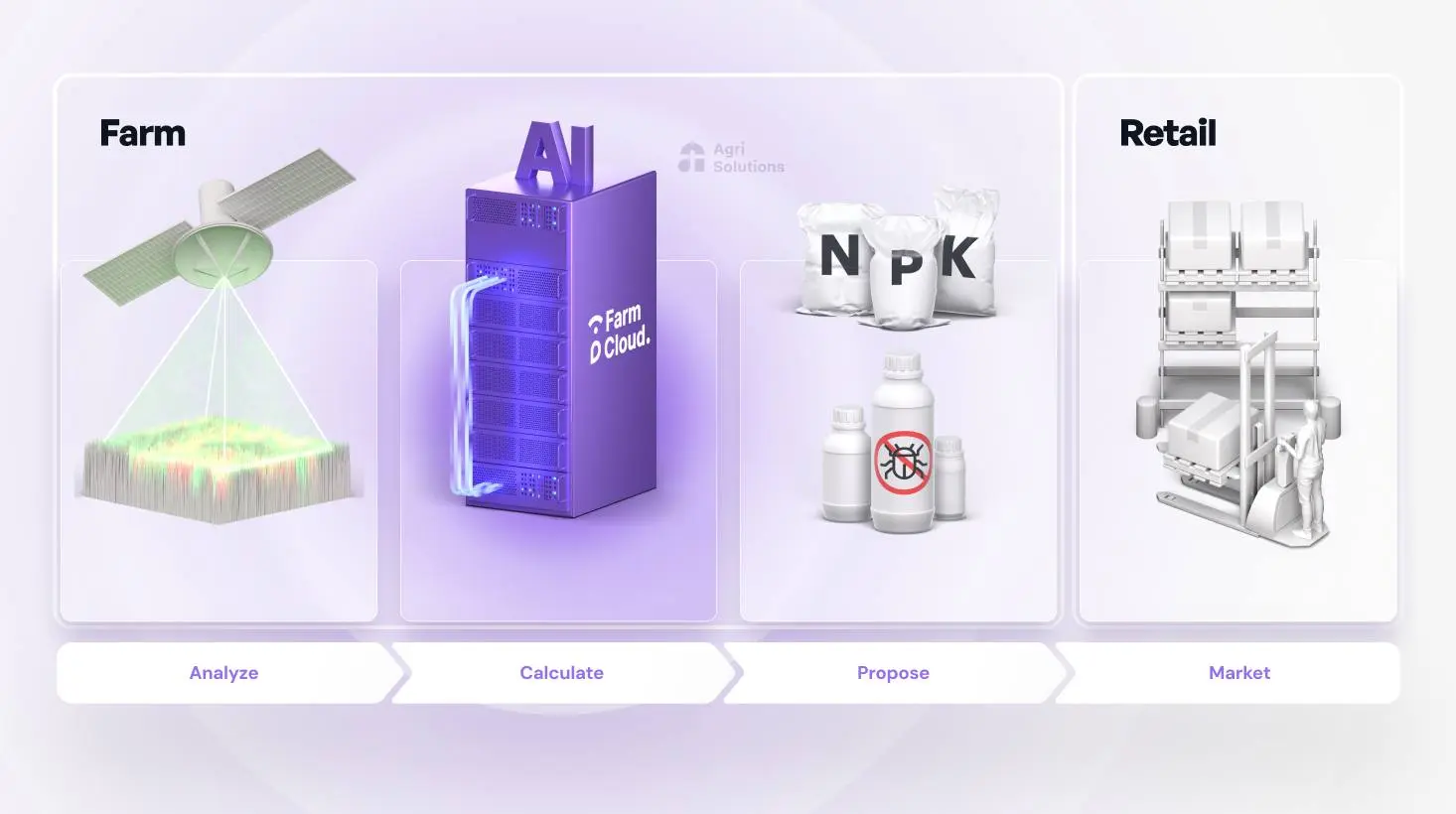
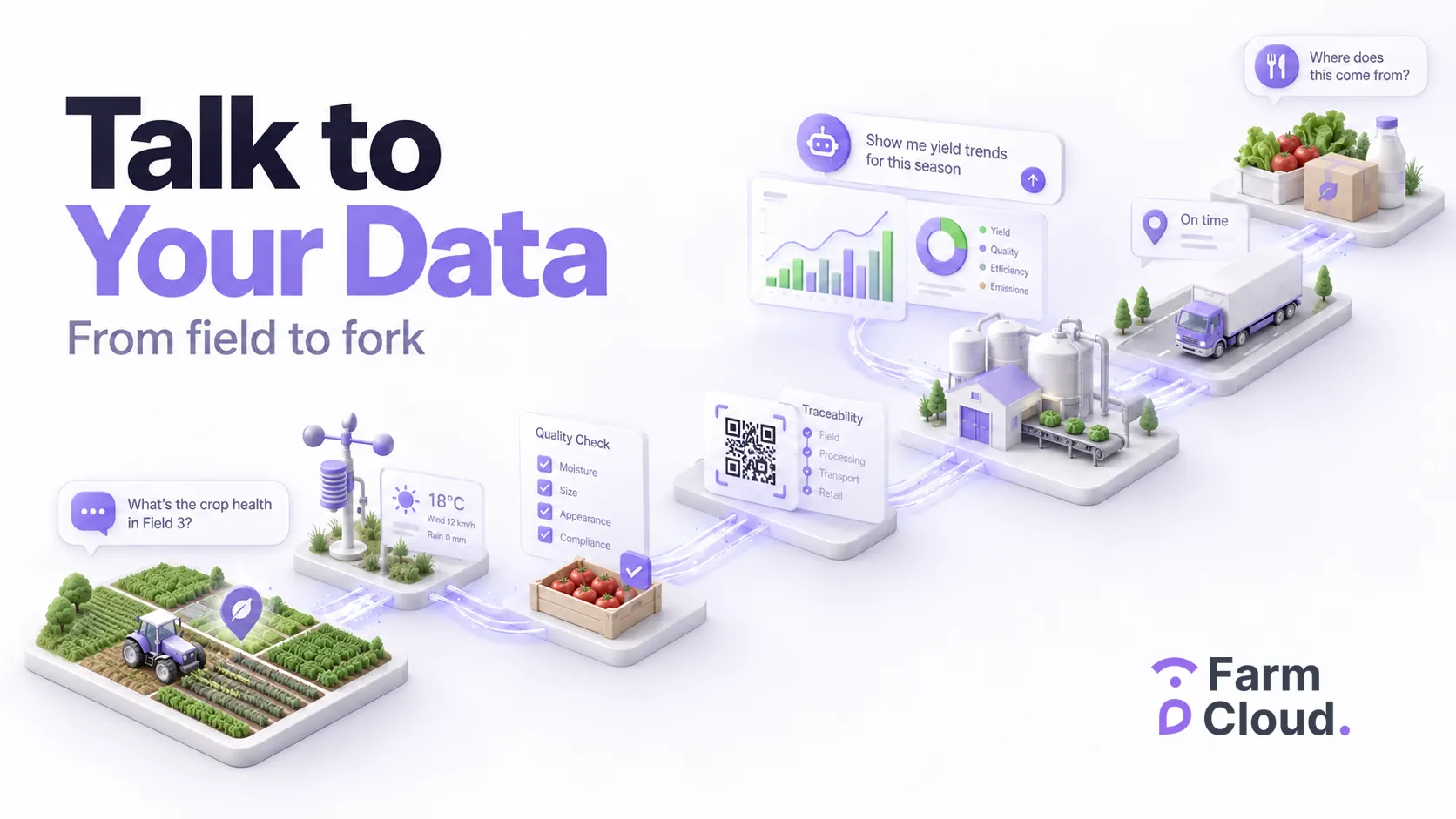
FarmCloud acts as a digital infrastructure and data exchange layer for multiple stakeholders in the supply chain. In this model, FarmPortal serves as the operational farm management system, while FoodPass provides the collaboration, quality, traceability, and supplier oversight layer for advisors, growers, and the raw material intake process.
The official FarmCloud and FoodPass materials clearly show that the system was designed for exactly these use cases: remote agronomic advisory work, document and recommendation exchange, sample collection workflow, quality reports, batch traceability, IoT integration, and data exchange with ERP, WMS, and CRM systems.
In practice, FoodPass enables agricultural advisors to:
- manage, support, and monitor production across multiple farms at the same time,
- plan visits, audits, sample collection, and advisory schedules,
- maintain their own database of farms, contacts, notes, and documents – effectively working with a CRM for agricultural advisors,
- navigate directly to crops based on field and plot geolocation,
- send crop recommendations while the grower receives the information in the FarmPortal mobile application,
- analyze soil test results and perform fertilizer calculations with recommendations for the grower,
- make decisions based on sensor data, weather station data, telemetry, and other measurement devices,
- send messages and files, including recommendations, analysis results, photos, invoices, and quality documents,
- document compliance with standards and support agricultural certification,
- run product and soil sample collection workflows for food safety testing.
You can read more about the advisory model in the article Cooperation between an agricultural advisor and a grower – a data-driven model with continuous monitoring. A broader overview of the platform is available on the FarmCloud functions page.
Table 2. FarmCloud and FoodPass capabilities that matter most for advisors, processors, and technology partners.
| Capability | Value for the advisor | Value for the supply chain |
|---|---|---|
| Remote agronomic advisory | Faster recommendations and fewer unnecessary visits | Shorter response time to quality risk |
| Document, message, and alert exchange | A consistent and structured communication channel | Less data fragmentation across e-mail, phone, and messaging apps |
| Sample collection workflow and test results | Recommendations linked to laboratory data | Better management of MRL issues, complaints, and batch holds |
| Delivery quality reports | Feedback on recommendation effectiveness | Better quality planning and settlement |
| Batch traceability and crop geolocation | Clear decision context at field and batch level | Audit readiness, recall readiness, and easier root-cause analysis |
| Integration with sensors, machinery, and IT systems | Less manual data entry and higher data reliability | Consistent data flow to ERP, QMS, WMS, and BI tools |
For advisory firms, machinery manufacturers, fertilizer producers, input suppliers, and ORM partners, the key point is that FarmCloud also provides an integration layer. This means devices, external services, data sources, and IT systems can be connected within one operating model instead of requiring a separate application for every function.
Documentation and tracking of recommendations
One of the biggest day-to-day problems in advisory work is the lack of a digital trace between the recommendation and what was actually done in the field. In the traditional model, the recommendation exists as a document or message, while the operation itself is recorded somewhere else – in a notebook, spreadsheet, or the grower’s own system. After a few weeks, it becomes difficult to say with certainty whether the grower applied exactly that dose, on that date, and on that specific plot.
From a quality perspective, this is a critical gap. If an MRL result, complaint, or batch quality deviation appears after delivery, the advisor and the buyer should be able to see the full sequence: recommendation, operation, batch, sample, and result. In FoodPass, this chain can be organized by linking recommendations, documents, sample workflows, and quality reports with FarmPortal data.
This solves three practical problems at once:
- recommendations no longer disappear in paper notes,
- the processor’s quality team can see not only the result, but also the agronomic context,
- the advisor can evaluate the effectiveness of decisions and refine the strategy for future batches and seasons.
Access to up-to-date regulatory data
The second major need is the ability to work on current regulatory data. Advisors must simultaneously consider the status of the crop protection product, the label, the pre-harvest interval, crop authorization, buyer restrictions, GlobalG.A.P. or IFS standards, and the internal rules of the given processor or retail chain.
From 1 January 2026, the EU applies a more detailed standard for keeping electronic records of crop protection product use in a machine-readable format. The rules refer, among other things, to the electronic format, prompt recording of use, information about dose, location, area, and crop codes. Member states may allow a transitional period for transferring records into electronic format for uses before 1 January 2027, but the direction is clear: documentation must be digital, consistent, and inspection-ready.
In practice, advisors therefore need not only agronomic knowledge, but also a system that organizes data from a compliance perspective. In the FarmCloud model, part of this work can be based on a shared document workflow, checklists, treatment history, and field and crop data. This reduces the risk of discrepancies between what the advisor recommended, what the grower recorded, and what the buyer expects.
For companies subject to sustainability reporting, value chain data is equally important. CSRD has already increased expectations for environmental and operational data coming from outside a company’s own facilities, while EUDR – even though it formally applies only to selected commodities – has reinforced the logic of geolocation, evidence trails, and due diligence. For advisors, this means that reliable data on the field, batch, and completed actions is becoming increasingly important.
Raw material quality and field conditions
Raw material batch quality is the result of decisions taken long before delivery. The problem is that in many organizations, advisors still lack tools to forecast how microclimate, fertilization history, water stress, or execution quality will affect size, sugar content, acidity, firmness, or storage stability.
The advantage comes from working with plot-level and block-level data rather than regional averages alone. A study published in 2024 in Nature Communications, based on mandarin orchards, showed that within-orchard analysis explained fruit quality variability better than between-orchard analysis. From an advisor’s perspective, this is a strong argument for using a digital crop twin, sensor data, treatment history, and quality results at the level of a specific field or block.
With FarmCloud and FarmPortal, advisors can base their work on real data, including sensor data, field measurements, soil analysis, and telemetry. When this is combined with machinery data or VRA execution records, advisors no longer have to guess whether variable-rate application was actually completed according to plan. They can verify it and relate it to the later quality outcome.
A quick reference sheet for quality-focused advisors:
- do not analyze a laboratory result without the treatment history,
- do not evaluate a batch without weather and field location context,
- do not compare farms only on seasonal averages,
- always verify whether the plan was actually carried out, not only recorded.
Supply continuity and planning
Many advisors still plan production and field activities without visibility into processor or distributor demand. That means knowledge about the field and knowledge about market demand exist in two different worlds. The result is predictable: delivery bottlenecks, poor synchronization between harvest and intake, increased risk of quality losses, and tension between growers and buyers.
FoodPass brings order to this area because it connects supplier data, schedules, quality assessment, contracting, and documentation with field information coming from FarmPortal. This allows the advisor to plan work more consciously: to see which farms carry the greatest quality deviation risk, which require an urgent visit, where samples should be collected earlier, and which batches are strategically important from the plant’s supply perspective.
This model is especially important when working with a larger group of farms. Without a prioritization system, seasonal peaks turn advisory work into constant reaction. With a system that collects data and alerts on deviations, advisors can work proactively.
Compliance and certification
In practice, advisors are often the people who “close the loop” on the documentation needed for audits, certification, or inspections. The issue is not the lack of data, but the fact that the same information is entered several times: into the grower’s log, buyer documents, audit checklists, the quality system, or spreadsheets prepared for a certifier.
With FoodPass and FarmCloud, part of this work can be centralized. The system supports document templates, checklists, audit preparation, generation of documentation for inspections and certification, and full batch traceability. From the advisor’s perspective, that means less manual rewriting and greater confidence that the documentation refers back to the same source data.
It is also worth remembering that official EFSA reports show pesticide residue issues are not marginal. In the 2025 summary of controls for 2023, 2% of samples exceeded the MRL and 1% were non-compliant after measurement uncertainty was taken into account. This is not an argument for creating more spreadsheets, but for linking advisory work, treatment execution, sample collection, and batch assessment much more effectively.
Communication in the supply chain
In many organizations, the advisor acts as an informal information intermediary between the grower and the buyer. Communication flows through phone calls, SMS, and e-mail, while the status of the field or batch exists in several parallel versions. This model works only until the first major quality deviation or audit appears.
FoodPass structures communication by bringing messages, documents, recommendations, alerts, analysis results, supplier statuses, and batch data into one place. For the advisor, this means that conversations with the grower, the quality department, and the processor can refer to exactly the same record, rather than three different interpretations of the same situation.
This also changes the alerting model. Instead of reacting after the fact, it becomes possible to warn earlier about frost, disease risk, an approaching application window, an ending pre-harvest interval, or the need for sample collection. In intensive agriculture, that response time is often more important than the number of physical field visits alone.
Scalability of advisory work
One advisor handling 30, 50, or 80 farms without digital tools will sooner or later start managing memory rather than knowledge. In practice, that means more time spent reconstructing relationship history, searching for documents, and rewriting information than analyzing data and genuinely supporting the grower.
The FarmCloud-based model reduces that time loss on several levels at once: it organizes the farm portfolio, history of actions, documentation, quality results, crop geolocation, visit planning, and the flow of recommendations. If an advisor changes region, team, or employer, the knowledge does not disappear with them. It remains in the system.
Advisor scalability checklist:
- Every farm has a complete history of fields, contacts, and documents.
- Every recommendation can be searched by date, crop, field, and grower.
- The advisor can see the day’s priorities without searching across multiple communication channels.
- Laboratory results and sample collection are linked to the batch and the farm.
- The team can take over a farm without losing historical knowledge.
Benefits for different stakeholder groups
This operating model is not valuable only for the advisor. Its value grows with the number of stakeholders working on the same dataset and according to the same rules of information flow.
Agricultural advisors and agronomists
They gain a structured farm portfolio, faster access to field history, the ability to support growers remotely, better documentation, and a stronger expert position toward both the grower and the buyer. Instead of working from memory and scattered files, they work on data that can be defended in audits, complaints, and effectiveness reviews.
Fruit and vegetable processors
They gain earlier visibility into quality and supply risk, easier linking of laboratory results with field processes, and a more predictable contracting model. As a result, the quality team, procurement team, and advisors no longer operate in separate worlds.
Distributors and importers
The biggest value lies in faster supplier verification, greater clarity of batch origin, and shorter response time to questions from customers or retail chains. In fresh fruit and vegetables, competitive advantage does not come from price alone, but from information reliability and quality predictability.
Machinery manufacturers, OEMs, and technology providers
FarmCloud provides them with an integration layer for devices, data, and processes. This makes it possible to build services based on actual field execution, not only on telemetry detached from agronomic context. For OEMs, the ability to exchange data with partner IT systems and use integration for after-sales, diagnostic, and advisory services is equally important.
Fertilizer producers, crop protection suppliers, and input providers
They gain better visibility into how recommendations are implemented in practice, what quality results they generate, and which farm segments require additional support. This opens the way to more precise advisory programs, more effective campaigns, and after-sales services based on data rather than commercial declarations.
If you want to see how FarmCloud connects devices, data sources, and IT systems, it is also worth visiting the FarmCloud integration page. A useful complement is the article Lidl – Case Study – Managing and Monitoring Food Safety, which shows the practical importance of traceability, laboratory testing, and rapid response in the supply chain.
Table 3. Traditional advisory work versus the FarmCloud-based model.
| Comparison area | Traditional advisory model | FarmCloud + FoodPass + FarmPortal |
|---|---|---|
| Field status | Fragmented, point-in-time knowledge | A shared, up-to-date view of the field and batch |
| Communication | Phone, SMS, e-mail, notes | Structured communication, documents, and alerts in one place |
| Laboratory handling | Analysis results outside the advisory system | Sample workflow and result linked to the batch and field history |
| Execution of recommendations | Difficult to verify | Can be linked to treatment records and telemetry |
| Service scale | More farms means lower work quality | Scale grows through prioritization and remote support |
How to implement a data-driven operating model
The biggest mistake in implementation is trying to digitalize everything at once. In practice, a staged model works much better: first, the organization of data and recommendation flow, and only later additional analytics, laboratory workflows, or machinery and ERP integrations.
- Define a shared data model. Determine which records are mandatory for the field, batch, operation, sample, and delivery.
- Define the scope of data sharing between the grower, the advisor, and the buyer. Data must be shared consciously and according to roles.
- Introduce a digital recommendation workflow. From that point on, every recommendation must have a recipient, a date, a scope, and an execution status.
- Link audits, samples, and laboratory results to batches. Without this, the quality loop cannot be closed.
- Add automated data. Start with weather stations, sensors, and machinery data where they create the greatest value.
- Measure effects with KPIs. Advisor response time, share of documented recommendations, audit preparation time, number of quality deviations, and schedule compliance.
Case study
The case study below is a deployment scenario based on typical processes in intensive fruit and vegetable production. The figures are illustrative, but they reflect realistic project targets for an organization working with a distributed supplier network.
Context
A procurement and processing company worked with 46 berry farms covering a total of 318 hectares. One advisory team was responsible for support in fertilization, crop protection, sampling plans, audit preparation, and communication with the quality department. Three issues caused the most difficulty: the lack of a complete recommendation trail, delayed laboratory information, and poor prioritization of visits during the seasonal peak.
Challenge
Before implementation, each stakeholder worked in its own tools. Advisors kept notes in files and phones, growers maintained documentation in different formats, and the quality department had a separate workflow for testing and complaints. As the number of farms grew, the risk of losing control over quality and delivery timeliness increased accordingly.
The FarmCloud solution
A model was implemented in which FarmPortal collected operational farm data, while FoodPass handled advisory work, document flow, sample collection workflow, analysis results, quality assessment, and supplier status. In addition, the team included weather data, crop geolocation, and reporting at batch and farm level.
Results after the first full season
Table 4. KPI results in the deployment scenario after launching FarmCloud and FoodPass.
| Indicator | Before implementation | After implementation | Change |
|---|---|---|---|
| Documented recommendations linked to field and date | 34% | 97% | +63 pp |
| Average time to retrieve complete batch documentation for an audit | 3 h 10 min | 22 min | -88% |
| Average advisor response time to a high-priority issue | 11 h | 2 h 40 min | -76% |
| Share of samples collected according to plan | 61% | 93% | +32 pp |
| Incomplete or missing batch attachments | 18% of batches | 4% of batches | -78% |
| Share of visits replaced by remote, data-driven support | 0% | 29% | +29 pp |
The most important change, however, was not time savings alone. The greatest value came from closing the loop between recommendation, execution, sample, and result. That is what enabled the advisory team to work more predictably and support stable-quality raw material deliveries more effectively.
User feedback
The statements below are synthetic example testimonials prepared for this article. They illustrate typical benefits and challenges observed when digitalizing advisory cooperation.
“We manage 74 hectares of strawberries and raspberries in tunnels and open field. Before, our advisor had knowledge, but not a full picture between visits. After implementing FarmPortal and FoodPass, the time from reporting a problem to receiving a recommendation dropped from several hours to a few dozen minutes, and the quality team now gets batch documents faster. The biggest benefitLess chaos and fewer decisions made on instinct.”
Marek Włodarczyk, berry farm, 74 ha, Lubelskie region
“I support more than 40 vegetable farms. Without a digital tool, it is no longer possible to maintain the same quality of advisory service across the whole client portfolio. FoodPass gives me one place for planning visits, keeping notes, collecting samples, and sending recommendations. In practice, the number of issues I can handle remotely has increased by around 30%, and audit preparation time has been cut by more than half.”
Anna Kaczmarek, agronomic advisor, portfolio of 43 farms, Kuyavia
Summary
The needs of agronomic advisors and agronomists in the supply chain are no longer limited to “a better note-taking app.” The market needs a working environment that connects recommendations, treatment execution, field data, laboratory data, audits, compliance, delivery scheduling, and communication between all participants in the chain.
That is why what matters is not a single function, but the architecture of the whole solution. FarmCloud acts as a digital infrastructure for data sharing and multi-actor cooperation, while FoodPass – directly integrated with FarmPortal – turns that architecture into daily operational work for advisors, processors, distributors, and producers.
If advisory work is to genuinely support raw material quality, compliance, and supply continuity, it must be documented, current, and grounded in data. In that sense, the digital advisory model is not an add-on to the supply chain. It is an operating condition for it.
Frequently asked questions
How can an agricultural advisor document that a recommendation was actually implemented in the field?
The best model is to connect the recommendation to a specific field, date, operation, and confirmation of execution in the farm system. The integration of FoodPass with FarmPortal makes it possible to compare the advisor’s recommendation with the actual operation record, applied dose, location, and field history.
Is FoodPass only a tool for processors, or is it also for advisors and agronomists?
FoodPass supports not only processors and distributors, but also agricultural advisors, agronomists, and producer groups. It enables monitoring of multiple farms, planning audits and sample collection, keeping documentation, communicating with growers, and analyzing quality and compliance.
How can laboratory results be linked to the crop protection plan and the history of recommendations?
You need to work on a shared data model for the batch, field, operation, and sample. In FarmCloud, an advisor can link recommendations, completed operations, sample collection workflow, and laboratory results, making it easier to assess the impact of agronomic decisions on raw material quality and food safety.
What does a processor gain from access to agronomic and field data before the raw material is delivered?
The processor gains earlier visibility into quality risk, compliance, and delivery timeliness. This makes it possible to plan intake schedules better, anticipate quality deviations, react faster to threats, and reduce costs related to complaints or batch withdrawals.
Do the new digital crop protection documentation requirements increase the importance of tools such as FarmCloud?
Yes. From 2026 onward, the EU applies a more detailed standard for electronic recording of crop protection product use, with a defined data scope and machine-readable format. This increases the need to work in a system that collects data quickly, consistently, and in a way that is ready for inspections, audits, and sharing with the buyer.
How can fertilizer producers, crop protection suppliers, and OEMs benefit from working with FarmCloud?
FarmCloud can serve as an integration and operational layer between the farm, the advisor, and the technology partner. Suppliers of agricultural inputs and machinery manufacturers can use it to build data-driven services, support remote advisory work, analyze the actual execution of recommendations, and integrate their own data and devices into farm and supply chain processes.
Glossary
- Traceability
- The ability to trace a product batch backward and forward across the entire supply chain.
- MRL
- The maximum residue level legally permitted for a crop protection product in food or feed.
- Digital crop twin
- A digital model of a field or crop that combines historical and current data to support crop status assessment and operational decisions.
- Sample collection workflow
- A structured process covering sampling request, collection, transport, test result, and quality decision.
- CSRD
- The EU Corporate Sustainability Reporting Directive, which increases the importance of value chain data.
- EUDR
- The EU regulation on deforestation-linked products. It formally covers selected commodities, but it strongly influences due diligence practices and expectations regarding geolocation and evidence trails.
- VRA
- Variable-rate application of fertilizer or another input based on maps and spatial data.
- OEM integration
- Integration of equipment or machinery manufacturers with a digital platform so that device data supports advisory, quality, and logistics processes.
Sources
Below are the key sources used in preparing this article. The number of external links has been intentionally limited, and some sources are provided in bibliographic form.
- EFSA, Pesticides residues in food: what’s the situation in the EU?, 2025.
- EUR-Lex, Consolidated text: 32023R0564, version as of 23.11.2025.
- Kim S. et al., An agricultural digital twin for mandarins demonstrates the potential for individualized agriculture, Nature Communications, 2024.
- Charlebois S. et al., Digital Traceability in Agri-Food Supply Chains: A Comparative Analysis of OECD Member Countries, Foods, 2024.
Follow us!
Preview what we are doing and be inspired by positive changes.