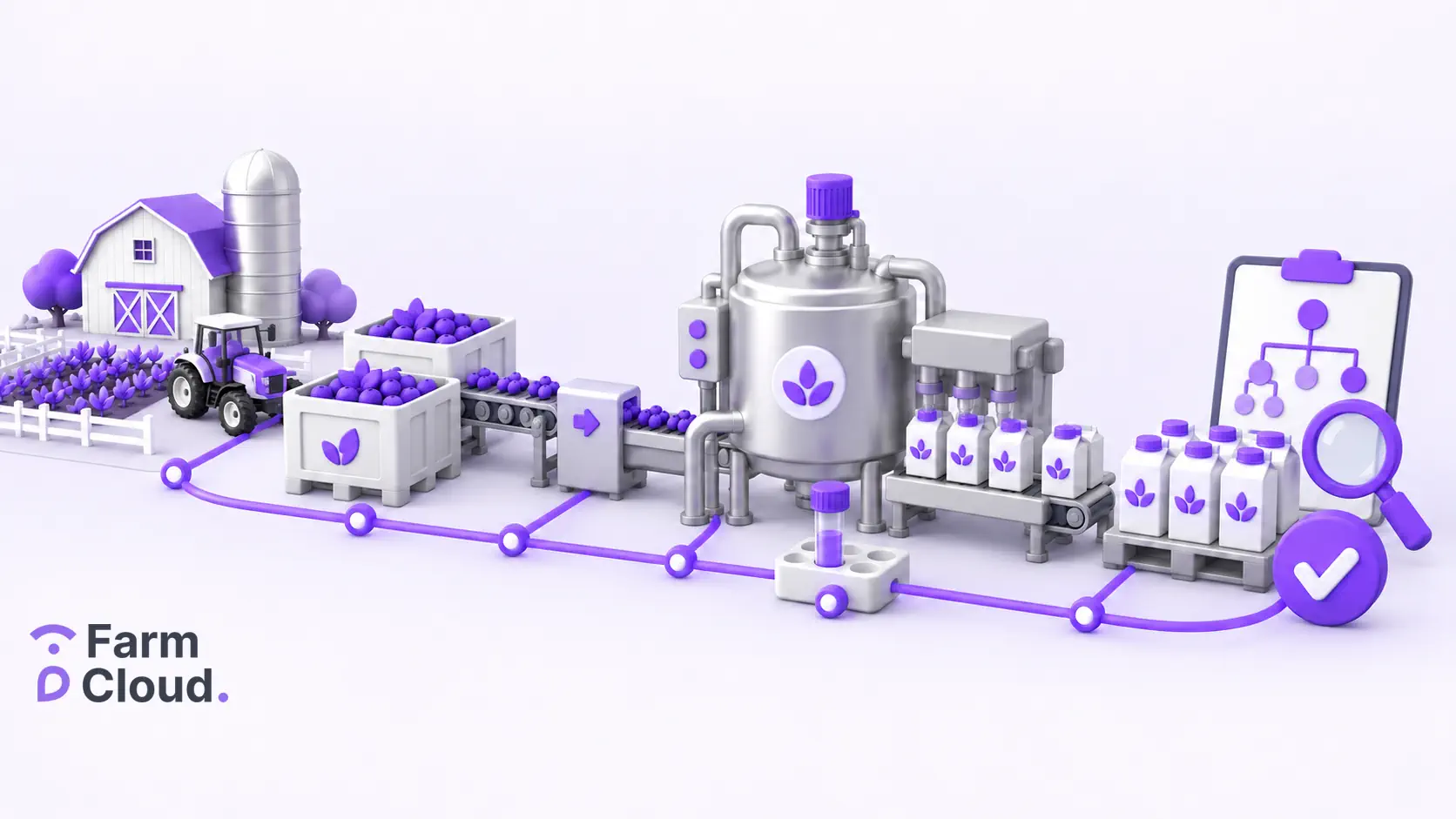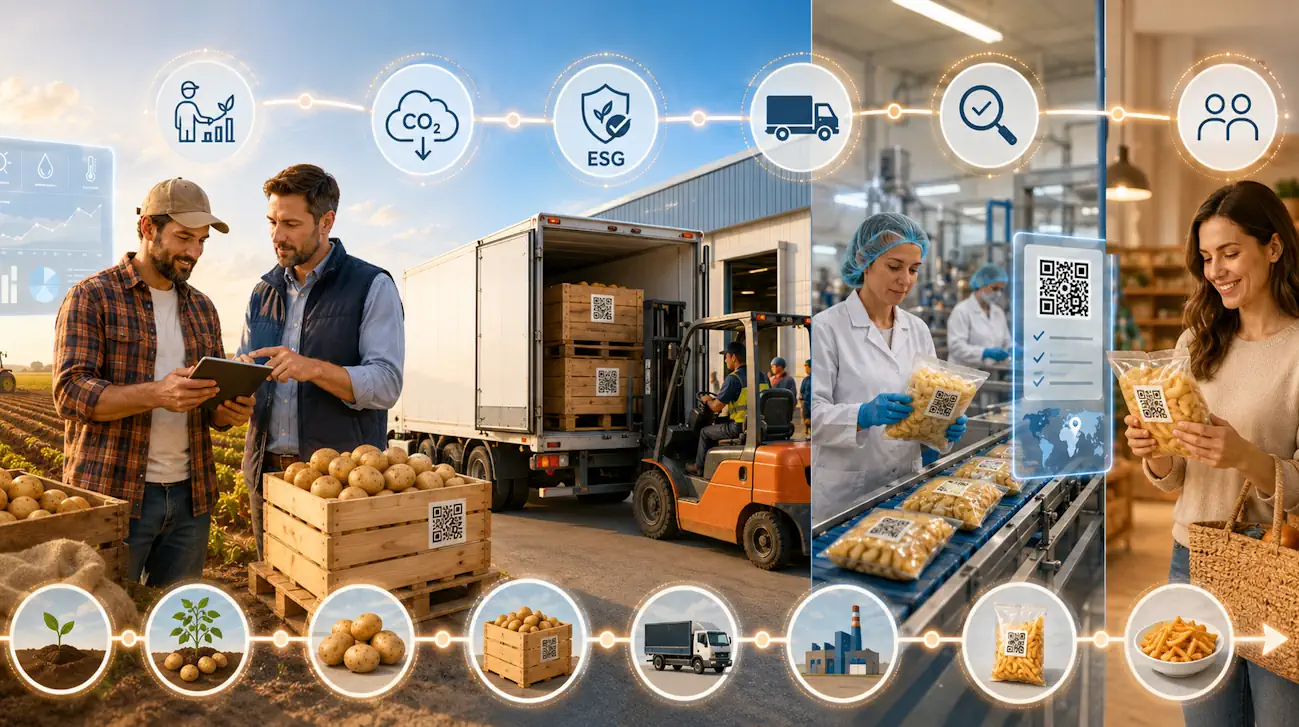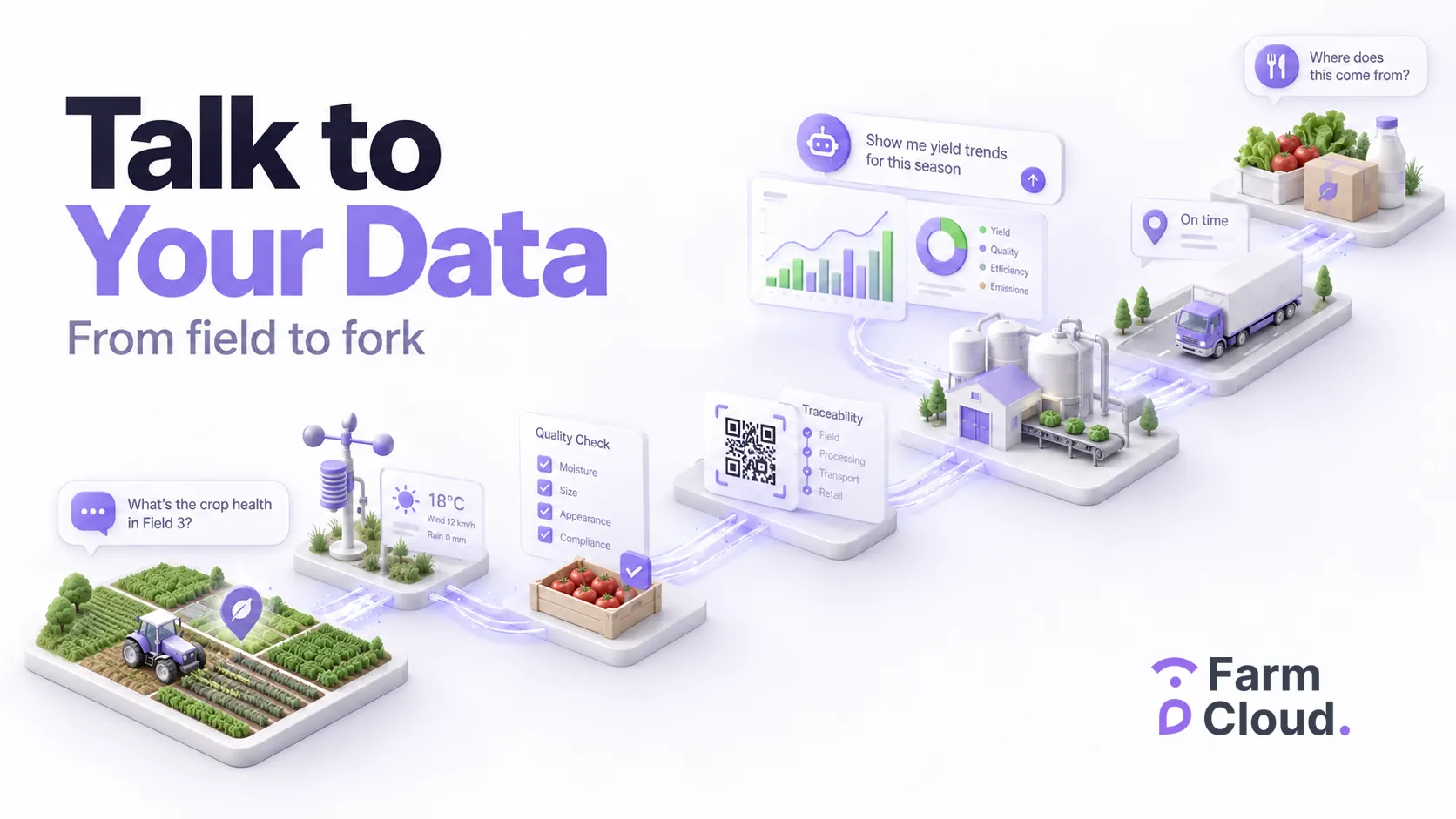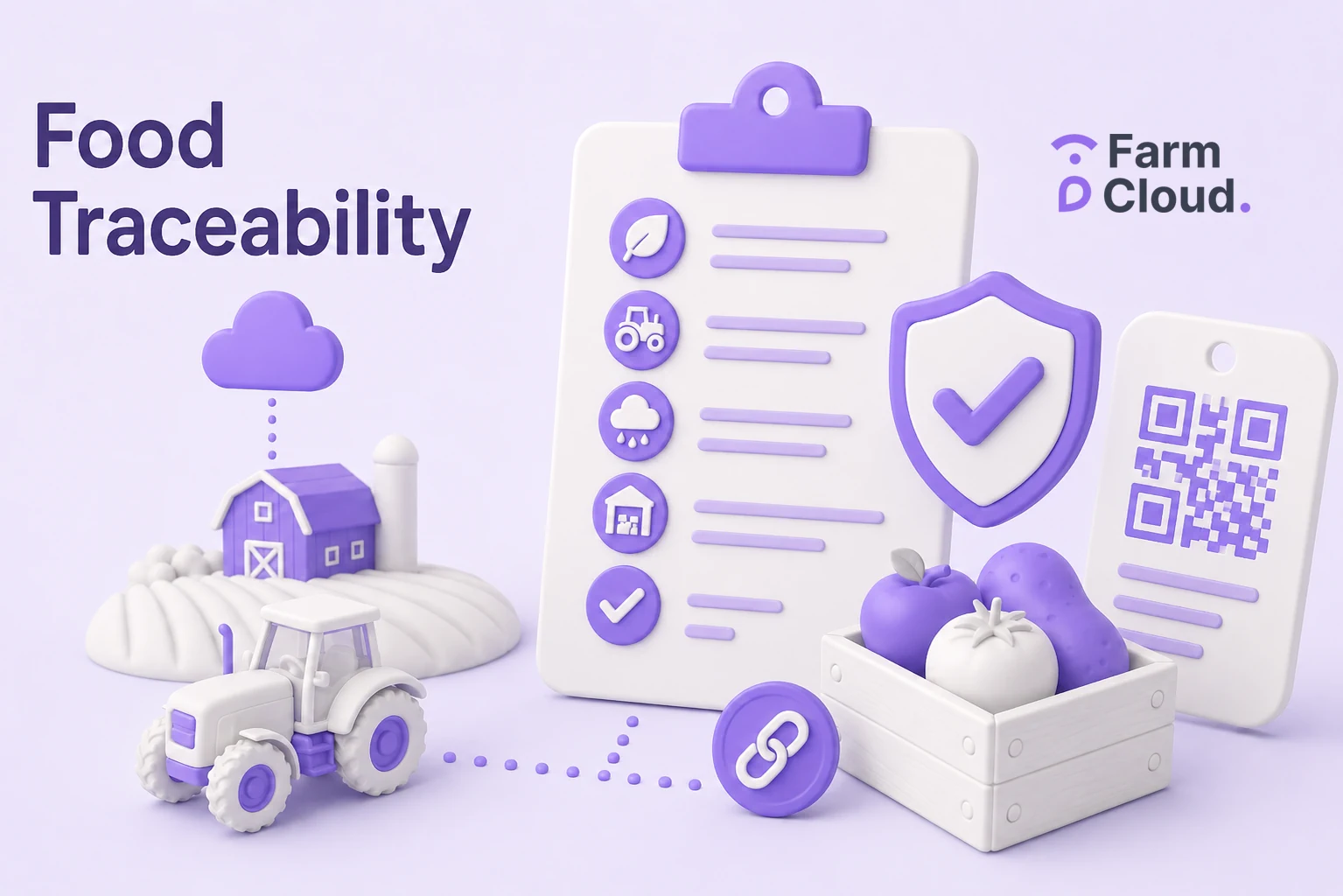
Food traceability is a digital model for collecting, organising and sharing data about an agri-food product from the field to the recipient. For Agri Solutions, it is not an abstract trend but a practical development direction for FarmCloud: a platform that connects data from farms, machinery, sensors, quality systems, documents and commercial relationships.
Summary
Food traceability is a digital model for collecting, organising and sharing data about an agri-food product from the field to the recipient. For Agri Solutions, it is not an abstract trend but a practical development direction for FarmCloud: a platform that connects data from farms, machinery, sensors, quality systems, documents and commercial relationships.
In this case study, we show how Agri Solutions’ experience from the pilot of Polish food traceability can be translated into concrete benefits for machinery manufacturers, OEMs, sales teams, marketing departments and key account managers serving farms. The main thesis is simple: food traceability does not start in the warehouse or in the ERP system. It starts in the field, in the machine, in the advisor’s recommendation, in the completed treatment and in the data confirming the quality of the raw material.
Key conclusions
- Food traceability creates a shared data language for the farmer, advisor, machinery manufacturer, processor and commercial buyer.
- FarmCloud makes it possible to record production events, integrate machinery and IoT data, manage documents and build a digital trace of a product batch.
- For OEMs and machinery manufacturers, food traceability means a new service layer: telemetry, automatic work reports, service support, FMS integrations and a post-sale relationship with the customer.
- For sales and marketing teams, traceability data can support CRM for agriculture, loyalty programmes for farmers, customer segmentation and trust building.
- For key account managers, food traceability provides a tool for discussing quality, efficiency, compliance and long-term cooperation with a farm.
Why food traceability has become a strategic topic
The food market increasingly requires not only quality declarations, but also data confirming origin, production method, treatment history, transport, storage and compliance with buyer requirements. In practice, this means moving from documents created for inspection purposes to an ongoing, digital model of product management.
Food traceability addresses several problems visible across the supply chain: declining trust in origin transparency, rising costs of paper documentation, the risk of food fraud, difficulty in quickly recalling only the batch affected by a problem, and data fragmentation between the farmer, advisor, trading company, machine, warehouse and recipient.
Official materials from the Polish national traceability project state that the objective is an IT system enabling the monitoring and identification of information about agri-food products in the supply chain “from field to fork”. This approach is particularly important for products whose quality depends on many events: variety, field, treatments, weather, fertilisation, harvest, transport and storage.
| Risk area | Problem in the traditional model | Importance of food traceability |
|---|---|---|
| Product origin | Data scattered across invoices, notes, warehouse documents and producer declarations. | One digital batch history: field, farm, producer, operations, deliveries and documents. |
| Food safety | Difficulty in quickly linking a batch with treatments, samples, test results and recipients. | Faster determination of which batch is affected by a problem and which corrective actions should be taken. |
| Inspection and audit handling | Documents compiled only before an audit, often manually and in several places. | Documentation is created during work and can be filtered by field, batch, supplier or season. |
| Relationship with the farm | Sales based mainly on price, commercial history and personal contact. | CRM for agriculture can use operational, compliance and quality data to build cooperation. |
| Value of machinery data | The machine generates data, but the data is not connected to the traceability record or commercial process. | Machinery data can confirm work completion, application rate, location, time, operator and process quality. |
The role of Agri Solutions in food traceability
Agri Solutions develops FarmCloud as a digital infrastructure for agri-food. In the context of food traceability, the key point is that FarmCloud is not only an application for farm documentation. It is an environment that connects FarmPortal, FoodPass, AgroSell and an integration layer, enabling cooperation between the farmer, advisor, technology manufacturer, processor, distributor and buyer.
In experience related to food traceability, the “data at source” approach was particularly important. It means that the most important product information should be recorded where it is actually created: on the farm, in the field, during a treatment, at harvest, in storage, in transport and at the raw material reception point. Without this, a food traceability record becomes only a digital declaration rather than a credible production trace.
Agri Solutions contributes three layers of competence to this model: knowledge of real agricultural processes, ready-to-use FarmCloud technology and experience in implementing applications used by many supply chain participants. This matters because food traceability is not a project of one IT department. It is an operational, quality, sales and relationship project.
What focusing on Agri Solutions means
This article does not describe the entire public programme or the full role of all institutions. It focuses on what is most important for the market from the Agri Solutions perspective: how FarmCloud technology helps turn the idea of a food traceability record into specific functions, processes, data and business benefits for companies working with farms.
- FarmPortal collects and organises production data on the farm.
- FoodPass enables supplier cooperation, quality control, documentation, samples, audits and traceability.
- AgroSell supports sales, marketing, partner programmes for farms, campaigns, segmentation and customer loyalty in agriculture.
- The FarmCloud integration layer makes it possible to connect data from machinery, IoT, ERP, CRM, laboratories, warehouse systems and analytical tools.
More information about the platform’s functions is available on the FarmCloud functions – functions for agriculture and the supply chain page.
Case study: a digital potato traceability record in the FarmCloud model
The following case study is an Agri Solutions implementation framework based on experience with food traceability and the FarmCloud model. It focuses on the potato market because it is a good example of a product whose final quality depends on the field, variety, crop protection, fertilisation, harvest, storage, transport and buyer requirements.
Business context
A producer or organisation cooperating with a large group of farms must provide the buyer with information about batch origin, documentation compliance, treatment history, storage conditions and quality status. In a paper-based or spreadsheet model, much of the data is created too late. The quality team often receives it only after delivery or before an audit.
For OEMs and machinery manufacturers, this problem has additional significance. A machine performs work that affects production quality and cost, but its data often remains outside the value chain. If a sprayer, spreader, tractor, harvester, sensor or ISOBUS terminal is not connected to a data platform, its commercial potential ends with the sale of the machine. FarmCloud makes it possible to move this model towards services, integrations and a continuous relationship with the farm.
Challenge
During the implementation of the system together with KOWR and NASK, the Agri Solutions team assumed that a potato traceability record must cover more than a batch number and a sales document. It must combine agronomic, location, operational, quality and relationship data. The most important challenges were:
- data fragmentation between farms, advisors, treatment documentation, storage and the buyer,
- lack of one batch status visible to those responsible for quality and purchasing,
- difficulty in quickly checking which field, treatment, operator or supplier is linked to a specific batch,
- untapped potential of machinery and sensor data,
- low scalability of key account managers’ and field advisors’ work,
- no simple way to build a loyalty programme for farmers based on real cooperation data.
Agri Solutions solution
Agri Solutions designed a model in which FarmCloud acts as a shared data layer for the traceability record. The farmer keeps day-to-day documentation in FarmPortal. The advisor or quality coordinator uses FoodPass. Sales, marketing and key account managers can use structured data in AgroSell for segmentation, communication, partner programmes and customer retention in the agricultural sector.
In this model, the traceability record is not a separate form. It is the result of the entire data ecosystem. Farm events, advisor recommendations, completed treatments, weather data, analysis results, document status, transport and raw material reception create the digital trace of a batch.
Data scope in the traceability record
The greatest value comes from a traceability record that combines operational data with quality data. A batch number alone is not enough. For the farmer, OEM, sales team and buyer, the key question is: what actually happened to the product and can it be confirmed?
| Data category | Example data | Data source in the FarmCloud model | Business value |
|---|---|---|---|
| Producer and farm | Farm ID, location, area, crops, cooperation history. | FarmPortal, FoodPass, CRM for agriculture. | Supplier segmentation, better KAM service, easier audits. |
| Field and crop | Field boundaries, variety, season, crop rotation, plant condition. | FarmPortal, maps, satellite data, agronomic data. | Linking product quality with production conditions. |
| Treatments and fertilisation | Date, rate, product, operator, machine, recommendation, execution. | FarmPortal, machinery integrations, terminals, mobile application. | Compliance control, lower risk of errors, proof of work performed. |
| Harvest and batch | Harvest date, field, quantity, batch, storage, delivery. | FarmPortal, FoodPass, warehouse, batch codes. | Batch traceability, faster recalls, better settlements. |
| Quality and testing | Samples, test results, quality comments, batch status. | FoodPass, laboratory, sample workflow. | Decisions on acceptance, blocking or corrective actions. |
| Commercial relationship | User activity, consents, campaigns, offer, points, rewards. | AgroSell, CRM, loyalty programme for farmers. | Customer retention, service sales, trust building. |
Result
The result is not only a “traceability record” understood as an information card. The result is a new model of cooperation. The farmer sees that documentation helps with sales and the relationship with the buyer. The advisor sees a fuller decision-making context. The OEM can connect machinery data with value for the farm. Sales and marketing teams can create offers, points programmes and communication based on real needs rather than assumptions.
Implementation KPIs and benchmarks
The KPIs below are model indicators used to assess a FarmCloud implementation in a food traceability project. They should not be treated as official results of a public pilot. They are indicators recommended by Agri Solutions for measuring business effects in companies working with farms.
Benchmark methodology
The benchmark model assumes a network of 120 farms producing potatoes for a commercial buyer or processor. The total crop area is 2,400 ha, average production is 40 t/ha, and the annual volume of raw material covered by monitoring is 96,000 tonnes. Baseline data comes from a typical paper-and-spreadsheet workflow, while target data shows a realistic objective after 6–12 months of FarmCloud implementation.
| KPI | Starting situation | Target after FarmCloud implementation | Change | How to measure |
|---|---|---|---|---|
| Time to identify a batch from delivery back to the field | 4–24 hours | 10–30 minutes | 87–98% reduction | Measure the time from reporting a quality issue to identifying the field, supplier, batch and documents. |
| Completeness of supplier documentation before delivery | 55–70% | 90–97% | Increase of 25–42 percentage points | Share of suppliers with complete treatments, documents, consents and assigned batches before acceptance. |
| Share of manually created documents | 80–90% | 25–40% | Reduction of 50–65 percentage points | Comparison of automatically generated documents with documents copied manually. |
| Time needed to prepare audit data | 3–7 working days | 0.5–1.5 working days | 70–85% reduction | Measure the work of the quality team, advisors and KAMs needed to prepare batch history and documents. |
| Share of batches with a full digital trace | 10–25% | 75–90% | Increase of 50–80 percentage points | Share of batches with a complete set: farm, field, treatments, harvest, storage, transport, quality. |
| Farm activity in the partner programme | No programme or activity not measured | 50–65% active farms monthly | New measurable relationship channel | Logins, task confirmations, campaign participation, reward use and responses to messages. |
The most important indicator is not the number of records in the system. What matters most is shortening the time needed to reach a credible answer: which field the batch came from, which treatments were performed, who confirmed them, what the quality results were and which deliveries may be affected by risk.
How FarmCloud supports food traceability
FarmCloud supports food traceability as a data, application and integration layer. The platform connects tools for the farmer, advisor, buyer, quality department, sales representative, technology manufacturer and management team. As a result, the traceability record is not created only at the end of the process, but emerges during work.
This approach is particularly important for OEMs and machinery manufacturers. Agricultural machinery increasingly generates data, but telemetry data alone does not create value if it is not connected to the field, treatment, batch, quality and commercial relationship. FarmCloud makes it possible to embed machinery data in the real production and sales process.
FarmCloud functions relevant to food traceability
- Production recording in FarmPortal – fields, crops, treatments, fertilisation, crop protection, harvests, storage and costs.
- FoodPass for the supply chain – supplier cooperation, samples, documents, audits, quality control, batch status and traceability.
- IoT and machinery integration – data from sensors, weather stations, machinery, GPS, terminals and external systems.
- CRM with advisory functions for agriculture – farm relationship, contact history, recommendations, segmentation, sales and marketing activities.
- AgroSell – loyalty programme for farmers, points programme for fertiliser buyers, campaigns, offers and rewards in a loyalty programme for farmers.
- Analytics and reporting – reports for quality, sales, management, advisors, OEMs and technology partners.
- Data security and consents – controlled access to information, user roles and limiting the scope of data according to the purpose of cooperation.
For companies that want to connect FarmCloud with their own systems, the FarmCloud integration layer for machinery, IoT and IT systems is particularly important. It helps avoid building another closed application that does not communicate with other tools in the supply chain.
7 practical applications of FarmCloud in food traceability
Food traceability can be used more broadly than only in the quality department. A well-designed system creates value for sales, marketing, service, advisory and product development. Below are seven use cases that are particularly important for companies working with farms.
- Confirming batch origin
FarmCloud makes it possible to link a product batch with the farm, field, crop, harvest date and production documentation. This allows the company to answer faster where the product came from and whether its history is complete. - Automatic machinery work reports
An OEM can integrate machinery data with FarmCloud to show completed work, time, location, operator and parameters. This builds new value around the machine and supports the sale of digital services. - Control of treatment compliance
Data on fertilisation, crop protection and advisory recommendations can be compared with buyer requirements. FarmCloud helps reduce the risk of errors and improve audit readiness. - Handling samples and laboratory results
FoodPass enables the organisation of sampling, assignment of samples to batches and fields, recording of results and decisions on batch status. - Farm segmentation in CRM for agriculture
Sales teams can segment farms by crops, region, potential, activity, documentation status and cooperation history. This allows more relevant campaigns and offers to be created. - Loyalty programme for farmers
Food traceability provides data that can feed a points programme: for timely documentation completion, training participation, purchases, use of service support or implementation of good practices. - Building trust in the brand
A brand that can document origin, quality and cooperation with farms has a stronger position in discussions with buyers and farmers. Trust building becomes a data-based process, not only a marketing message.
FarmCloud vs Excel, ERP and point traceability applications
Many companies start with spreadsheets, then try to expand ERP, and later add separate applications for quality, advisory, samples or farmer communication. The problem is that food traceability requires connecting several worlds: the field, machine, supplier, quality, trade, marketing and documents.
FarmCloud is designed as digital infrastructure for agri-food. This means it does not replace every system in the company, but it can connect data and processes that a typical ERP or CRM does not handle well enough at farm and field level.
| Criterion | Excel and paper documents | Classic ERP or CRM | Point traceability application | FarmCloud |
|---|---|---|---|---|
| Field data | Manual entries, high risk of gaps. | Usually lacks a detailed field and treatment model. | Often limited to batch or delivery. | Full model: farm, field, crop, treatment, harvest, batch. |
| Machinery and IoT integration | None or manual import. | Possible, but costly and not very agronomic. | Vendor-dependent. | Integration layer for machinery, sensors, GPS, weather and IT systems. |
| Cooperation with the farmer | Email, phone, paper. | The farmer usually does not work directly in the ERP. | Often only a supplier portal. | FarmPortal for the farmer and FoodPass for cooperation with the buyer. |
| CRM for the agricultural sector | Sales representative notes and purchase history. | CRM does not know the field, crop and season context. | Usually no sales functions. | AgroSell connects the commercial relationship, activity, campaigns and agri data. |
| Loyalty programme | Difficult to settle based on data. | Possible, but disconnected from production. | Usually outside scope. | Points, rewards, tasks and communication can be linked to the farm. |
| Traceability record | Created manually, often after the fact. | Based mainly on commercial and warehouse documents. | Possible, but within a narrow scope. | Built from production, quality, machinery and relationship data. |
| Scalability | Low with a large number of farms. | Good within the company, weaker at the farmer interface. | Depends on integrations. | Multi-actor model: farmer, advisor, OEM, processor, distributor. |
Benefits for OEMs, sales teams, marketing and key account managers
Food traceability may be perceived as a quality-related topic, but in practice its significance goes far beyond control. It gives new tools to companies that want to build long-term relationships with farms, sell machinery and services, improve customer retention and create more credible marketing.
| Audience group | Problem addressed by the article | Benefit from FarmCloud | Example success metric |
|---|---|---|---|
| Machinery manufacturers | After sale, the machine often loses its digital relationship with the customer. | Machine data can support the traceability record, work report, service and advisory. | Share of machines actively sending data to FarmCloud: 60–80% within 12 months. |
| OEMs | Building an in-house FMS application is costly and duplicates market functions. | Integration with FarmCloud makes it possible to add FMS, traceability and white-label functions faster. | Shortening the implementation time of digital functions from 18–24 months to 3–6 months. |
| Sales teams | Sales are based on contact and intuition rather than data on the farm’s real needs. | CRM for agriculture can use segmentation, seasonality, crops, activity and cooperation history. | Increase in campaign conversion to active farms by 10–25%. |
| Marketing | Communication is often not linked to the real stage of the season and the farmer’s problem. | FarmCloud enables contextual communication: crop, region, season, need and user status. | Increase in message opens and campaign responses by 15–30%. |
| Key account managers | A KAM manages many farms and lacks one view of quality, risk, activity and potential. | One working model for farm view, contact history, documentation, batches and recommendations. | Reduction in visit preparation time by 40–60%. |
Food traceability and customer loyalty in agriculture
Food traceability can become the basis for a new type of relationship with farms. A traditional loyalty programme for farmers is usually based on purchases and rewards. This works, but it does not build full value if it is not connected with production, advisory, quality and data.
FarmCloud makes it possible to move from a simple discount to a partner programme for farms. A farmer can receive points or benefits not only for purchases, but also for participating in training, completing documentation on time, using advisory services, implementing recommendations, being active in the application, integrating machinery or sharing data needed to confirm quality.
More about the shift from a transactional sales model to a partnership model can be found in the article From seller to partner: how to build relationships with farmers.
Example logic of a points programme
| Farm activity | Example number of points | Value for the company | Value for the farmer |
|---|---|---|---|
| Completing digital field documentation before delivery | 50 pts | Better audit readiness and traceability. | Less work before inspection and greater supplier credibility. |
| Confirming implementation of an advisor’s recommendation | 30 pts | Closing the loop: recommendation – execution – effect. | Better work organisation and access to recommendation history. |
| Connecting a machine or sensor to FarmCloud | 100 pts | More automatic data and fewer manual entries. | Work reports, service support and more precise documentation. |
| Participation in quality or technology training | 40 pts | Standardisation of practices across the supplier network. | Access to knowledge, certificates and better practices. |
| Timely submission of batch data | 20 pts | Faster delivery handling and fewer delays. | Smoother settlement and fewer questions after delivery. |
In this model, rewards in a loyalty programme for farmers are not only a marketing cost. They become a tool for organising data, strengthening relationships and improving cooperation quality.
How to implement food traceability step by step
Food traceability implementation should start with the process, not with the choice of a single technology. First, the product, batch and business problem that should be covered by the digital trace must be defined. Only then should integrations, forms, user roles and reports be selected.
-
Select the product and supply chain
At the beginning, choose one product or product group, such as potatoes, vegetables for processing, soft fruit, contracted grain or raw material for a plant. Too broad a scope at the start increases the risk of delays.
-
Define the batch and critical events
Determine when a batch is created, how it is labelled, what data must describe it and which events affect quality. For potatoes, this includes the field, variety, treatments, harvest, storage, sorting, transport and reception.
-
Define the minimum data scope
Do not collect everything at once. In the first stage, it is worth covering data needed for origin identification, safety, audit and complaint handling.
-
Connect farms to FarmPortal
The farmer should have a simple way to enter data and receive benefits. If the system is only an obligation for the supplier, adoption will be slower.
-
Launch FoodPass for quality, advisory and deliveries
FoodPass organises cooperation with farms: documents, recommendations, samples, audits, statuses, comments and information flow.
-
Integrate machinery, sensors and company systems
It is worth starting with data sources that reduce manual work the most: GPS, machinery, weather stations, soil moisture, warehouse, ERP, WMS, laboratory or Power BI.
-
Build a KPI dashboard
Monitor data completeness, batch identification time, farm activity, number of documentation gaps, sample status and communication effectiveness.
-
Connect food traceability with the commercial relationship
Finally, launch segmentation, campaigns, a points programme and offers. Traceability data can support sales, but only when it is collected with a clear purpose and user consent.
Implementation checklist
This checklist helps quickly assess whether an organisation is ready to implement food traceability in the FarmCloud model. It can be used during a workshop with quality, sales, marketing, IT, advisory and OEM service teams.
Quick guide for machinery manufacturers and OEMs
- Do we know what data the machine generates and which of it has value for the traceability record?
- Can the machine transmit data on location, working time, application rate, operator or operation type?
- Do we want to offer customers a work report, digital documentation or service functions?
- Do we have an FMS integration strategy instead of building the entire application from scratch?
- Can machine data support predictive maintenance, fault detection and after-sales service?
Quick guide for sales and marketing teams
- Do we have consent and a legal basis for digital communication with farms?
- Do we know the crops, region, potential, activity history and needs of the farm?
- Are campaigns linked to the season, production type and real events on the farm?
- Does the loyalty programme for farmers reward behaviours valuable to both sides?
- Is CRM for the agricultural sector connected with advisory and field data?
Quick guide for a key account manager
- Before a visit, can I see the status of documents, batches, activity and contact history?
- Can I check which farms require urgent intervention?
- Can I see farm potential by crops, area, machinery and cooperation history?
- Do I have one history of recommendations, arrangements and corrective actions?
- Can I use data to discuss value, not only price?
Expert quotes and user testimonials
“In food traceability, the most important thing is not simply generating a digital product card. What matters most is that data is created naturally in the process: during the work of the farmer, advisor, machine, warehouse and quality team. Then the traceability record becomes credible, not merely declarative.”
“For a machinery manufacturer, digitalisation should not end with a screen in the cab. If machine data flows into FarmCloud, it can support documentation, service, a loyalty programme, reporting and the customer relationship throughout the entire season.”
Farmer testimonial: 420 ha potato farm
“We run around 420 ha, including 180 ha of contracted potatoes. Our biggest problem was collecting documents after the season and answering the buyer’s questions about specific batches. After moving to the digital model, we can see the history of the field, treatments and deliveries in one place. The biggest difference is time: preparing documents for inspection was reduced from several days to one day, and batch identification takes a dozen or so minutes.”
Key account manager testimonial: portfolio of 85 farms
“I manage farms with different levels of digital maturity. Previously, before a visit I had to check notes, spreadsheets, messages and documents from the quality department. In the FarmCloud model, I have one view of the farm: crops, documents, batch status, activity and potential. With a large customer portfolio, this changes the way I work. I spend less time searching for information and more time discussing decisions, quality and purchase plans.”
Conclusion
The food traceability case study shows that a digital traceability record is not only a tool for controlling origin. It is a new model for managing the relationship between the farm, technology, advisory, quality, sales and marketing. For Agri Solutions, the practical side of this process is crucial: data must be created at source, understandable for the user and usable in real decisions.
FarmCloud supports this model as digital infrastructure for agri-food. It connects FarmPortal, FoodPass, AgroSell, machinery integrations, IoT, documentation, CRM for agriculture, traceability and analytics. As a result, machinery manufacturers, OEMs, sales teams, marketing teams and key account managers can use food traceability not only as a quality obligation, but as a tool for competitive advantage.
The most important change is that product data stops being an administrative cost. It becomes an asset: helping build trust, shorten response times, reduce risk, strengthen customer loyalty in agriculture and create new services around machinery, advisory and sales.
Let’s discuss food traceability in your organisation
If you are a machinery manufacturer, OEM, technology provider, trading company or team serving farms, FarmCloud can become the integration, data and cooperation layer for working with farmers. Start with one product, one group of farms and one measurable process: batch identification, machine work report, partner programme or digital supplier documentation.
FAQ
Can a machinery manufacturer use food traceability as a new service for farmers?
Yes. A machinery manufacturer can use data about machine operation, location, application rate, operator and treatment time as part of the product’s digital trace. After integration with FarmCloud, this data can support work reports, farm documentation, service, predictive maintenance and a partner programme for farms.
Does an OEM need to build its own FMS application to enter food traceability?
No. In many cases, integration with the ready-made FarmCloud platform is a better solution. The OEM can focus on its technological advantage, machine, sensors or devices, while FarmCloud provides the FMS, traceability, farm cooperation, CRM for agriculture and supply chain integration layer.
How can a key account manager use traceability data in everyday work with a farm?
A key account manager can use traceability data to prepare for a visit, assess documentation status, identify quality risks, discuss farm potential and plan offers. Instead of relying only on purchase history, they can work with data on crops, batches, activity, machinery and production needs.
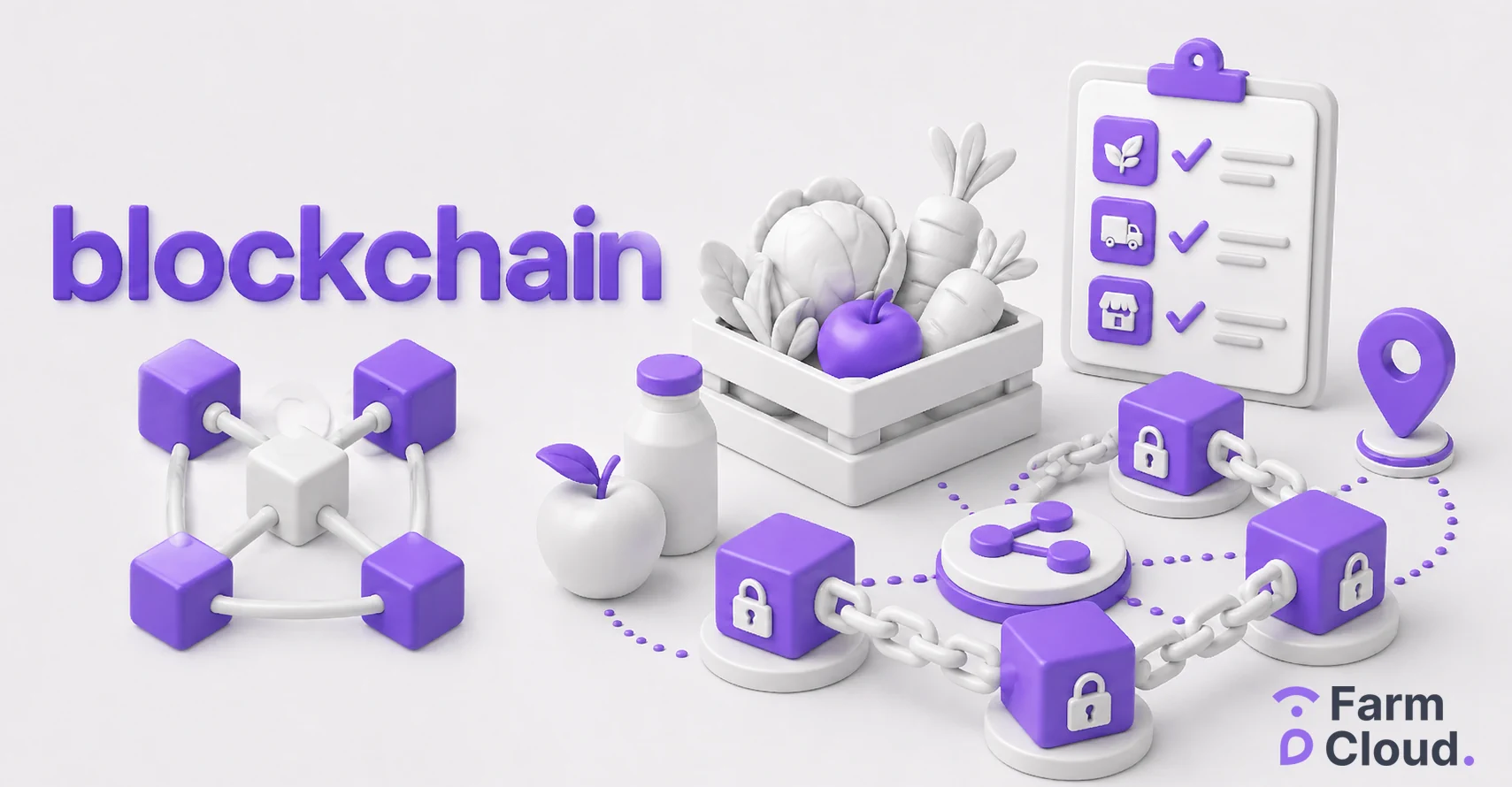
Is blockchain necessary for food traceability?
Blockchain can be useful as an additional layer for confirming the immutability of selected data, but it does not solve the core problem if source data is incomplete or incorrect. In practice, the most important elements are: a correct data model, batch identification, farm integration, access control, event audit and reliable data sources.
How does FarmCloud help build customer loyalty in agriculture?
FarmCloud connects production data, user activity, cooperation history, communication and AgroSell functions. This allows a company to create a loyalty programme for farmers based not only on purchases, but also on participation in advisory, documentation completeness, app activity, machinery integration and implementation of good practices.
Which data is most important in an agricultural traceability record?
The most important data includes: farm, field, crop, variety, treatments, fertilisation, products used, harvest date, batch, warehouse, transport, quality results, samples, documents and delivery status. In the FarmCloud model, this data can be combined with information from machinery, IoT, ERP systems, laboratories and CRM.
Is food traceability useful only for processors and retail chains?
No. Processors and retail chains are important data recipients, but food traceability also benefits farmers, machinery manufacturers, OEMs, advisors, sales teams and marketing teams. The farmer gains better documentation and credibility, the OEM gains new digital services, and sales teams gain better segmentation and customer retention.
Glossary
- Food traceability
- Digital collection and sharing of data about an agri-food product, its origin, production, processing, quality and path through the supply chain.
- Traceability
- The ability to trace a product backwards and forwards in the supply chain. In practice, it means being able to determine where a batch came from, what happened to it and who received it.
- FarmCloud - digital infrastructure
- Agri Solutions’ digital infrastructure for agri-food, connecting applications, data, IoT, machinery, documentation, traceability, CRM, advisory and analytics.
- FarmPortal
- A system for farms used to manage fields, crops, treatments, resources, documentation, sensors and production.
- FoodPass
- A FarmCloud module for supplier cooperation, supply chain monitoring, quality, documents, samples, audits and digital traceability records.
- AgroSell
- The sales and marketing layer of FarmCloud supporting CRM for agriculture, loyalty programmes, campaigns, offers, segmentation and relationships with farms.
- CRM for agriculture
- A system for managing relationships with farms that, in addition to commercial data, includes agricultural context: crops, season, region, production potential, activity and needs.
- OEM
- Original equipment or technology manufacturer, such as a producer of machinery, devices, sensors or systems installed at the customer’s site or under a partner’s brand.
- Blockchain
- Distributed ledger technology. In food traceability, it can be used to confirm the immutability of selected data, but it does not replace proper data collection at source.
- Loyalty programme for farmers
- A model for building relationships with farms through points, rewards, services, communication and benefits for specific actions, such as purchases, participation in training or documentation completeness.
Sources and references
The article uses official materials from the Polish national traceability project, the final pilot report and studies on traceability, food safety and the economics of product recalls. External links have been limited to two official and professional sources.
- National Support Centre for Agriculture: Polish national traceability project
- European Commission: 2023 Annual Report on food safety alerts and agri-food fraud investigations
- Resende-Filho, M.A., Buhr, B.L. Economics of traceability for mitigation of food recall costs, 2010.
- Charlebois, S. et al. Digital Traceability in Agri-Food Supply Chains, Foods, 2024.
- Final Report: Pilot of Polish national traceability project, NASK – PIB, 2023.
Follow us!
Preview what we are doing and be inspired by positive changes.