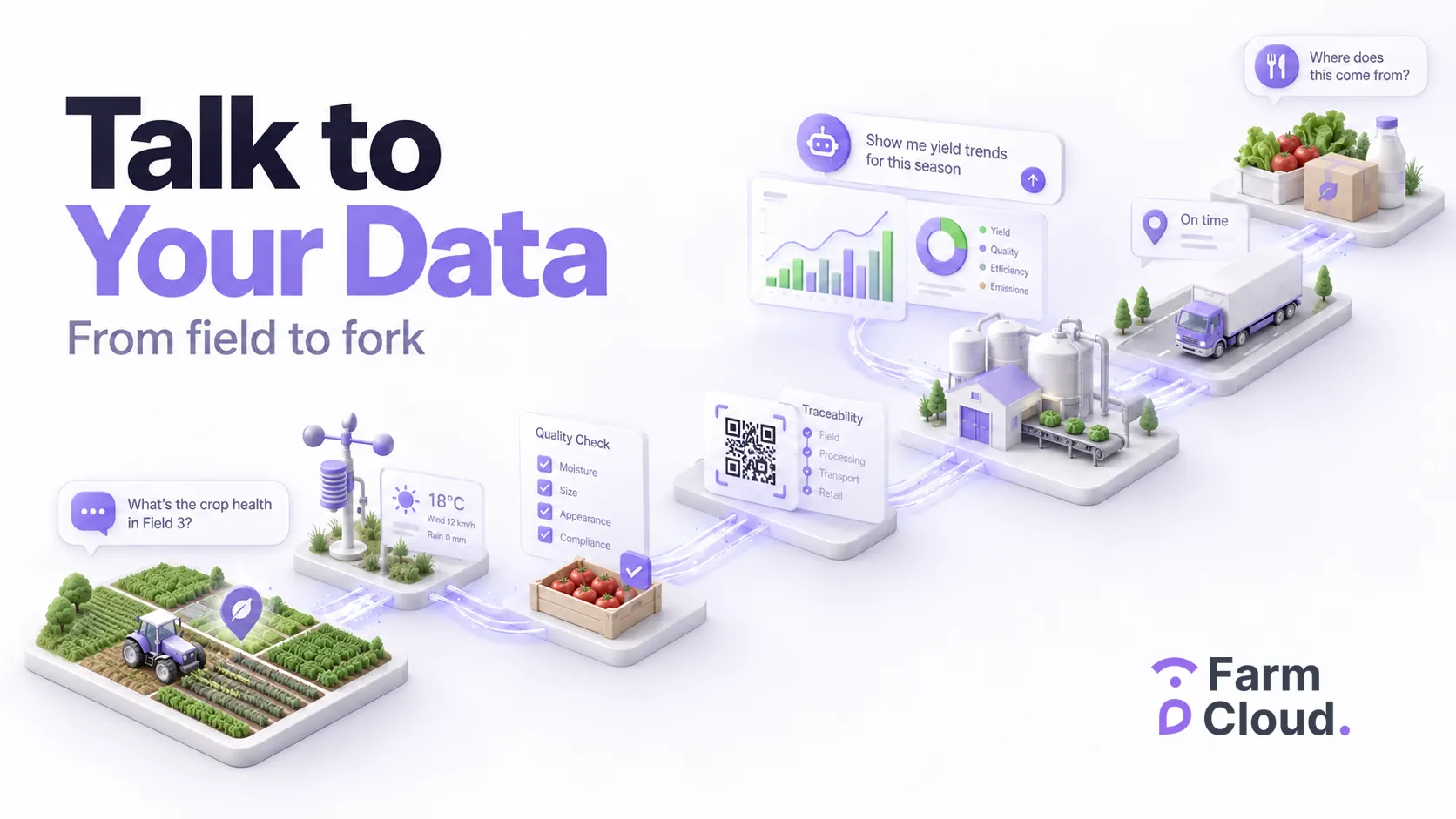
A loyalty programme for farmers should not be limited to a reward catalogue and a simple “spend PLN 1,000, collect points” mechanism. In the fertiliser, seed, crop protection and premix sectors, effective loyalty is created when the purchase, advisory, field data, sales representative communication and real benefits for the farm are combined into one process.
Summary
A loyalty programme for farmers should not be limited to a reward catalogue and a simple “spend PLN 1,000, collect points” mechanism. In the fertiliser, seed, crop protection and premix sectors, effective loyalty is created when the purchase, advisory, field data, sales representative communication and real benefits for the farm are combined into one process.
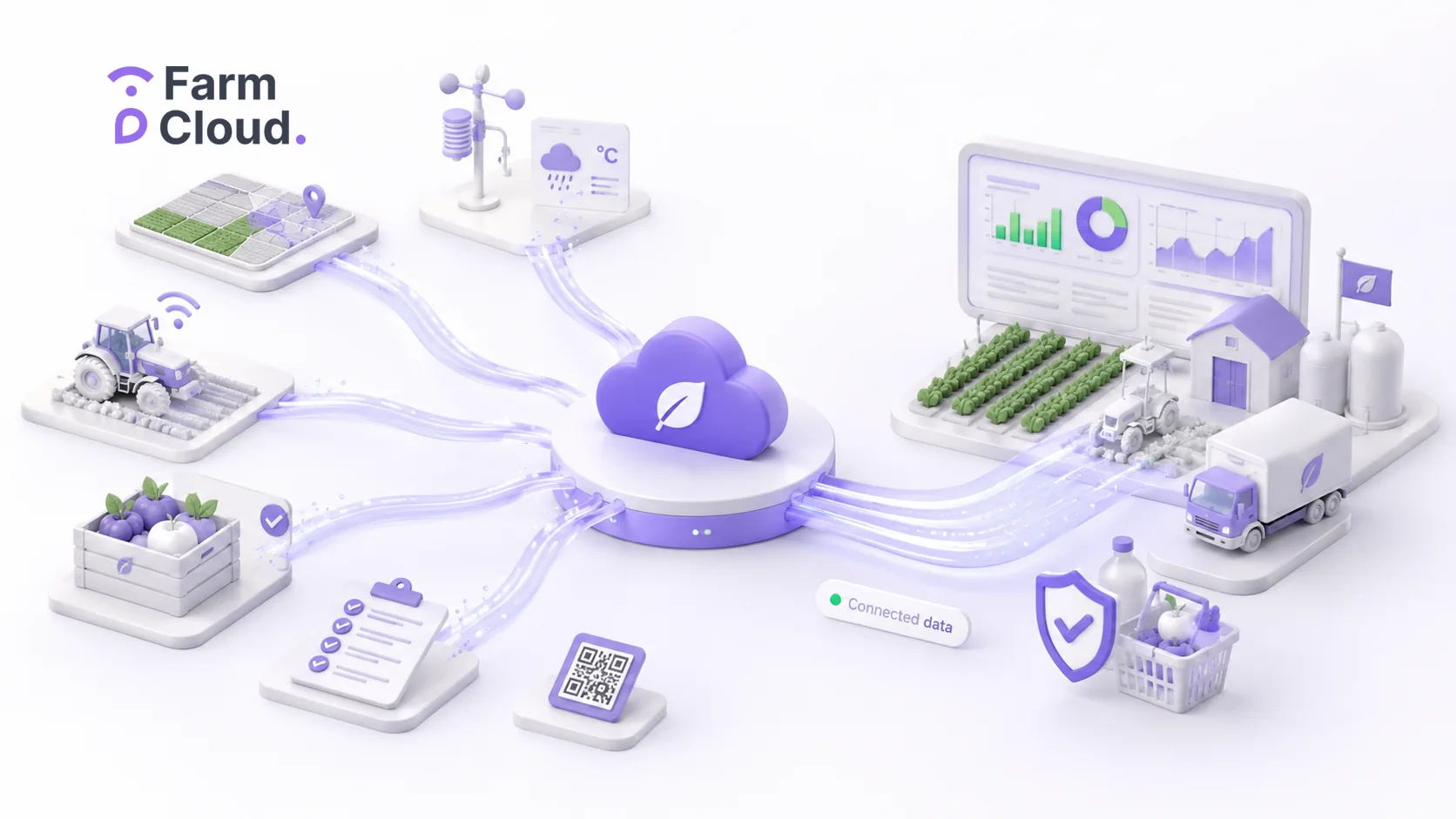
FarmCloud makes it possible to build this model by combining FarmPortal as the farmer’s everyday FMS, AgroSell as the campaign, offer and loyalty layer, and a broader data infrastructure for agribusiness partners. The farmer does not need to install another application, while the agricultural input manufacturer or distributor gains a tool for customer retention, farm segmentation, demand analysis and trust building.
Who is this article for?
This article is for companies that sell agricultural inputs and want to stop competing only on price. It is intended primarily for fertiliser manufacturers, seed producers, crop protection companies, biostimulant and premix producers, distributors, dealer networks, sales and marketing teams, and key account managers serving large farms.
Each of these groups faces different problems, but all of them come down to one question: how do you maintain a relationship with a farmer when the competition offers a similar product, a generic substitute or a one-off discount?
| Target group | Business problem | How a loyalty programme helps | Role of FarmCloud |
|---|---|---|---|
| Fertiliser manufacturers | Price pressure, substitutes, seasonal demand peaks and weak visibility of end-customer purchases. | A points programme for fertiliser buyers increases repeat purchases and links points with soil analysis, advisory and fertilisation planning. | FarmPortal stores fields, crops and treatment history, while AgroSell handles campaigns, offers and point allocation. |
| Seed producers | Long purchase decision cycle, need to build trust in a variety and need to demonstrate results. | Bonuses for early purchase, participation in on-farm trials, crop registration and post-season result reporting. | The farm profile and crop structure help match varieties to the region, soil, crop rotation and production technology. |
| Crop protection manufacturers | Regulations, pressure for integrated pest management and generic products after patent expiry. | The programme shifts communication from “buy the product” to “apply the right solution at the right time and document the decision”. | Weather data, treatment calendar, field maps and decision models can support communication based on real agronomic need. |
| Distributors and dealers | Risk that the manufacturer builds a relationship with the customer while bypassing the sales channel. | A partner programme can reward registrations, customer service, sales representative activity and joint promotional campaigns. | FarmCloud can provide a partner panel, reports and co-marketing mechanics without creating conflict with the distribution channel. |
| Marketing teams | Low effectiveness of mass campaigns, lack of first-party data and difficulty personalising content. | Segmentation by acreage, crops, region, machinery fleet and purchase history increases communication relevance. | AgroSell and FarmCloud connect campaigns with operational data, not only with an email list. |
| Sales teams and key account managers for large farms | Lack of context before a visit, work based on notes and weak control of post-sales activities. | The sales representative sees the customer status, points, active tasks, contact history and cross-sell potential. | Agricultural CRM in FarmCloud can combine sales data with agronomic context. |
Why is a loyalty programme for farmers becoming strategic?
In agriculture, loyalty rarely comes from a discount alone. A farmer makes decisions under pressure from the season, weather, cash flow, product availability, advisor recommendations, previous-year experience and neighbours’ opinions. This is why a loyalty programme for the agricultural sector must work differently from a retail loyalty programme in a grocery store.
The most important difference is that the purchase of an agricultural input is part of the production process. The farmer is not buying only fertiliser, seed or a crop protection product. The farmer is buying a decision that affects yield, quality, residue risk, cost per hectare, compliance with standards and the farm’s financial result.
Research into loyalty programmes indicates that well-designed mechanisms can influence retention, relationship duration and share-of-wallet, but the effect depends on reward attractiveness, programme simplicity and real value for the user. In agriculture, this means cashback alone is not enough. Advisory, digital tools, farm profiling, analytical services and communication aligned with the agronomic calendar are needed.
In practice, an agricultural loyalty programme should pursue three objectives at the same time: increase value for the farmer, improve data and predictability for the organiser, and strengthen the brand position against generics, marketplaces and independent discount aggregators.
How does a loyalty system work in the agricultural sector?
The programme mechanics should be simple for the farmer but precise enough for the organiser. The user must understand what earns points, when points are allocated, how long they remain valid and what they can be exchanged for. The company running the programme must control the budget, purchase verification, fraud, terms and conditions, reward logistics and reporting.
The best agricultural programmes combine purchase mechanics with data and education mechanics. A farmer collects points not only for purchases, but also for actions that improve data quality and advisory effectiveness: completing the farm profile, adding fields, indicating crops, taking a photo of an invoice, completing a post-season survey or participating in a field demonstration.
| Programme element | How it works | Agricultural example | Risk to control |
|---|---|---|---|
| Point allocation for purchases | Net value in PLN or product value is converted into points. | 1 point for every PLN 10 net, with a ×2 multiplier for a selected fertiliser line or seed variety. | Margin erosion if multipliers are not linked to margin and sales objectives. |
| Farm profiling | The farmer provides acreage, crop structure, region, production type, machinery fleet and needs. | A different offer for an 80 ha cereal farm and a different one for a 700 ha maize, rapeseed and wheat farm. | An overly long registration form reduces conversion. |
| Purchase identification | The purchase is confirmed by invoice, QR, serial number, distributor POS or KSeF. | The farmer takes a photo of an invoice in the app and AI recognises the products included in the programme. | Fraud, incorrect document reading and duplicate submissions. |
| Membership tiers | Annual thresholds build motivation for repeat purchases. | Bronze, Silver, Gold and Platinum based on turnover, fertiliser tonnes or hectares covered by the technology. | Thresholds that are too high demotivate smaller farms. |
| Reward catalogue | Points can be exchanged for discounts, cashback, services, vouchers and digital modules. | Voucher for soil analysis, discount on advisory, access to disease forecasts, workwear. | Rewards unrelated to the farm have low practical value. |
| Tasks and challenges | The farmer earns points for completing data, surveys, photos and seasonal activities. | “Complete your crop structure”, “add a crop photo”, “complete a post-harvest survey”. | Gamification without agronomic meaning quickly loses credibility. |
| Referral programme | The farmer receives a bonus for successfully referring another farm. | Bonus after the new programme member makes the first verified purchase. | Multiple accounts, artificial referrals and abuse within families or buying groups. |
What drives farmer participation and activity?
Farmer activity in a loyalty programme is not even throughout the year. In agriculture, communication must follow the rhythm of production, not only the brand’s marketing calendar. The same message sent at the wrong time will be treated as spam, while the same message sent in the right agronomic window can trigger a purchase, a conversation with an advisor or data completion in the application.
The strongest activity triggers are seasonality, decision pressure and the real cost of making a mistake. A farmer reacts when an offer is related to a specific field, a specific crop and a specific problem: sowing, fertilisation, a T1/T2/T3 treatment, disease risk, harvest, autumn phosphorus and potassium purchases, or point redemption before expiry.
10 key activity triggers in a loyalty programme for farmers
- Agronomic calendar: autumn sowing, start of vegetation, nitrogen fertilisation, T1/T2/T3 fungicide treatments, harvest and autumn purchases.
- Product launches: a new variety, new molecule, new fertiliser formulation or new biostimulant.
- Early-use bonus: additional points for early adopters who test a product on a selected acreage.
- Competitive price pressure: the programme offsets the higher price of a branded product with the value of services, advisory and rewards.
- Advisor or sales representative activity: registration during the first visit, invoice reminder and help with redeeming points.
- Industry events: trade fairs, field shows, maize days, demo days, local meetings with rural women’s associations and opinion leaders.
- Data triggers: weather, treatment timing, crop condition, NDVI, disease risk and end of season.
- Social proof: regional rankings, neighbour case studies, opinions from demonstrators and local community leaders.
- Expiring points: a 12–24 month validity period triggers loss aversion.
- Useful rewards: soil analysis, advisory, a discount on the next purchase and digital tools work better than random gadgets.
Benefits for farmers
A farmer will join a programme only when the benefit is understandable, quick and practical. During the season, there is no time for five-screen forms, additional logins and another app that will be used once per quarter. This is why a loyalty programme for farmers should be embedded in a tool that already supports everyday farm work.
In the FarmCloud model, the farmer’s main interface can be FarmPortal, an FMS available on web and mobile. The farmer manages fields, treatment history, crop observations, weather data, satellite data and advisory, while also collecting points for purchases of products included in the partner programme.
Key benefits for the farm
- One application instead of several systems: the loyalty programme works alongside the FMS, not as a separate tool to be forgotten.
- Simple purchase identification: invoice photo, file upload, QR, serial number or KSeF integration with the farmer’s consent.
- Real financial premium: in practice, points programmes are often designed so that reward value equals approximately 1–4% of net purchase value, and sometimes 6–8% for VIP segments if justified by margin, volume or retention strategy.
- Rewards matched to farm needs: soil analysis, residue testing, advisory, disease forecasts, discounts on digital modules, accessories, parts and services.
- Transaction and point history: the farmer can see what points were awarded for, which purchases were approved and when points expire.
- No lock-in to a single supplier: the programme can include multiple partners and product categories if the organiser’s strategy allows it.
- Access to knowledge: webinars, training, reference visits, technology demonstrations and agronomic recommendations.
- Documentation support: FMS data can support ESG, MRV, GlobalG.A.P., SAI, eco-schemes and internal quality standards of buyers.
- Data security: purchase and production data should be used in line with the farmer’s consent and the principle of data minimisation.
Benefits for agricultural input manufacturers and distributors
For the organiser, a loyalty programme is a sales, marketing and analytical tool. It is not only about point allocation. It is about creating a permanent relationship channel with the farm, better understanding production needs and increasing the brand’s share in the farmer’s purchase basket.
In a world where third-party data is less accessible and mass communication is losing effectiveness, first-party data becomes a competitive advantage. In agriculture, it is particularly valuable because it describes not only the buyer, but also acreage, crops, technology, region, seasonality and purchase potential.
Strategic benefits for the programme partner
- First-party data about the farm: crop profile, region, acreage, needs, activity, purchase categories and seasonal potential.
- Direct B2F relationship: the manufacturer stops being anonymous, even if sales still go through distribution.
- Better demand prediction: declared crops and purchase history help plan production, logistics, availability and campaigns.
- Share-of-wallet growth: a farmer buying two products from the portfolio can be motivated to complete the technology with additional SKUs.
- Defence against generics: the programme increases the cost of switching supplier if it provides services, data and advisory, not only a discount.
- Faster launch of new products: a base of active users supports recruitment of early adopters and on-farm trials.
- Lower retention cost than acquisition cost: marketing literature indicates that maintaining a relationship with the right customer can have significantly better economics than acquiring a new one, although the effect depends on the sector, margin and programme quality.
- Content marketing material: case studies, field results, farmer statements, seasonal reports and data for sales presentations.
- Lead nurturing for cross-sell: moving from seeds to seed treatments, from fertilisers to soil analysis, from crop protection to biostimulants and advisory.
How does FarmCloud support a loyalty programme for farmers?
FarmCloud is digital infrastructure for agribusiness. In the context of loyalty, this means that a points programme is not a detached promotional campaign, but part of a broader ecosystem covering FMS, agricultural CRM, advisory, campaigns, field data, integrations and reporting.
The key advantage is that the farmer can access the programme through FarmPortal, a tool that supports everyday farm management. Campaigns, offers and loyalty mechanics can be created and managed through AgroSell, while data and processes can be integrated with the broader FarmCloud ecosystem. More information about the platform’s functional areas is available on the FarmCloud functions page.
Key functions in the FarmCloud model
- FarmPortal as the farmer front end: web and mobile FMS, fields, crops, treatment history, weather data, NDVI, observations, tasks and documentation.
- AgroSell as the loyalty and campaign layer: points programme, offers, segments, messages, tasks, reward catalogue and support for field sales teams. More about this part of the ecosystem: AgroSell in FarmCloud.
- AI invoice reading: the farmer takes a photo of the purchase document, and the system can recognise the seller, date, line items, amounts and products covered by the programme.
- KSeF integration with the farmer’s consent: in Polish conditions, KSeF makes it possible to consider automatic analysis of purchase invoices if the user grants the relevant permissions and understands the scope of data processing.
- Multi-method purchase verification: invoice, QR, serial number, distributor POS or purchase declaration confirmed by the dealer.
- Farm profiling: acreage, region, crops, crop structure, machinery fleet, production type and seasonal activity.
- Reports for partners: the partner can see campaign effectiveness, segment activity, reward usage, purchase dynamics and cross-sell potential within the agreed scope.
- Logistics support: Agri Solutions as the operator can store documentation, manage points, handle the reward catalogue and support settlement processes.
- White-label and dedicated deployment: the partner can launch its own version of the programme, including its own branding and deployment in its own environment.
- Data security: farmer data should not be shared with partners outside the clearly defined scope of consents, terms and processing purpose.
In practice, FarmCloud connects three worlds: the farmer’s everyday work, the partner’s sales and marketing objectives, and the data processes needed for reporting, advisory and trust building. This model is consistent with the approach described in the article on building relationships with farmers through FarmCloud and AgroSell.
Case study: points-based programme for a fertiliser manufacturer
Context
A specialist fertiliser manufacturer wants to increase retention among large and medium-sized farms in three voivodeships. The company has a strong brand but is losing part of its volume to cheaper generic products and local distributor promotions. The sales team manages relationships with farms, but much of the information remains in notes, spreadsheets and sales representatives’ phones.
Challenge
The company wants to build a partner programme for farms that is not just a simple discount. The goal is to increase the brand’s share in the fertiliser basket, promote soil analysis, improve data quality on crops and prepare the customer base for future advisory and MRV services.
Solution with FarmCloud
Farmers register through FarmPortal. During registration, they complete acreage, main crops, region and selected fields. Purchases are submitted by taking a photo of an invoice or uploading a document. The system reads the invoice, recognises products covered by the programme, allocates points and assigns the purchase to the farm. The partner sees aggregated reports, customer segments and campaign results. The farmer exchanges points for soil analysis, a discount on future purchases, advisory service or a digital module.
| Parameter | Starting value | Target after 12 months | How to measure it? |
|---|---|---|---|
| Number of farms in the pilot | 0 in the programme | 600 farms | Registrations in FarmCloud, profile activation and acceptance of programme terms. |
| Total acreage covered by the programme | No unified database | 90,000–120,000 ha | Declared and verified data in the FarmPortal profile. |
| Active farms | Not measured | ≥ 55% of registered farms with at least one approved purchase | Transactions approved in the loyalty module. |
| Average share-of-wallet uplift in the active segment | Index 100 | Index 108–115 | Comparison of programme member purchases with a control group and distributor data. |
| Redemption rate | 0% | 35–50% | Share of points exchanged for rewards out of points available for redemption. |
| Share of agronomic rewards | 0% | ≥ 40% of all redemptions | Analysis of reward categories: soil analysis, advisory, disease models and application modules. |
| Farm profile quality | Low or fragmented | ≥ 70% of profiles with acreage, crop structure and region | Completeness score in FarmCloud. |
| Reward cost relative to net turnover | No programme | 1.5–3.5% | Value of rewards, service, logistics and point budget / qualified net turnover. |
Expected result
The most important result is not the number of rewards issued. The value lies in connecting purchases with the farm profile, building relationship history and creating a channel for further activities: fertiliser campaigns, advisory, soil testing, customer segmentation, demand planning and cross-sell.
In a well-designed pilot, effects should be assessed after at least one full season, and preferably after 18–24 months. Agricultural loyalty programmes need time because purchase decisions are seasonal and the full cycle includes planning, purchase, application, observation, harvest and evaluation of the effect.
FarmCloud vs a separate loyalty app
Many companies start with the idea of creating their own loyalty app. This is tempting because it gives full control over branding. The problem is that the farmer does not need another promotional app. The farmer needs a tool that saves time and helps make decisions on the farm.
That is why a programme based on FarmCloud has an advantage: it works where the farmer already manages field and operational data. Loyalty becomes part of everyday work, not a separate administrative obligation.
| Criterion | Separate loyalty app | Programme based on FarmCloud |
|---|---|---|
| Farmer adoption | More difficult because it requires installing and learning another tool. | Easier because the programme works inside an FMS that the farmer can use for everyday work. |
| UX during the season | Often reduced to forms and invoice photos. | Can combine invoices, fields, crops, tasks, advisory and communication in one place. |
| Farm profiling | Usually limited to declarative data. | Can use field data, crop structure, treatment history and operational data. |
| Relationship with distribution | Risk of conflict if the manufacturer communicates directly with the dealer’s customer. | Possible partner model: dealers, sales representatives and distributors can be part of the process. |
| Integrations | Require separate development and maintenance. | FarmCloud can integrate CRM, ERP, POS, KSeF, FMS data, sensors and partner systems. |
| Value for the farmer | Usually points, discounts and rewards. | Points plus FMS, advisory, soil analysis, documentation, satellite data, models and services. |
| Value for the partner | Campaign and transactional data. | Campaign, transactional, agronomic, segmentation and operational data within the agreed scope. |
| Scaling | Requires building a user base from scratch. | Can use existing workflows, applications, reach and the FarmCloud structure. |
Disadvantages, risks and how to reduce them
A loyalty programme can increase retention, but it can also reduce margin, complicate team operations and create conflict with distribution. The risk increases when the organiser starts with a reward catalogue instead of an economic model, data process and clear value proposition.
In agriculture, regulations, seasonality, taxes, GDPR, fair point allocation and dealer relationships are particularly important. The programme must have terms and conditions, a data policy, budget, complaint procedures and anti-fraud mechanisms already at pilot stage.
Key risks
- Margin erosion: the cost of points and rewards is a real cost if it does not increase volume, price, retention or customer value.
- Conflict with the distribution channel: dealers may feel bypassed if the manufacturer builds a relationship with their customer without a partner mechanism.
- Cannibalisation: a farmer who would have bought the product anyway receives a discount without an additional sales effect.
- Operational complexity: returns, complaints, point expiry, reward logistics, invoice corrections and user support.
- Tax risk: rewards and promotional sales require tax analysis; in Poland, the one-off value limit of a reward and whether the reward is related to the participant’s business activity may be relevant.
- GDPR and profiling: farm segmentation, marketing automation and analytics require clear consents, legal bases, DPIA and data retention rules.
- Fraud: scans of other people’s invoices, codes from wholesale packaging, duplicates, multiple accounts per farm and fake referrals.
- Loyalty to the discount instead of the brand: if the programme provides no services or expert value, the relationship ends with the points.
- Difficulty measuring ROI: the first season is often a learning period, and the full effect becomes visible only after 18–24 months.
- Regulation of crop protection products: promotions related to crop protection products must be designed carefully, in line with integrated pest management principles and applicable regulations.
How to reduce risk
- Start with a regional pilot and one or two product categories.
- Set the point budget as a percentage of qualified net turnover.
- Separate financial rewards from service-based and agronomic rewards.
- Include distributors in registration, purchase confirmation and co-marketing.
- Introduce anti-fraud thresholds: duplicate invoices, point limits, NIP verification, SKU and date consistency.
- Define clear rules for point expiry, complaints and corrections.
- Prepare DPIA, terms and conditions, privacy policy and consent matrix.
- Measure the programme against a control group, not only by the number of registrations.
Building brand value and trust
A well-designed loyalty programme changes the nature of the relationship. The brand does not appear only at the moment of purchase, but accompanies the farmer throughout the season. This is particularly important in agriculture, where purchase decisions are strongly based on trust, recommendations, field results and advisor credibility.
The programme should lead from transaction to relationship. This means that points are only the beginning. True loyalty is built through knowledge, support, fast response, transparent rules and practical tools that improve the farm’s result.
How does a loyalty programme build the brand?
- Education instead of advertising: webinars, reports, podcasts, seasonal alerts and guides build expert positioning.
- Community: regional meetings, thematic groups, demo days and demonstration farms create a sense of belonging.
- Farmer storytelling: field stories are more credible than traditional product advertising.
- Premium positioning: the brand can maintain a higher price if it sells a product plus an ecosystem of services, not just a canister, bag or seed unit.
- Brand ambassadors: top-tier members of the programme can become natural influencers in the agricultural community.
- Consistency with ESG and soil regeneration: rewards for soil analysis, MRV documentation, biodiversity or improved practices can support the sustainable agriculture narrative.
Competitive aspect: data, switching cost and the farmer relationship
In the agricultural input sector, competitive advantage increasingly depends on data and relationships, not only on the product. When several companies offer similar technical parameters and similar pricing, the winner is the one that better understands the farm, reacts faster to needs and can deliver additional value.
A loyalty programme can create an advantage, but only if it is not a race for discounts. If everyone increases cashback, margins fall for everyone and the farmer receives a very similar benefit in every programme. Mechanisms based on services, history, field data, advisory and integration with everyday farm work are stronger.
Key competitive mechanisms
- Switching cost: accumulated points, history, field profile, data and membership tier make it harder to move to a competitor.
- Data moat: the company that first builds a GDPR-compliant database of farms can target offers and needs more effectively.
- Lock-in through services: soil fertility maps, MRV, advisory and FMS tools are harder to abandon than a simple discount.
- Arms race: when competitors have programmes, not having one may be perceived as a weaker offer.
- Risk of a race to the bottom: uncontrolled discounts can destroy differentiation and margin.
- Threat from aggregators: a marketplace or independent platform can collect discounts from many manufacturers and take over the farmer relationship.
- Strength of the ecosystem: cooperation with FMS, fintech, distribution and advisory can be stronger than a standalone programme from a single brand.
KSeF, invoices and automatic point allocation
In Poland, combining a loyalty programme with structured invoices is a particularly interesting direction. KSeF creates a new standard for invoice circulation, and for the agricultural sector it means the possibility of reducing manual document entry if the user knowingly grants permissions and consents.
In practice, FarmCloud can support several purchase confirmation variants. The simplest option is taking a photo of an invoice in the app. A more advanced option is AI-based document reading. The most automated option is integration with KSeF, where the system analyses purchase invoices and allocates points for products covered by the programme.
Why is this important for UX?
The farmer should not have to copy data from an invoice. During the season, every additional activity reduces engagement. A good user experience means: take a photo, send it, wait for verification and see the points. If the purchase is confirmed automatically through KSeF or the distributor’s POS system, the process can be even shorter.
Data security
This is an area that must be communicated very clearly: Agri Solutions and FarmCloud, as the platform operator, should not share the farmer’s purchase data with partners in a way that is inconsistent with the terms and consents. The programme partner may receive analytical data, reports and campaign information within the agreed scope, while detailed purchase data requires a proper legal basis, purpose and transparent information for the user.
How to implement a loyalty programme step by step
An agricultural loyalty programme should be implemented in stages. The most common mistake is designing a full nationwide programme from the start, with an extensive reward catalogue, many integrations and too many rules. It is better to begin with a pilot, verify the mechanics and only then scale.
12 implementation steps
- Define the business objective: retention, share-of-wallet growth, sale of a new SKU, defence against generics, data improvement or cross-sell.
- Select the pilot segment: region, product category, farm type, minimum acreage and distribution channel.
- Define the value proposition: points plus services, not only a discount. For example soil analysis, advisory and access to decision models.
- Design the point mechanics: PLN-to-points conversion, multipliers, tiers, limits, point validity and correction rules.
- Design the reward catalogue: cashback, discounts, vouchers, digital modules, training, trips, equipment and services.
- Define purchase identification: invoices, QR, serial number, POS, dealer, KSeF or a mixed model.
- Include distribution: dealers should see programme value and have their own benefits.
- Prepare terms, GDPR and taxes: terms and conditions, privacy policy, consents, DPIA, data matrix, tax interpretation and complaint procedures.
- Launch seasonal communication: messages around sowing, fertilisation, crop protection, harvest and autumn purchases.
- Train sales representatives: the programme must be a conversation tool, not only a link to an app.
- Measure results: compare programme members with a control group and measure impact on basket, retention and margin.
- Scale after correction: after 6–12 weeks, optimise UX and communication; after the season, update the economic model.
KPIs for an agricultural loyalty programme
Programme measurement must include both user activity and real business results. The fact that a farmer registered for the programme does not yet mean loyalty. What matters is whether the farmer buys more often, buys a larger part of the portfolio, returns in the next season and uses services that strengthen the relationship.
The best practice is to compare programme participants with a control group. Without such a comparison, it is easy to attribute to the programme sales that would have happened anyway.
| KPI | What does it measure? | Why is it important? | Example pilot threshold |
|---|---|---|---|
| Activation rate | Share of registered users who completed the first valuable action. | Shows whether onboarding works. | ≥ 50% after 90 days |
| Redemption rate | Share of points exchanged for rewards. | A low level may indicate a weak catalogue or overly complicated process. | 35–50% after the season |
| Share-of-wallet uplift | Change in the brand’s share of the farmer’s purchase basket. | The most important indicator of the programme’s sales value. | +8–15% in the active segment |
| Retention rate | Share of farms returning in the next season. | Shows whether the programme builds a lasting relationship. | +5–10 percentage points vs the control group |
| ARPU of member vs non-member | Average purchase value of a programme member compared with a similar customer outside the programme. | Helps assess whether the programme increases customer value. | Index 108–115 |
| Reward cost / qualified turnover | Reward budget relative to turnover covered by the programme. | Protects margin and EBITDA. | 1.5–3.5% |
| NPS of programme members | Willingness to recommend the programme and the brand. | Shows whether the programme builds trust, not only discounts. | Increase by 8–12 points |
| Profile completeness score | Data completeness: acreage, crops, region, fields and machinery fleet. | Without data, there is no personalisation or effective agricultural CRM. | ≥ 70% complete profiles |
Checklist for sales and marketing teams
Before launching the programme, it is worth going through a short checklist. Its purpose is not to delay implementation, but to avoid a situation where the programme works technically but does not deliver a business result.
Checklist before the pilot
- Does the programme have one main business objective for the first season?
- Is it clear which products and SKUs are covered by points?
- Are the multipliers aligned with margin, strategy and product availability?
- Does the reward catalogue include agronomic services, not only gadgets?
- Can a farmer submit a purchase in less than 60 seconds?
- Does the process work in both the mobile app and the web portal?
- Do dealers and sales representatives have a clear role in the programme?
- Do the terms describe point expiry, complaints, corrections and returns?
- Have legal bases for data processing and GDPR compliance been prepared?
- Has a control group been defined for ROI measurement?
- Does the team know how to respond to fraud and duplicate invoices?
- Is communication aligned with the agronomic calendar?
Quick guide: what not to do
- Do not launch a programme that requires daily farmer login without real value.
- Do not build loyalty only on cashback.
- Do not bypass distribution if distribution controls the sales relationship.
- Do not collect data that you cannot justify with the programme’s purpose.
- Do not measure success only by the number of registrations.
- Do not design communication according to the marketing calendar if it ignores agronomy.
Farmer testimonials and expert insights
“The biggest difference is that I do not have to remember another app. I add the fertiliser invoice in FarmPortal, the points are allocated after verification, and I can immediately see whether it is better to use a voucher for soil analysis or a discount on the next purchase. With 620 ha of wheat, rapeseed and maize, even 2–3% of purchase value in services matters if those services genuinely support fertilisation decisions.”
“For me, a programme makes sense only when the reward does not end with a gadget. We exchanged points for soil testing and a fertilisation consultation for potato fields. The greatest value was that the data stayed in the system and could be connected with treatment history, field maps and the plan for the next season.”
Expert insight
“In agriculture, loyalty does not come from a discount alone. It is built when the agricultural input manufacturer becomes part of the farm’s decision-making process: helping select the product, document the treatment, reduce risk and improve the result per hectare.”
“The best loyalty programme in agriculture should work like CRM with advisory functions for agro. The sales representative does not see only points and turnover. They see the farm, the season, the needs, the activity and the context for the conversation.”
Conclusion
A loyalty programme for farmers makes sense when it is more than a discount. In agriculture, true value is created by connecting points with advisory, farm data, purchase history, the agronomic calendar, documentation, services and the farmer’s everyday work tool.
FarmCloud enables this model to be designed as digital infrastructure for agribusiness. The farmer uses FarmPortal, the partner manages campaigns and the programme through AgroSell, and Agri Solutions as the operator can support point settlement, documentation, logistics, reports and integrations. As a result, a fertiliser, seed or crop protection manufacturer or distributor does not have to build the entire technology from scratch.
The most important conclusion is simple: an effective agricultural loyalty system should not buy loyalty with a discount. It should build trust, make the farmer’s work easier and create data that helps sell, advise and plan the season more effectively.
Do you want to launch a loyalty programme for farmers?
FarmCloud can help design the pilot, point mechanics, reward catalogue, FarmPortal integration, partner reports and a white-label model for an agricultural input manufacturer or distributor.
Glossary
Agricultural loyalty programmes combine marketing, sales, technology, data and regulation. The glossary below explains the key terms used in this article.
- Loyalty programme for farmers
- A system in which a farm receives points, rewards, discounts or services for purchasing products, being active in an app, participating in campaigns or completing tasks related to agricultural production.
- Points programme for fertiliser buyers
- A mechanism in which purchases of fertilisers covered by the programme are converted into points. Points can be exchanged for a discount, soil analysis, advisory, equipment or digital modules.
- FMS
- Farm Management System, a system for managing a farm. In the FarmCloud context, FarmPortal acts as the FMS.
- CRM for agriculture
- A customer relationship management system for agricultural customers that reflects the specificity of a farm: acreage, crops, season, needs, contact history, purchases and advisory activity.
- CRM with advisory functions for agriculture
- An extended CRM in which a sales representative or advisor sees not only sales data, but also agronomic context and can have a conversation based on the farm’s real needs.
- First-party data
- Data collected directly from the user or through an organisation’s own relationship with the customer, such as farm profile, submitted purchases, consents, activity in the application and point redemption history.
- Share-of-wallet
- The share of a given brand or company in the customer’s total purchases within a category. In agriculture, it may mean, for example, a manufacturer’s share in a farm’s fertiliser basket.
- Redemption rate
- The share of points exchanged for rewards compared with points available for redemption. A low rate may indicate a weak reward catalogue or an overly difficult redemption process.
- Switching cost
- The cost of changing supplier. In a loyalty programme, it may result from the loss of points, history, status, services, data, advisory and the convenience of working in one system.
- Data moat
- A competitive advantage created by data. In agriculture, this means lawfully collected data about farms, crops, purchases, needs and activity.
- Blockchain
- Distributed ledger technology. In loyalty programmes, it may be useful for immutable recording of events, but it is not always necessary. A well-designed audit register is often sufficient.
- KSeF
- The Polish National e-Invoicing System. In a loyalty programme, it can support automatic identification of purchases from structured invoices if the user grants the relevant permissions.
- MRV
- Monitoring, Reporting and Verification. In agriculture, it may relate to emissions, regenerative practices, carbon footprint and environmental data.
Frequently asked questions
Should a loyalty programme for farmers be a separate app?
In most cases, no. A separate app increases the entry barrier, requires another login and competes for the farmer’s attention during the season. A better solution is a programme embedded in an FMS, such as FarmPortal in the FarmCloud ecosystem.
How can a farmer confirm the purchase of fertilisers, seeds or crop protection products?
The farmer can take a photo of an invoice, upload a file, scan a QR code or serial number, use integration with the distributor’s POS system, or consent to integration with KSeF. FarmCloud can support this process through AI and automatic recognition of invoice line items.
Will a fertiliser manufacturer see all the farmer’s invoices?
It should not. Purchase data should be processed in line with the terms, consents and the principle of data minimisation. The programme partner may receive reports and data within the agreed scope, but detailed purchase data requires a clear legal basis and transparent information for the farmer.
Can a loyalty programme operate without conflict with the distributor?
Yes, if dealers are part of the programme. They can be rewarded for registering users, confirming purchases, serving farms and participating in co-marketing activities. The programme should not undermine the sales channel, but strengthen it.
Which rewards are best for farmers?
Practical rewards work best: a discount on the next purchase, a voucher for soil analysis, agronomic consultation, residue testing, access to disease models, application modules, training, spare parts, workwear and tools.
Can a loyalty programme support ESG and MRV?
Yes. Points can encourage farmers to complete data on fields, practices, treatments, soil analysis and documentation. If the data is high quality, it can support ESG reporting, MRV, eco-schemes and food buyer requirements.
How long does it take to see programme results?
Early signals such as registrations, activation and purchase submissions can be measured after a few weeks. A full assessment of retention, share-of-wallet and profitability is best performed after a full season, and in many cases after 18–24 months.
Can FarmCloud be deployed as a white-label solution?
Yes. The programme can operate under the partner’s brand, with its own branding, reward catalogue, rules and integration with partner systems. Deployment in the partner’s technology environment is also possible.
Sources and references
The article uses publicly available scientific studies, regulatory information and project experience in agricultural digitalisation, agricultural CRM, FMS and loyalty programmes.
- Dorotic, M., Bijmolt, T. H. A., Verhoef, P. C. (2012). Loyalty programmes: Current knowledge and research directions. International Journal of Management Reviews.
- European Commission. Sustainable use of pesticides. Information on the SUD Directive, integrated pest management and the SUR proposal.
Follow us!
Preview what we are doing and be inspired by positive changes.