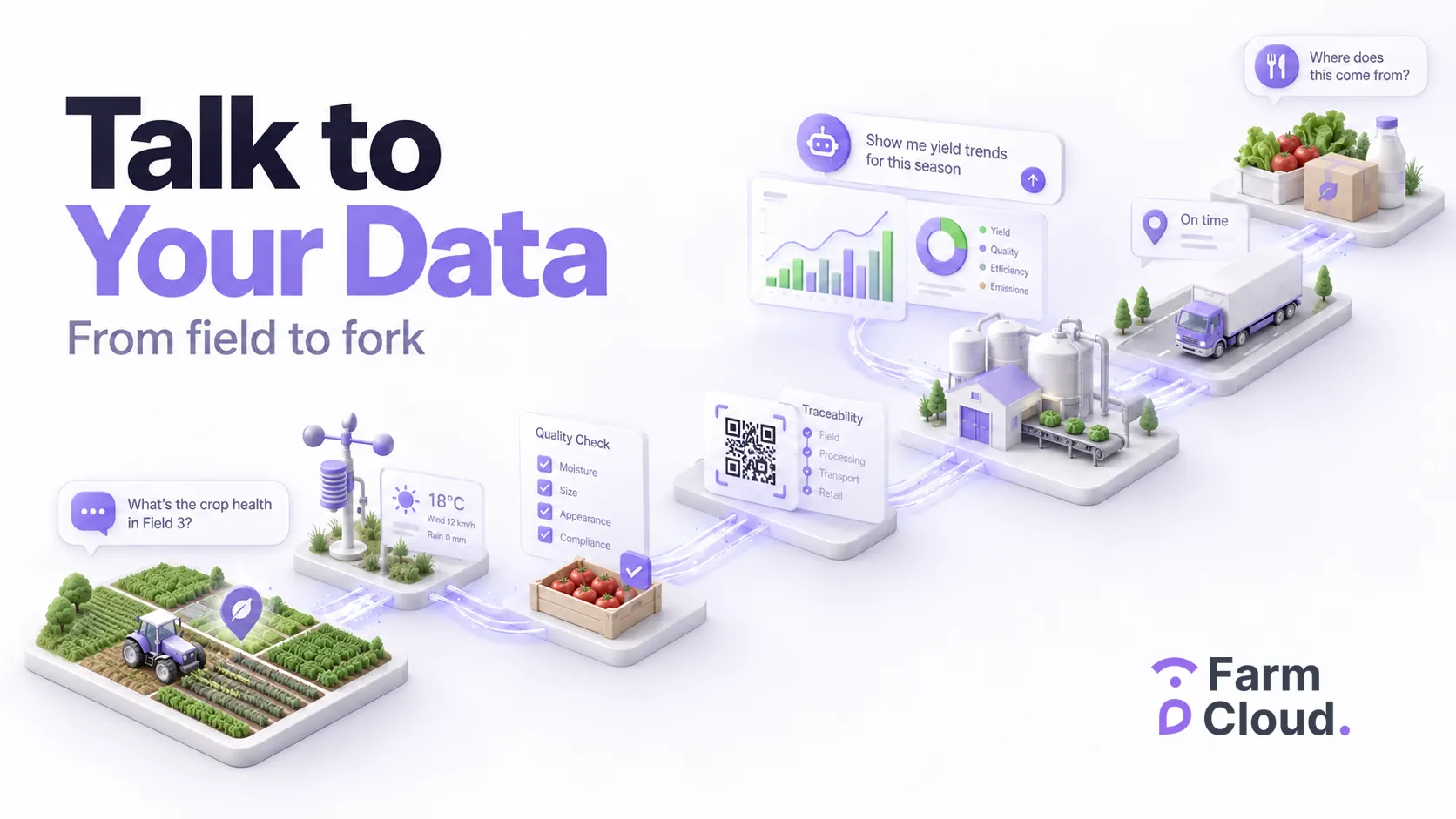
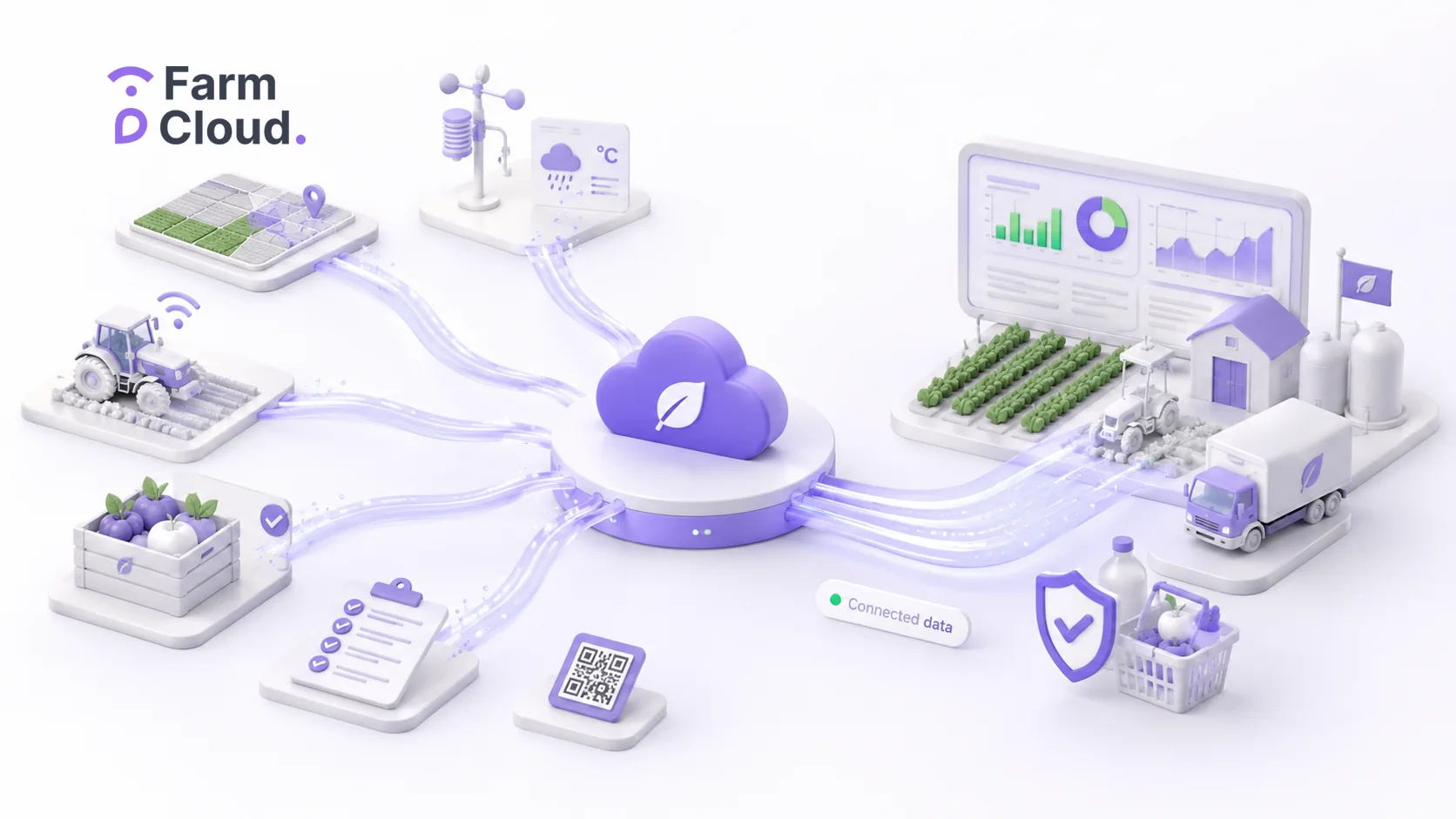
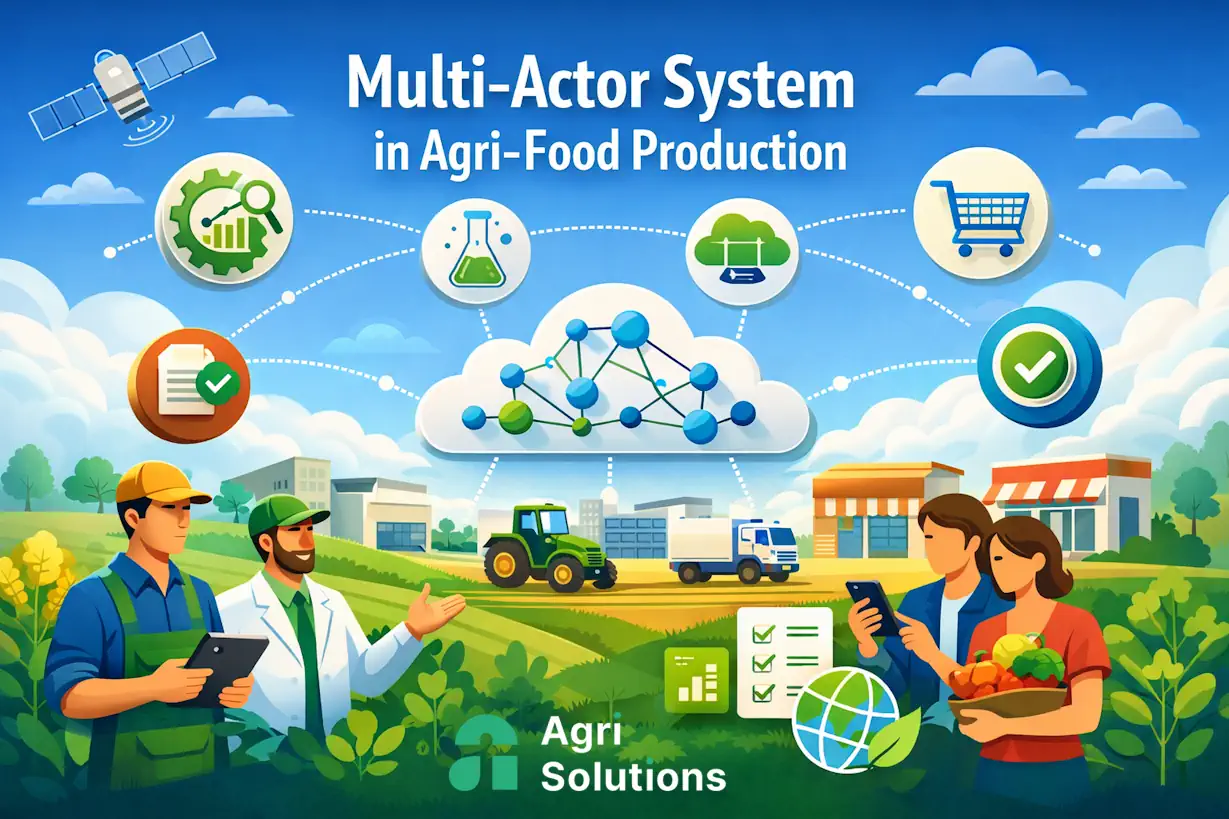
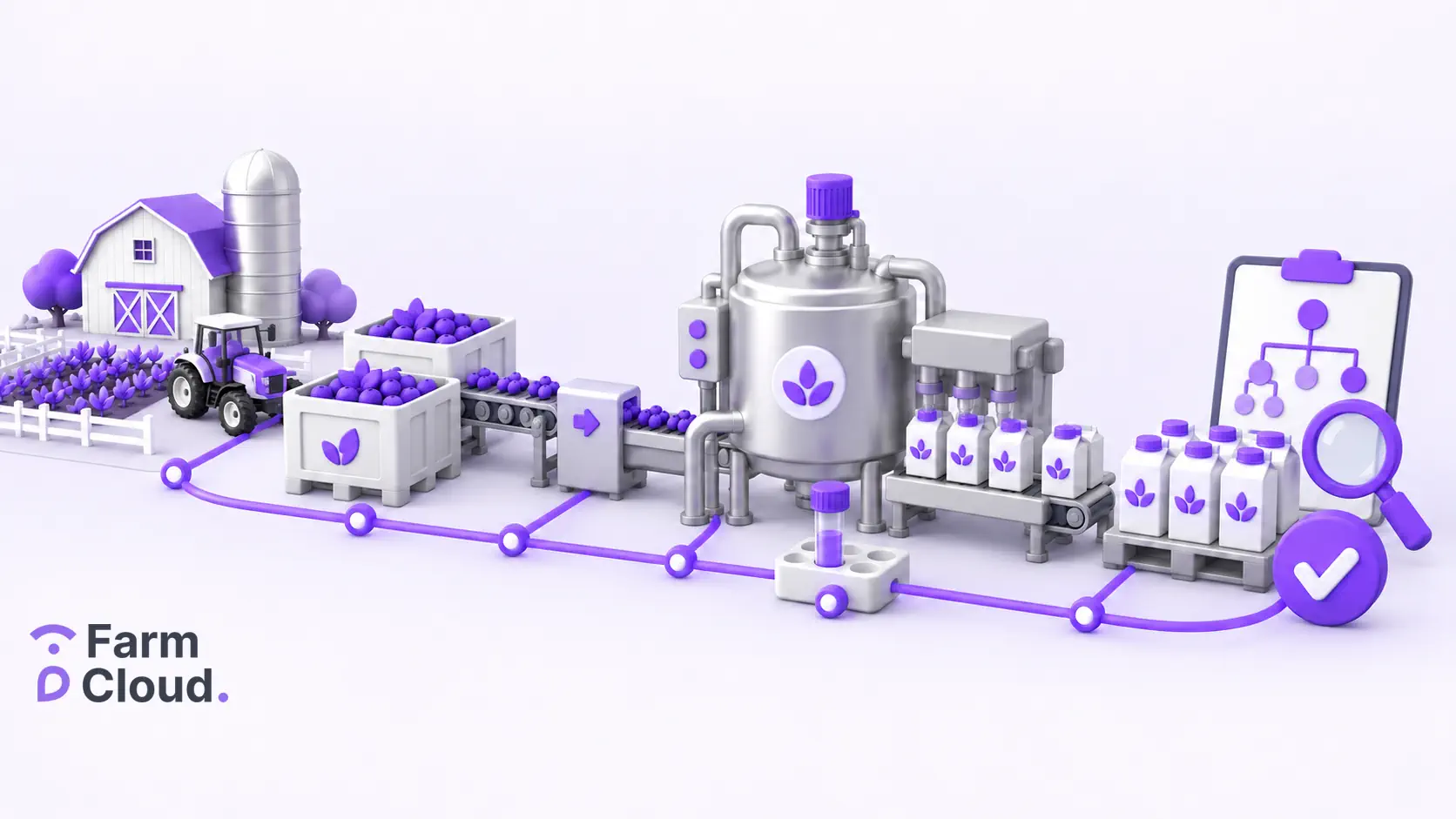
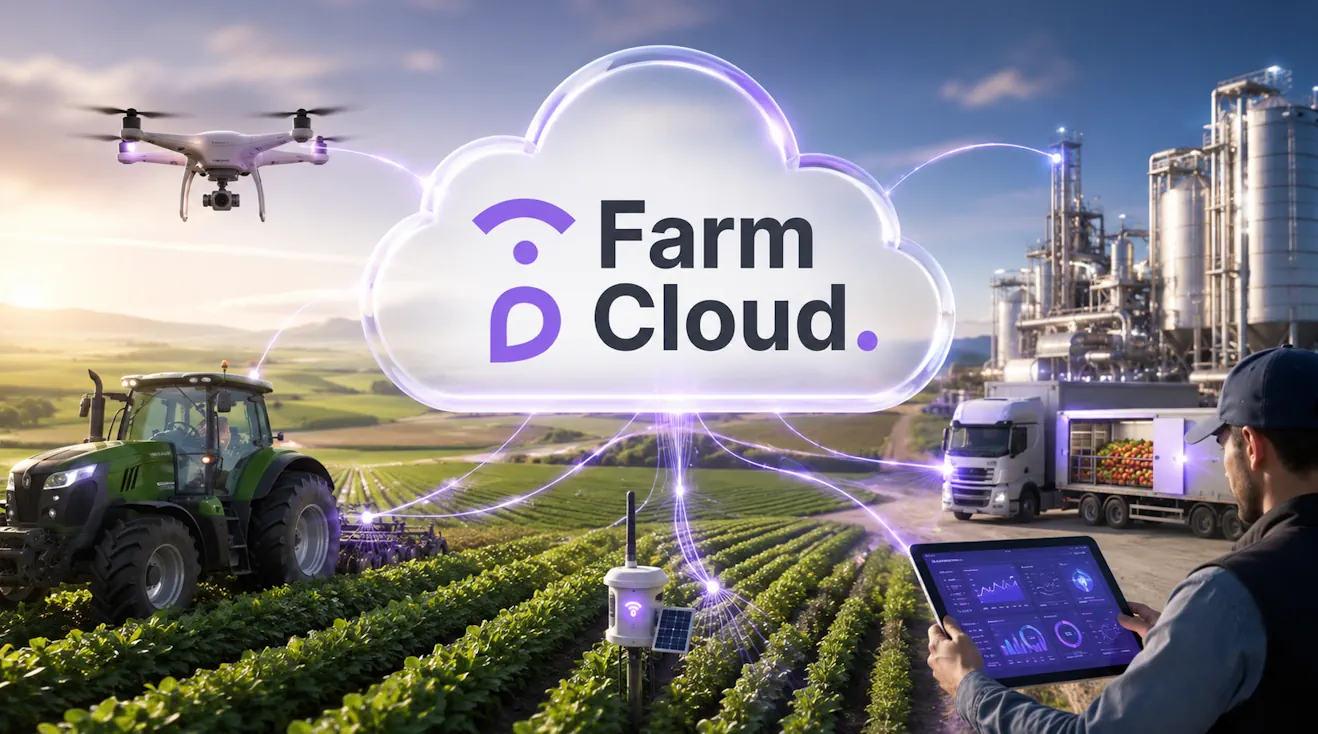
FarmCloud as digital infrastructure for the agri-food sector means more than an app for farmers, a CRM system, a traceability tool or an IoT platform. It is a shared layer of data, processes and integrations that connects farms, advisors, processors, distributors, agri-retail, machine manufacturers, sensors, ERP, CRM, WMS and analytics into one ecosystem.
Summary
FarmCloud as digital infrastructure for the agri-food sector means more than an app for farmers, a CRM system, a traceability tool or an IoT platform. It is a shared layer of data, processes and integrations that connects farms, advisors, processors, distributors, agri-retail, machine manufacturers, sensors, ERP, CRM, WMS and analytics into one ecosystem.
The key value of FarmCloud is that data from fields, machines, sensors, advisory services, quality, purchases, deliveries and sales can work together. As a result, the agri-food sector can move from declarations and scattered files to an operational model based on data, access control, automation and trust.
What does it mean that FarmCloud is digital infrastructure?
The shortest definition is this: FarmCloud is digital infrastructure for the agri-food sector that collects data from fields, farms, machines, sensors, advisory services, quality, purchases, deliveries and sales, and then makes it available to different participants in the value chain in a controlled, secure and business-useful way.
This approach reflects the idea of “Connecting Agribusiness”. FarmCloud is not just an FMS, CRM, traceability system, IoT platform or reporting tool. It is a layer that connects these functions into a single flow of data and processes.
In practice, this means that one piece of information — for example, a treatment performed on a specific field, a soil analysis result, a moisture measurement, a machine pass, an advisor’s recommendation or a quality control result — can feed several processes at the same time. It can be used in farm management, advisory services, audits, delivery settlement, MRV, ESG, profitability analysis, sales campaigns or customer service.
Why a backbone, not another farming app?
In IT, a backbone means the structural core or supporting layer of a system. It is not a single screen, feature or end-user application. It is the layer that allows different systems, users and services to work together.
In agriculture, the problem is no longer only the lack of applications. The problem is the excess of disconnected tools. A farmer has one system for recording treatments, a machine manufacturer has its own telemetry, an advisor keeps notes and files, a processor has a quality system, the purchasing department uses a spreadsheet, and the sales department uses a CRM. The data exists, but it does not form one shared operational truth.
FarmCloud solves exactly this problem. The platform can act as an overarching layer in which individual applications — FarmPortal, FoodPass, AgroSell and Agri Insights — serve different areas of the market while relying on a shared data foundation. This is why FarmCloud can be understood as the agri-food digital backbone: an infrastructure layer on which agriculture, processing, distribution, agri-retail, OEMs and science can build their own processes.
Who is this article for?
This article is intended for people who are not looking for another point solution, but want to understand how to build a digital architecture for collaboration in the agri-food sector. It is especially relevant to organisations working with many farms, devices, suppliers, advisors and internal systems.
The greatest value from this approach is gained by companies and institutions that need to connect operational data with business decisions. This applies to the sale of fertilisers, seeds and crop protection products, as well as to traceability, processing, research, OEM, automation, compliance, MRV and building trust across the supply chain.
| Target group | Typical problem | What value does the infrastructure approach provide? |
|---|---|---|
| Machine manufacturers and OEMs | Machine data is disconnected from agronomy, advisory services and farm processes. | Integrating telemetry, GPS, CAN-bus, ISOBUS and operational data with FarmCloud enables the creation of service, advisory and analytics offerings. |
| Manufacturers of fertilisers, seeds and agricultural chemicals | It is difficult to assess the real needs of farms and the effectiveness of recommendations. | Combining farm profiles, treatment history, soil data, yields, VRA and sales enables better advisory services, segmentation and loyalty programmes. |
| Food processors and distributors | Lack of full visibility over fields, deliveries, quality, audits and documentation. | Combining FarmPortal and FoodPass creates a digital trail from field to product batch, delivery, audit and reporting. |
| Sales and marketing departments | CRM does not understand the real context of the farm, crops and season. | AgroSell can use FarmCloud data to personalise offers, campaigns, partner programmes and customer retention in the agricultural sector. |
| Key account managers | The relationship with a farm is based on the salesperson’s memory rather than data. | FarmCloud helps shift from product sales to advisory based on crop history, needs and farm activity. |
| Research projects and scientists | Field data is heterogeneous, incomplete and difficult to compare. | A data harmonisation layer makes it easier to combine sensors, satellites, machines, samples, observations and predictive models. |
| Regulators and public institutions | Environmental and compliance reporting is often based on declarations. | A digital trail of operations, geolocation, MRV, audits and data standardisation improves evidential quality. |
Table 1. Main target groups of the article, their problems and the value of the FarmCloud infrastructure approach.
The 7 layers of the FarmCloud digital backbone
FarmCloud is best understood as a layered architecture. Each layer is responsible for a different type of data, users and processes, but real value is created only when they work together.
1. Farm operations layer
FarmPortal is the core data layer for the farm. It covers fields, crops, treatments, resources, warehouse, employees, machines, fertilisation, crop protection, irrigation, VRA, soil analysis, satellite imagery, field notes and sensors.
This is the foundation of the entire infrastructure. Without field-level data, there is no reliable traceability, MRV, ESG, Scope 3, EUDR, quality control, agronomic advisory or sales automation based on the real needs of the farm.
2. Sensors, machines and automation layer
FarmCloud is not based solely on manual data entry. The platform integrates data from many hardware manufacturers: weather stations, soil moisture sensors, storage monitoring devices, GPS systems, machine trackers, automatic guidance systems, scales, cameras, environmental sensors and other IoT devices.
This layer transforms the system from a “note-taking app” into measurement and operational infrastructure. Data can appear in the system automatically, with geolocation, timestamps, operating parameters and device history.
3. Harmonisation and proprietary data model layer
The biggest challenge in digital agriculture is not simply collecting data. The bigger problem is comparability. Data from machines, sensors, satellite imagery, laboratories, ERP systems and mobile apps has different formats, frequencies, levels of accuracy and business logic.
This is why FarmCloud requires a data harmonisation layer. Its role is to transform information from different sources into a coherent agricultural production data model. As a result, a treatment, machine pass, recommendation, fertiliser rate, soil analysis result, NDVI measurement, delivery and product batch can be analysed in one context.
4. Supply chain and quality layer
FoodPass transfers farm data into the world of processors, distributors, advisors, audits and quality departments. It enables the organisation of supplier collaboration, contracting, deliveries, documents, audits, samples, test results, quality control and traceability.
This is critical for companies that need to prove product origin, crop history, compliance with customer requirements, food safety and the credibility of environmental data. FarmCloud therefore does not end at the farm. It carries data further — to the raw material buyer, quality department, purchasing department, auditor, advisor, ESG department and management board.
5. Sales, marketing and farmer relationship layer
AgroSell shows the other direction of data flow: from agri-businesses to farmers. In this layer, FarmCloud supports CRM for agriculture, advisory CRM for agri-business, loyalty programmes for farmers, partner programmes for farms, customer segmentation, campaigns, offer personalisation and sales automation.
This matters for producers and distributors of fertilisers, seeds, crop protection products, premixes, machines and services. A traditional CRM knows who the customer is. FarmCloud can also know what crops they grow, their acreage, region, purchase history, fertilisation needs, equipment, VRA potential, advisory activity and seasonal risks.
6. Analytics, scoring and prediction layer
Agri Insights is the analytics layer. Its role is to turn operational data into reports, scoring, risk models, predictions, segmentation, supplier assessments, performance indicators, quality analytics and decision-support models.
Data from FarmCloud can feed yield models, delivery risk assessment, quality forecasts, emission calculations, profitability analyses, scientific research and organisational reporting. In this sense, the platform does not only record the past. It creates the basis for prediction and optimisation.
7. Deployment layer: SaaS, Private Service and white-label
FarmCloud can operate as SaaS, but also as a Private Service on the client’s infrastructure. For large organisations, OEMs, processors, capital groups, research institutions and technology partners, this is critical. They can use FarmCloud technology in their own environment, with greater control over data, integrations, security and processes.
The white-label option means that a partner can use FarmCloud as its own digital layer for customers, suppliers or dealers. It does not need to build FMS, IoT, traceability, CRM, integration and analytics infrastructure from scratch. It can deploy ready-made technology under its own brand and connect it with its own business model.
10 elements that make up the FarmCloud digital backbone
A digital backbone is not created from a single module. It consists of a set of mechanisms that allow many market participants to work on coherent data. In the case of FarmCloud, ten elements are especially important.
- Multi-sided design. FarmCloud supports farmers, advisors, processors, distributors, agri-retail, machine manufacturers, scientists and institutions.
- A single source of truth for agricultural production. Field data can feed farm management, traceability, ESG, advisory services, sales and analytics.
- Hardware integrations. The platform can connect data from weather stations, sensors, GPS, machines, scales, storage facilities and IoT devices.
- Enterprise integrations. FarmCloud can exchange data with ERP, CRM, WMS, QMS, BI and the client’s internal systems.
- REST API and integration architecture. The API enables one-way or two-way communication between applications, devices and systems.
- Data harmonisation. Data from different sources is organised into a shared operational model.
- Access control. Farmer, supplier or partner data can be shared selectively, according to role, consent and business purpose.
- Compliance layer. Traceability, MRV, ESG, EUDR, audits and documentation can use the same source data.
- Deployment models. SaaS, Private Service and white-label make it possible to adapt the platform to scale, security policy and partner strategy.
- Analytics and predictive models. Operational data can be used for scoring, forecasting, risk assessment and decision optimisation.
FarmCloud vs a standalone FMS, CRM, IoT or traceability system
There are many good point solutions on the market. The problem is that a single system usually solves only one part of the process. An FMS organises the farm, a CRM handles sales, a traceability system tracks product batches, and an IoT platform collects device data. FarmCloud connects these areas into one operational layer.
This comparison does not mean that individual tools are unnecessary. Quite the opposite — many of them can continue to operate. The difference is that FarmCloud can become the layer that integrates them, standardises them and turns them into a coherent data flow.
| Area | Standalone point solution | FarmCloud as digital infrastructure |
|---|---|---|
| FMS | Records fields, crops, treatments and farm resources. | Connects farm data with advisory services, quality, deliveries, ESG, CRM and analytics. |
| CRM for the agricultural sector | Manages contacts, sales history and opportunities. | Adds agronomic context: acreage, crops, needs, treatment history, machine profile, region and advisory data. |
| IoT platform | Collects data from sensors and devices. | Connects measurements with the field, crop, treatment, alert, recommendation, report and operational decision. |
| Traceability | Tracks the origin of a product batch. | Connects the batch with field history, treatments, samples, quality, documents, logistics and audits. |
| ESG or MRV system | Collects data for reporting purposes. | Creates source data during everyday work on the farm, with machines, sensors and deliveries. |
| OEM system | Shows machine telemetry or device status. | Connects machine data with the field, crop, application map, cost, service, advisory process and report. |
Table 2. The difference between a point solution and FarmCloud as digital infrastructure for the agri-food sector.
Standards, machine data and information harmonisation
Digital infrastructure in agriculture must understand the language of the sector. It is not enough to accept a CSV file or API data. The system must understand what a field, plot, crop, treatment, rate, machine pass, machine, batch, yield, variety, sample, application map, satellite index, certificate and advisory recommendation mean.
This is exactly why data standardisation and harmonisation are crucial. FarmCloud can integrate different data sources and then organise them into its own agricultural production data model. Such a model makes it possible to analyse information from different sources in one context.
| Concept or standard | What does it mean? | Why is it important in FarmCloud? |
|---|---|---|
| ISOBUS / ISO 11783 | A communication standard between tractor, machine, terminal and implement. | It facilitates the exchange of data on machine work, sections, application and completed tasks. |
| ISO-XML | A data exchange format for agricultural tasks, often used for application maps and work documentation. | It helps transfer planned and completed treatments between the FMS, terminal and machine. |
| CAN-bus | A communication bus used in vehicles and machines. | It can provide data on machine operation, fuel, operating parameters and device status. |
| NDVI | A vegetation index calculated from remote sensing data. | It can support the assessment of crop condition, the creation of management zones and variable-rate application. |
| VRA | Variable-rate application of fertilisers, crop protection products or other inputs based on maps and spatial data. | It connects soil, satellite, yield, machine and recommendation data into a specific field operation. |
| API | An interface for exchanging data between systems. | It enables the integration of FarmCloud with ERP, CRM, WMS, QMS, BI, mobile applications and devices. |
| MRV | Monitoring, reporting and verification of environmental or operational data. | It requires reliable source data from fields, machines, sensors and documents. |
Table 3. Selected standards and technical concepts relevant to FarmCloud digital infrastructure.
The European Commission is developing the direction of common data spaces for agriculture, whose goal is secure and trusted data exchange between companies, technology providers, farmers and public administration. This direction confirms that the future of agriculture will not be based on closed silos, but on controlled interoperability.
Blockchain in agricultural data infrastructure
Blockchain is sometimes presented as the solution to all traceability problems. This is an oversimplification. Blockchain can confirm the integrity of selected events, but it does not guarantee that the data entered into the system is true. If incorrect information is written to a blockchain, it remains incorrect — only harder to change.
In practice, the greatest value lies not in blockchain itself, but in a reliable data chain: field, treatment, machine, sensor, advisor, sample, laboratory, delivery, quality control and audit. FarmCloud can use blockchain as an additional layer for confirming the integrity of selected records, but the foundation remains source data quality and process control.
The most sensible model is to store operational data in the system and record cryptographic hashes, event identifiers or document version confirmations on the blockchain. This gives the organisation evidential value without publishing sensitive data belonging to farms, suppliers or customers.
How does FarmCloud support the digital infrastructure of the agri-food sector?
FarmCloud supports this model by connecting applications, data, integrations and sector-specific processes. The platform includes the farm layer, supply chain layer, sales, marketing, analytics, hardware and enterprise integrations.
A full overview of the processes supported by the platform is available on the FarmCloud functions — processes supported by FarmCloud page. In the context of digital infrastructure, the most important areas include agronomic advisory, supplier portal, ESG reporting, loyalty programme, farm audits, food traceability, raw material contracting, quality control, crop health monitoring and farm operations management.
FarmPortal: source data from the farm
FarmPortal provides operational data from the farm. This is where the digital trail of the field, crop, treatment, machine, employee, cost, warehouse, irrigation, fertilisation, crop protection and yield is created. For an infrastructure platform, this is the source layer.
FoodPass: quality, traceability and supplier collaboration
FoodPass uses farm data for supplier collaboration, audits, contracting, quality control, samples, test results and traceability. As a result, a processor or distributor can work with farmers not only through documents and declarations, but through operational data.
AgroSell: CRM, sales and customer loyalty in agriculture
AgroSell develops the commercial relationship layer. It enables campaigns, personalised offers, point-based programmes, partner programmes for farms and customer retention activities in the agricultural sector. Agronomic data helps transform sales from mass contact into advisory based on real needs.
Agri Insights: reporting, scoring and predictive models
Agri Insights enables FarmCloud data to be processed into reports, scoring, risk models, predictions and strategic analyses. This is especially important for research projects, scientific institutions, insurers, financial companies, processors and agricultural input manufacturers.
Enterprise integrations and deployments
FarmCloud can integrate with enterprise systems, devices, data providers and client systems. More information about the integration architecture is available on the FarmCloud integration — API, IoT and enterprise system integrations page. Organisations that require full control can use the SaaS, Private Service and white-label model.
Benefits for different groups of users
The value of FarmCloud increases with the number of participants working on coherent data. For a single farmer, the platform can be a farm management system. For a processor — a supplier collaboration system. For a fertiliser manufacturer — a tool for advisory and loyalty. For an OEM — a device integration layer. For science — a research data environment.
Machine manufacturers and OEMs
FarmCloud allows machine manufacturers to connect device data with real agricultural processes. Telemetry does not have to stop at a route map or machine status. It can feed planning, service, work settlement, variable-rate application, treatment documentation, MRV and farm analytics.
For OEMs, the ability to integrate with FarmCloud without building their own FMS, mobile application, traceability system and advisory modules from scratch is especially important. The partner can focus on what constitutes its technological advantage, while basing the operational layer on FarmCloud.
Manufacturers of fertilisers, seeds and crop protection products
Companies producing agricultural inputs need better knowledge about farms. Sales history alone is not enough. Crops, acreage, region, soil, fertilisation needs, production technology, treatment history, VRA potential and seasonal risks are all important.
FarmCloud can support advisory services, fertiliser calculators, application maps, CRM for the agricultural sector, loyalty programmes for farmers, campaigns and segmentation. As a result, the question “how to build farmer loyalty?” is not reduced to a discount. Loyalty can be built through data, advisory support, fast response, technological assistance and measurable effects.
Processors, distributors and food companies
Processors need not only raw material, but stable quality, predictable deliveries and documentation. Problems begin when data from farms, advisory services, deliveries, laboratories and quality systems is scattered.
FarmCloud connects these areas. It enables the creation of a digital trail from field to product batch, faster response to deviations, audit planning, sample management, supplier control and support for ESG or Scope 3 reporting.
Sales departments, marketing teams and key account managers
Sales teams in the agri sector increasingly need to operate like advisory teams. Farmers expect not only a price, but also recommendations, fast service, product availability, technological knowledge and in-season support.
FarmCloud makes it possible to combine CRM with agronomic data. As a result, an account manager can talk to a farm based on real data, not only invoice history. This improves personalisation, customer retention and campaign effectiveness.
Research projects, scientists and R&D institutions
Agricultural research requires field data, but this data is often inconsistent. It has different formats, comes from many devices and depends on the quality of manual entry.
FarmCloud can serve as an environment for collecting and standardising data from sensors, machines, satellites, soil samples, laboratories, field observations and mobile applications. This makes it easier to build predictive models, validate hypotheses, perform comparative analyses and implement research results in practice.
Regulators, certification bodies and the public sector
Regulators need increasingly higher-quality data. This concerns the environment, crop protection product residues, welfare, raw material origin, geolocation and the impact of agricultural practices.
FarmCloud can support a model in which evidential data is created in everyday processes, not only shortly before an audit. This means fewer declarations, more source data and better verification capability.
How to implement a digital backbone model step by step
The biggest mistake is trying to digitise everything at once. Data infrastructure implementation should begin with the highest-value processes: farm data, supplier integrations, quality, audits, sales or hardware. Only later does it make sense to extend the system with more advanced analytics, blockchain or predictive models.
- Define the main business process. Determine whether the priority is traceability, advisory, sales, MRV, hardware, quality, audits, CRM or a loyalty programme.
- Describe the minimum data model. Define which data is mandatory: farm, field, crop, treatment, machine, sample, batch, delivery, document, user, consent and event.
- Select data sources. Start with data that already exists: FarmPortal, ERP, CRM, WMS, weather stations, GPS, machines, laboratories, spreadsheets and satellite imagery.
- Set access and consent rules. The farmer, advisor, processor, machine manufacturer and agricultural input supplier should not see everything. Each role requires a different scope of access.
- Connect the first integrations. The greatest effect usually comes from integration with ERP/CRM, weather stations, sensors, GPS or a quality system.
- Harmonise the data. Data from different sources must flow into a shared model: fields, crops, machines, operations, samples, deliveries and product batches.
- Define performance indicators. Measure document preparation time, data completeness, number of automatic measurements, response time reduction, level of gaps and reporting accuracy.
- Extend the implementation with analytics. Once the data is organised, supplier scoring, yield prediction, quality models, emission calculations and customer segmentation can be built.
- Consider white-label or Private Service. If the platform is to become part of a partner’s offering or operate under the organisation’s security policy, deployment on its own infrastructure should be considered.
Case study: a vegetable processor and a network of 280 farms
The following case study is a model implementation scenario developed to show how FarmCloud works as digital infrastructure. The figures are realistic reference points for an organisation working with a large group of raw material suppliers.
Context
A medium-sized vegetable processor works with 280 farms covering a total area of 8,600 ha. The organisation purchases potatoes, onions, carrots and beetroot. Previously, farm data was scattered across purchasing department spreadsheets, advisor notes, the quality system, document folders, laboratory results and ERP.
Challenge
The company had three main problems. First, preparing audit documentation took too long. Second, the quality department did not have a complete connection between the raw material batch and the field history. Third, the purchasing department did not see the risk of raw material shortages or quality problems at specific suppliers early enough.
How does FarmCloud help?
In the FarmCloud model, farmers receive access to FarmPortal as the farm’s operational layer. The processor works in FoodPass, where it manages suppliers, contracting, documents, audits, samples, quality and deliveries. Weather data, fields, treatments, samples, documents and deliveries are connected in one model. Selected information flows into ERP and management reports.
Proprietary data methodology
The indicators in the table compare the situation before implementation with the situation after the first full season of working in the digital model. The data covers 280 farms, 8,600 ha, four main vegetable species, 1,920 delivery batches and 740 quality samples. The values are an illustrative reference point for implementations of a similar scale.
| Indicator | Before implementation | After one season with FarmCloud | Change |
|---|---|---|---|
| Average time to prepare complete batch documentation for an audit | 3 h 20 min | 28 min | -86% |
| Batches with a complete connection: field — treatment — delivery — quality result | 41% | 92% | +51 p.p. |
| Share of samples assigned to the correct field and batch | 68% | 96% | +28 p.p. |
| Average response time to a quality deviation | 18 h | 4 h 10 min | -77% |
| Supplier documentation gaps detected only before an audit | 23% of farms | 6% of farms | -17 p.p. |
| Share of weather and sensor data automatically assigned to fields | 12% | 74% | +62 p.p. |
| Estimated advisor working time spent searching for documents | 9.5 h per week | 2.1 h per week | -78% |
Table 4. Model KPIs after implementing FarmCloud as digital infrastructure for a vegetable processor working with 280 farms.
The key effect
The biggest change was not the time saving itself. The most important result was closing the data loop: advisor recommendation, treatment execution, weather conditions, sample, quality result, delivery and purchasing decision began to exist in one model. This is precisely what distinguishes digital infrastructure from a standalone tool.
Sample user testimonials
The following statements are sample, realistic testimonials created to show how different user groups may describe the value of FarmCloud. They are not quotes from a specific publicly identified implementation.
“We run 146 ha of field vegetables and work with two buyers. The biggest problem was not recording treatments itself, but the fact that everyone asked for data in a different format. After organising fields, treatments, samples and deliveries in one system, the time needed to prepare documents for the buyer fell from several hours to a few dozen minutes. For us, that means less stress during the season and fewer phone calls before an audit.”
“I manage a portfolio of around 90 fruit and berry farms. Without a shared database, advisory work starts to rely on memory and messages on the phone. In the FarmCloud model, I can see field history, recommendations, photos, weather and document status. The number of cases I can close remotely has increased by around 30%, and field visits are better planned.”
Checklist for companies that want to build digital agri-food infrastructure
Digital infrastructure does not start with choosing an application. It starts with deciding what data should flow between market participants and which processes should become measurable. The checklist below helps assess organisational readiness.
- Do we have one defined model of the farm, field, crop, supplier, batch, treatment and sample?
- Is data from farms connected with the quality, purchasing and advisory departments?
- Can data from machines, GPS, CAN-bus, ISOBUS or ISO-XML feed the operational system?
- Is sensor data assigned to a specific field, crop, storage facility or batch?
- Does the farmer control what data is shared with a partner?
- Does the sales department use only CRM, or also the customer’s agronomic context?
- Is the loyalty programme for farmers linked to real farm activity, not only purchases?
- Are ESG, MRV, EUDR or Scope 3 reports based on operational data or manually collected declarations?
- Can the organisation deploy a SaaS solution, or does it need Private Service or white-label?
- Do we have KPIs showing change: time, data quality, documentation completeness, risk response and advisory effectiveness?
Conclusion
FarmCloud as digital infrastructure for the agri-food sector means a shared layer of data, processes and integrations. The platform connects farms, advisors, processors, distributors, agri-retail, machine manufacturers, sensors, ERP, CRM, WMS, traceability, blockchain, data standards and analytics into one ecosystem.
The key advantage is not that FarmCloud has one specific module. The advantage is that data from many sources can work together. The same digital trail can support farm management, advisory services, quality, audits, sales, a loyalty programme, MRV, ESG, EUDR, scientific research and strategic decisions.
That is why FarmCloud is not just another application in agriculture. It is an infrastructure layer that enables the entire agri-food sector to work on shared, reliable and up-to-date data — from the field, through delivery and quality, to ESG, sales and analytics.
To see how FarmCloud can work as a layer of data, integrations and processes in your organisation, visit the FarmCloud functions for the agri-food sector page or see a practical example of traceability in the article Lidl — case study on managing and monitoring food safety.
Glossary
The following terms often appear in discussions about digital infrastructure in agriculture. The short definitions help organise the language of technology, data and sector-specific processes.
- Digital backbone
- A layer of data, processes and integrations that connects many systems, users and information sources into one ecosystem.
- FarmCloud - digital infrastructure
- The positioning of FarmCloud as digital infrastructure for the agri-food sector, not only as a standalone application.
- FMS
- Farm Management System — a system for managing a farm, fields, crops, treatments, costs, warehouse and resources.
- CRM for agriculture
- A customer relationship management system for the agricultural sector. In the FarmCloud model, CRM can use agronomic data, not only commercial data.
- Traceability
- The ability to track a product, batch or raw material backwards and forwards across the supply chain.
- FoodPass
- A FarmCloud application supporting the supply chain, quality, traceability, audits, suppliers, documents and collaboration with farms.
- FarmPortal
- A FarmCloud application for farms, covering production data, treatments, fields, sensors, machines, resources, yields, costs and advisory services.
- AgroSell
- The FarmCloud layer supporting sales, CRM, campaigns, partner programmes, loyalty programmes for farmers and commercial relationships in the agri sector.
- Agri Insights
- The FarmCloud analytics layer used for reporting, scoring, prediction, risk models and agri-food data analytics.
- IoT
- The Internet of Things — a network of devices and sensors that send data to digital systems.
- NDVI
- A vegetation index used in remote sensing to assess crop condition.
- VRA
- Variable Rate Application — variable-rate application of fertilisers, crop protection products or other inputs based on spatial data.
- ISOBUS
- A communication standard between tractor, machine and terminal, used in precision agriculture.
- ISO-XML
- A data exchange format for agricultural tasks, used, among others, for application maps and machine work documentation.
- CAN-bus
- A communication bus used in vehicles and machines that allows operating parameters to be read from devices.
- MRV
- Monitoring, Reporting, Verification — a system for monitoring, reporting and verifying data, often environmental or climate-related.
- Blockchain
- A distributed ledger technology that can be used to confirm the integrity of selected data or events.
- White-label
- A model in which a partner uses the technology under its own brand.
- Private Service
- A model for deploying FarmCloud on the client’s infrastructure, with greater control over data, integrations and security.
FAQ
Is FarmCloud only an FMS for farmers?
Not exactly. FarmCloud is a suite of applications, one of which is the FMS — FarmPortal. FarmCloud includes FMS functionality, but its role is broader. The platform connects data from farms, advisory services, sensors, machines, the supply chain, quality, sales, CRM, ERP, WMS and analytics into one coherent operational model.
How can an agricultural machinery manufacturer use FarmCloud?
A machinery manufacturer can treat FarmCloud as a ready-made application and integration layer. Instead of building its own farm management system from scratch, it can integrate data from machines, telemetry, GPS, CAN-bus, ISOBUS or ISO-XML with farm, advisory, service and analytics processes.
Can FarmCloud be deployed as a white-label solution on a client’s own infrastructure?
Yes. FarmCloud can operate in a SaaS model, but also as a Private Service on the client’s infrastructure. For large organisations, this means greater control over data, the ability to integrate deeply with internal systems and the potential to deploy the solution as white-label.
Does FarmCloud support integration with hardware from different manufacturers?
Yes. FarmCloud integrates data from multiple hardware sources, including weather stations, soil moisture sensors, GPS systems, machine trackers, navigation systems, storage monitoring sensors and other IoT devices used in agricultural production.
Why is data harmonisation so important for fertiliser, seed and crop protection product manufacturers?
Without harmonisation, data from fields, machines, treatments, recommendations, soil, weather and sales remains locked in separate systems. FarmCloud organises this information into a coherent data model, enabling companies to profile farm needs more effectively, measure the effectiveness of recommendations, support advisors and build partner programmes based on real data.
Is blockchain necessary for food traceability?
Not always. Blockchain can be useful as a layer for confirming the integrity of selected events, but it does not solve the problem of data quality by itself. The most important element is collecting accurate data at the source: from the field, machine, sensor, laboratory, advisory process, delivery and quality control.
How can regulators and research institutions use FarmCloud?
Regulators and research institutions can use FarmCloud as an environment for collecting, standardising and analysing data from multiple sources: farms, sensors, machines, satellites, laboratories and corporate systems. This approach supports MRV, research projects, the assessment of farming practices and the development of predictive models.
Sources
The following sources were selected as open, professional materials showing the broader context of agricultural digitalisation, automation, data and interoperability. The number of external links has been intentionally limited.
- FAO, The State of Food and Agriculture 2022: Leveraging automation in agriculture for transforming agrifood systems.
- European Patent Office, Digital agriculture technologies grow three times faster than average as global food security challenge intensifies.
- European Commission, Digitalising the EU agricultural sector; Common European Agricultural Data Space — materials on trusted data exchange in agriculture.
- Wolfert, S., Ge, L., Verdouw, C., Bogaardt, M.J. Big Data in Smart Farming — A review. Agricultural Systems, 2017.
Follow us!
Preview what we are doing and be inspired by positive changes.