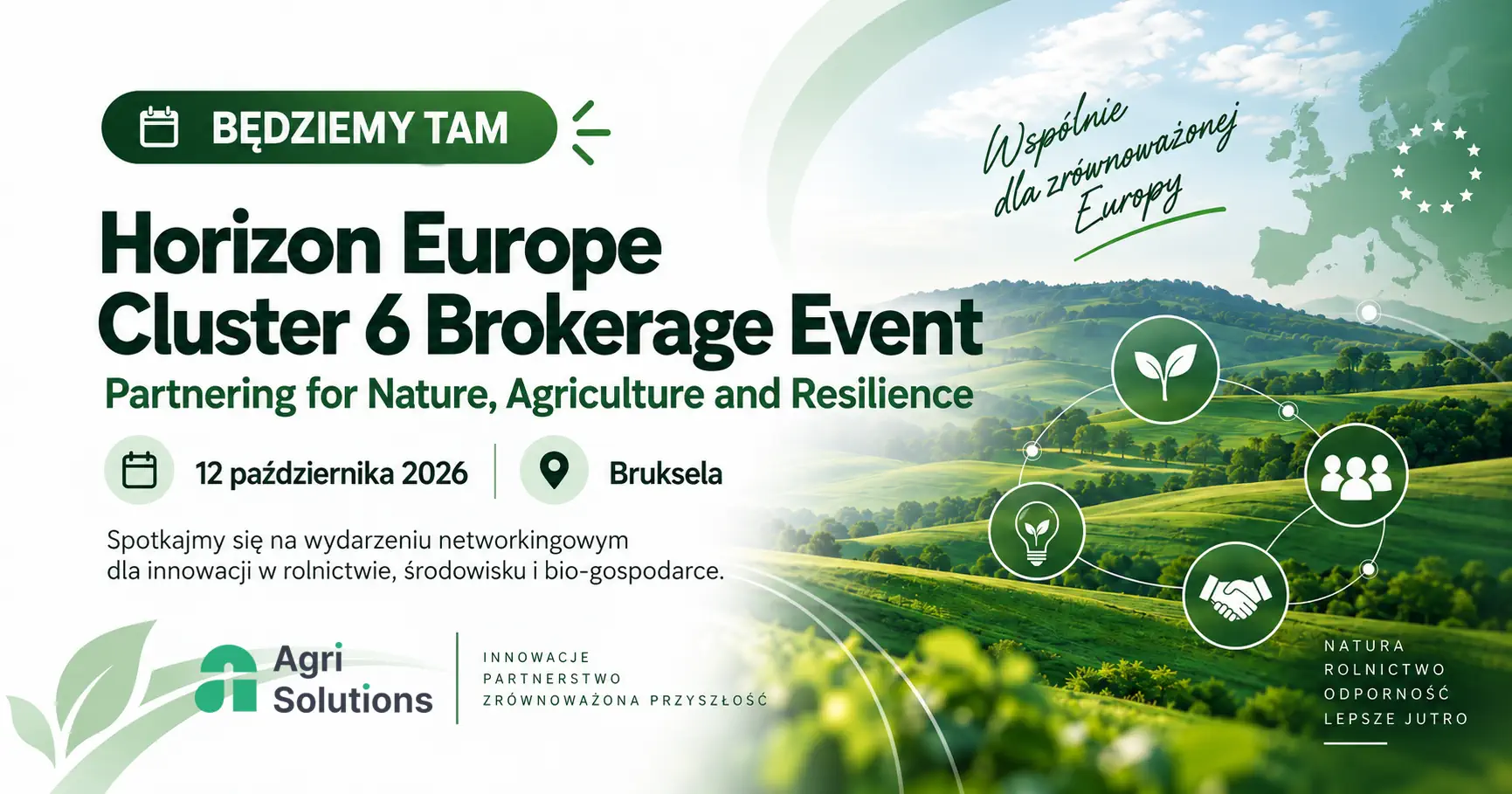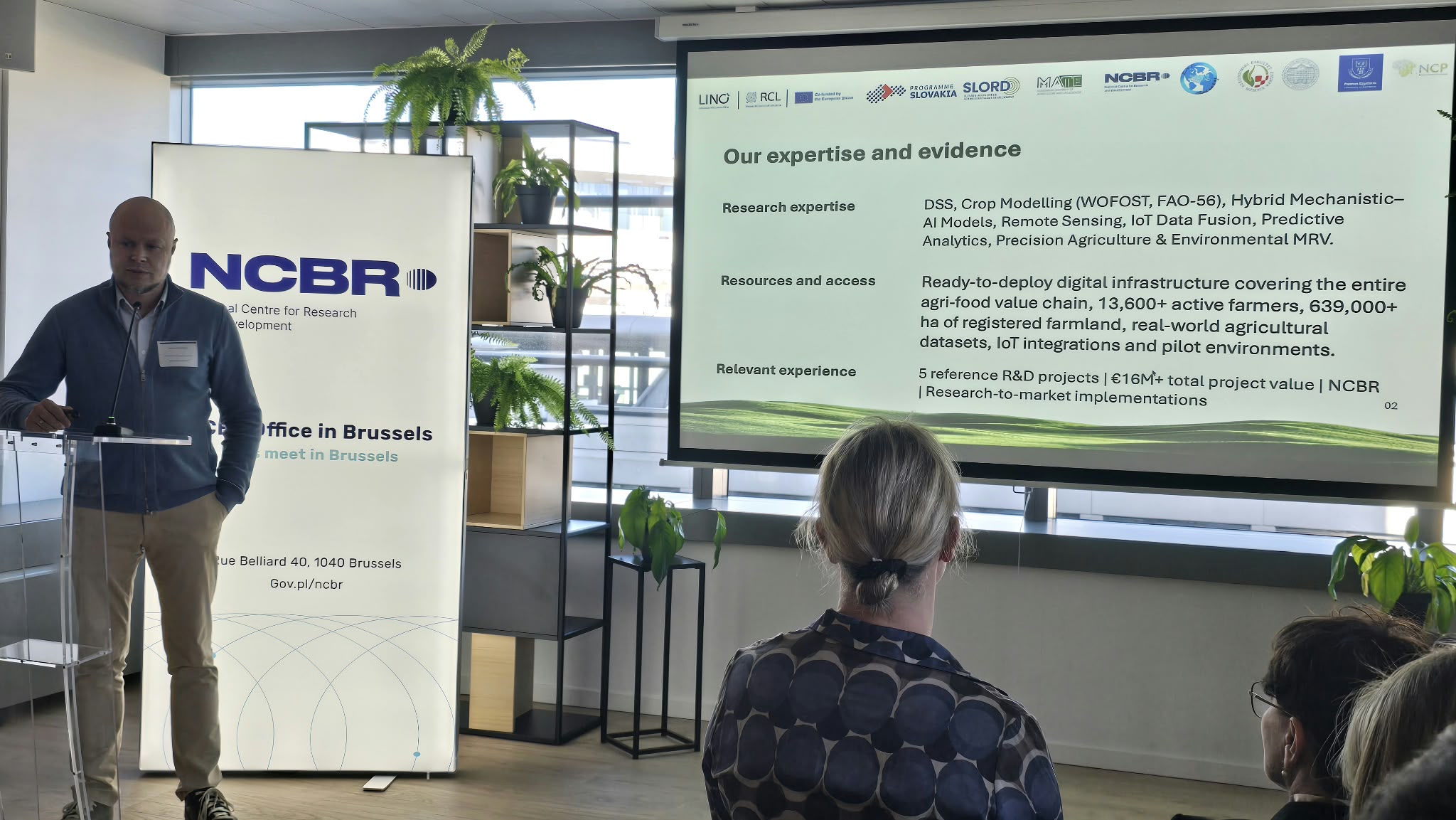
On 12 October 2026, Agri Solutions participated in the Horizon Europe Cluster 6 Brokerage Event – Partnering for Nature, Agriculture and Resilience, at the NCBR Office in Brussels. Agri Solutions develops FarmCloud, a digital platform connecting agricultural data, applications and participants across the agri-food sector. FarmCloud provides the digital foundation for agricultural research, validation and commercialisation, with project-specific development agreed with each consortium.
Data collection, device connections, user accounts and interfaces all take work. Reusing an existing platform can leave more effort for innovation. Building on our September event announcement, this article explains a possible delivery model.
Horizon Europe Cluster 6: a shared research environment
Horizon Europe Cluster 6 covers food, bioeconomy, natural resources, agriculture and environment. Consortia addressing these themes often bring together universities, research organisations, technology providers and operational users.
Their systems may use different formats, measurement conventions and device protocols. Trials across countries also need comparable observations and clear reporting responsibilities. A shared platform can organise these information flows, while partners define scientific methods and quality criteria. FarmCloud is a potential technology contribution to an individual project, rather than official Horizon Europe programme infrastructure.
FarmCloud as a digital R&D backbone
Digital infrastructure for agricultural R&D combines data acquisition, storage, integration and applications so researchers can develop and evaluate technologies in operational settings. FarmCloud offers existing components that can be extended for a research question. Our article on digital infrastructure for the agri-food sector describes the wider platform approach.
Seven principles make this useful to a consortium:
- Reuse: start with operational applications and farm records.
- Integration: connect agreed agricultural, environmental and business sources.
- Interoperability: align identifiers, units and meanings across datasets.
- Extensibility: add adapters, algorithms and interfaces for the research task.
- Validation: connect predictions with observations and practical feedback.
- Scalability: plan for additional sites, users and data volumes.
- Commercialisation: create a route into applications used beyond the project.
The starting point is a capability review: which functions already exist, which require configuration, and which need development? The FarmCloud R&D offering provides context for this discussion.
Integrating and harmonising research data
A source inventory may include weather stations, soil moisture probes, temperature sensors, agricultural machinery, FMIS and ERP systems, laboratories, satellites, drones and manual field observations. Teams should record availability, update frequency, ownership and access conditions before designing the pipeline.
FarmCloud integration can use APIs, available interfaces and dedicated adapters. Compatibility with a particular device or service requires assessment. A common data model then connects field identifiers, timestamps, units, spatial references and provenance. Harmonised information can feed models and partner reports, linking production records with environmental observations.
An environment for AI, machine learning and crop models
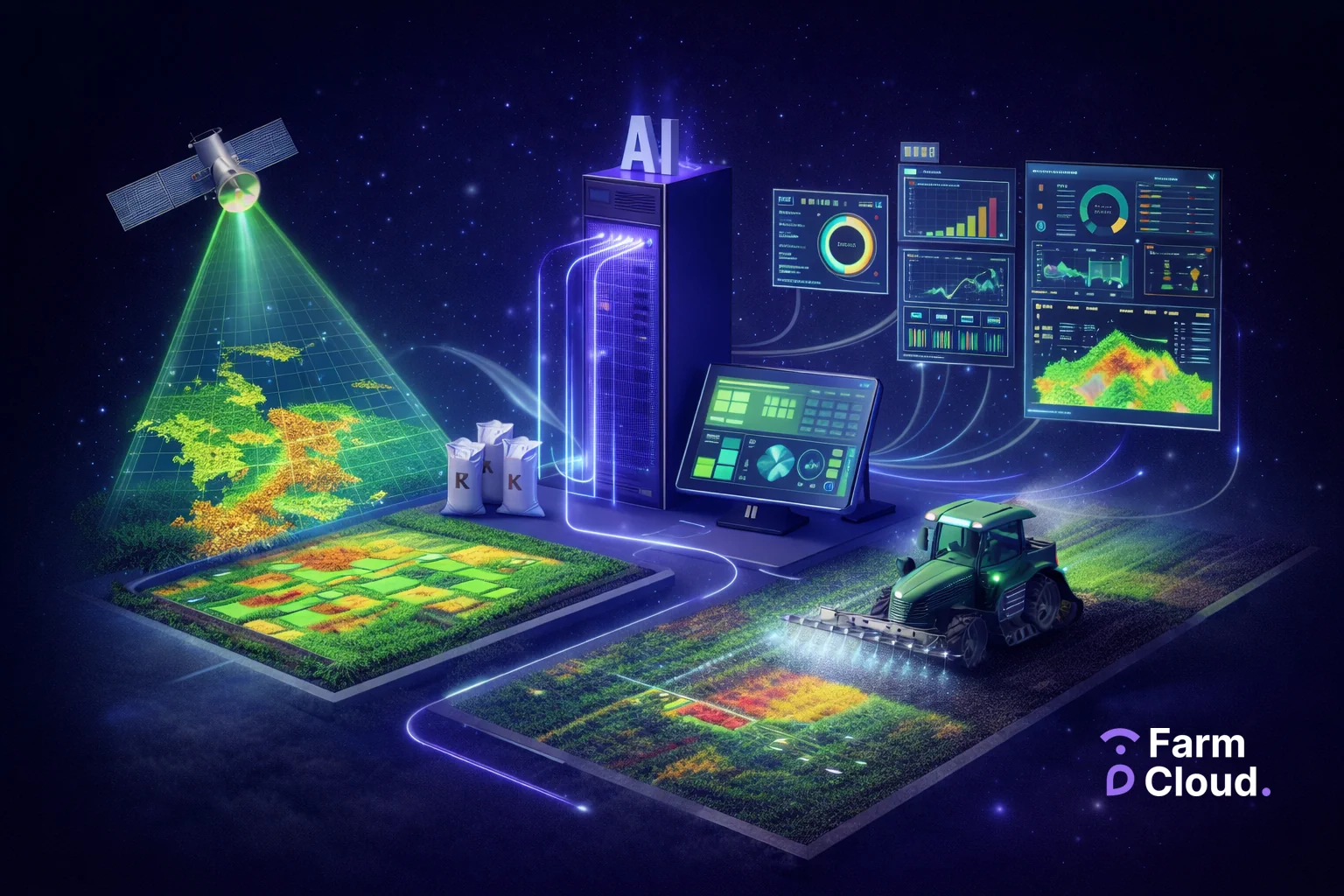
A possible workflow is data collection → validation → harmonisation → feature engineering → model development → model validation → inference → decision support → field deployment. FarmCloud contributes data access and operational interfaces. Research teams define hypotheses, training and validation datasets, algorithms and evaluation methods; model integration is a specific delivery task.
Mechanistic crop models represent biological and physical processes. WOFOST models crop production, while FAO-56 provides methods for estimating evapotranspiration and crop water requirements. Hybrid approaches can combine process knowledge with AI. Time series and geospatial datasets help evaluate performance across seasons and locations.
Potential applications include yield forecasting, disease risk, irrigation needs, plant stress and nutrient recommendations. Agri Insights provides a product context for analytics and communicating results. Selecting and calibrating a model remains project work; this architecture does not imply that every model, an experiment platform or a complete MLOps toolchain is included as standard.
Pilots, Living Labs and field validation
Historical accuracy is only part of the evidence. A model must also be assessed under different soils, weather, varieties and management practices. FarmCloud applications can support field identification, crop records, operations, measurements, observations and delivery of results through web and mobile tools.
The Agri Solutions event recap reports over 13,600 active farmers and 639,000 hectares of registered farmland. These are company-reported ecosystem figures, not a committed research cohort; the post does not specify the activity measurement period. Participation, permissions and data access must be agreed separately.
A pilot should define its baseline, observation schedule and missing-data procedures. Operational software helps organise the evidence and feedback needed to judge whether a result is useful under real farming conditions.
A reference architecture for an agricultural R&D project
The following sequence describes a possible project architecture. Research components and additional integrations are project-specific extensions, not a catalogue of ready-made modules.
- Data sources: farms, IoT sensors, weather stations, satellites, machinery, laboratories and ERP systems, subject to access agreements.
- FarmCloud data infrastructure: ingestion, APIs, harmonisation, storage, access management and operational applications, with configuration and adapters scoped for the project.
- Research and analytics: AI/ML, crop models, decision support, environmental MRV and predictive algorithms, developed or integrated as project-specific extensions.
- Validation: field pilots, Living Labs, multi-location trials, monitoring, reporting and demonstration under consortium-defined protocols.
- Exploitation: FarmPortal, FoodPass, AgroSell, Agri Insights, custom modules and commercial deployment under agreed technical and commercial terms.
Where FarmCloud fits within work packages
| Project area | FarmCloud contribution |
|---|---|
| Data collection | Connect sources and collect measurements |
| Data management | Organise, harmonise and control access to information |
| IoT and monitoring | Integrate sensors and monitor parameters |
| AI and modelling | Supply data and interfaces for research models |
| Pilots and Living Labs | Support operational activities at participating sites |
| Validation and demonstration | Record evidence for evaluating results |
| Decision support | Present model outputs in user applications |
| Exploitation and commercialisation | Offer a potential route to product deployment |
Responsibilities depend on the project and consortium agreement. Scientific methodology, software development and maintenance need explicit owners. Our discussion of R&D consortia provides further context.
Instead of developing every digital component from scratch, research consortia can build on an existing agricultural technology ecosystem.
| R&D challenge | FarmCloud contribution | Project value |
|---|---|---|
| Fragmented data | Data integration | Consistent analytical foundation |
| Multiple IoT providers | APIs and sensor adapters | Easier consolidation of measurements |
| Field validation | Farm-level applications | Operational support for pilots |
| AI model deployment | Integration with user tools | A path from model to application |
| Multiple partners | Shared platform architecture | Coordinated data flows |
| Research exploitation | Existing software ecosystem | Potential commercialisation pathway |
Data governance and deployment choices
Deployment models include SaaS and Private Service, using a private cloud or customer infrastructure, including on-premises arrangements where agreed. The decision should reflect integration requirements, control of data and the maintenance plan.
Partners must define data ownership, access roles, controlled sharing, retention and handling of sensitive farm information. GDPR requirements and research data management need to be addressed in project design and agreements. Platform selection does not replace a compliance assessment. The data management plan should also cover export, archiving and responsibilities after funding ends.
From research prototype to market-ready solution
The pathway is research → prototype → integration → field validation → demonstration → productisation → commercialisation → scale-up. An algorithm needs documentation, a usable interface, failure handling and support before it becomes a dependable service.
FarmCloud can connect these stages. Research outputs may become dedicated modules, reuse established integrations and reach users through operational applications. Existing distribution channels offer a possible route to market, subject to licensing, intellectual property and service responsibilities.
An exploitation strategy should therefore begin during proposal development. Identify the intended customer, the evidence required for technology readiness progression, and the organisation responsible for maintenance. Technology transfer, go-to-market planning and post-project sustainability require resources. Access to an ecosystem supports these activities without guaranteeing adoption or commercial success; no unverified TRL levels are assigned to individual modules.
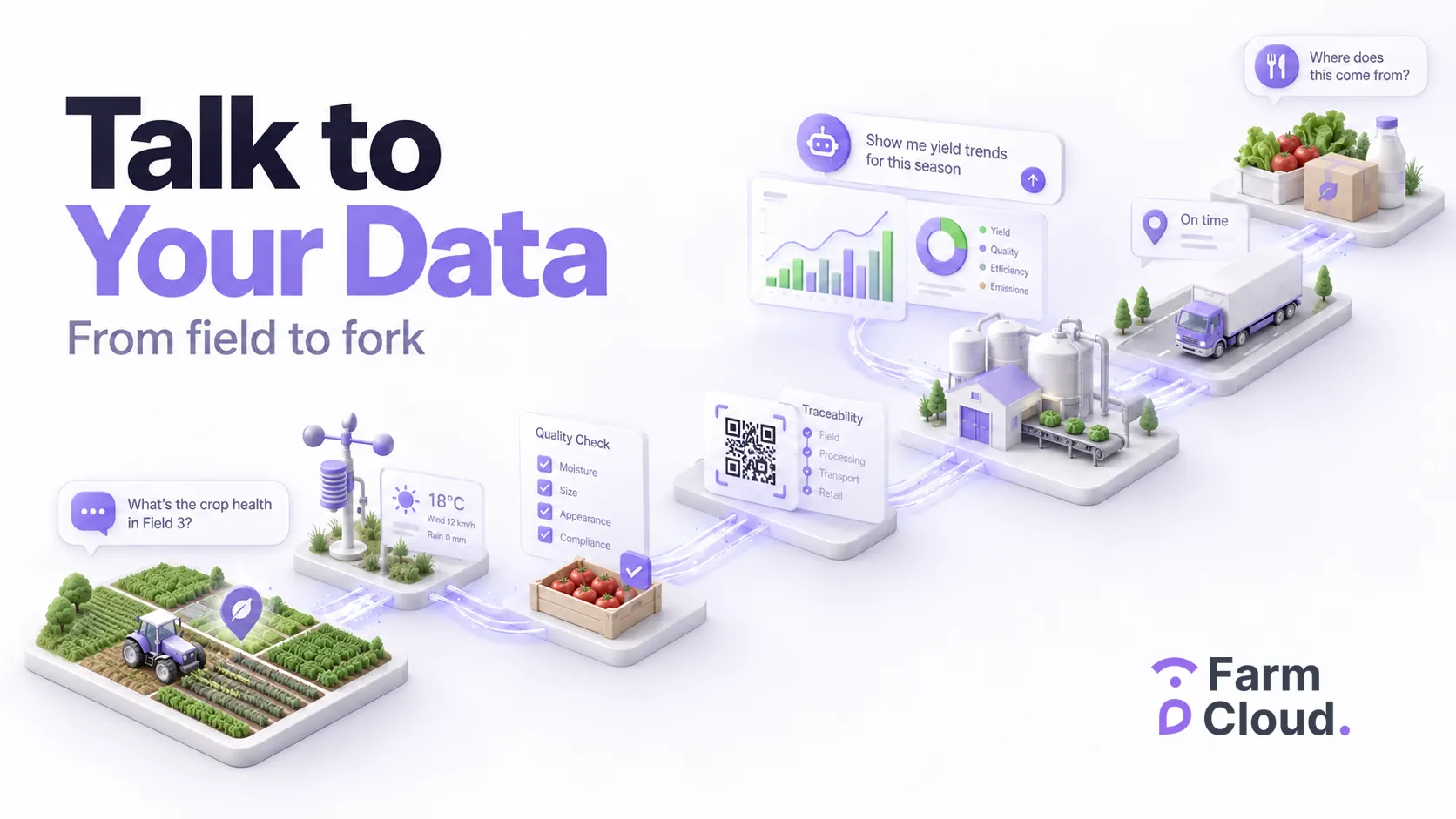
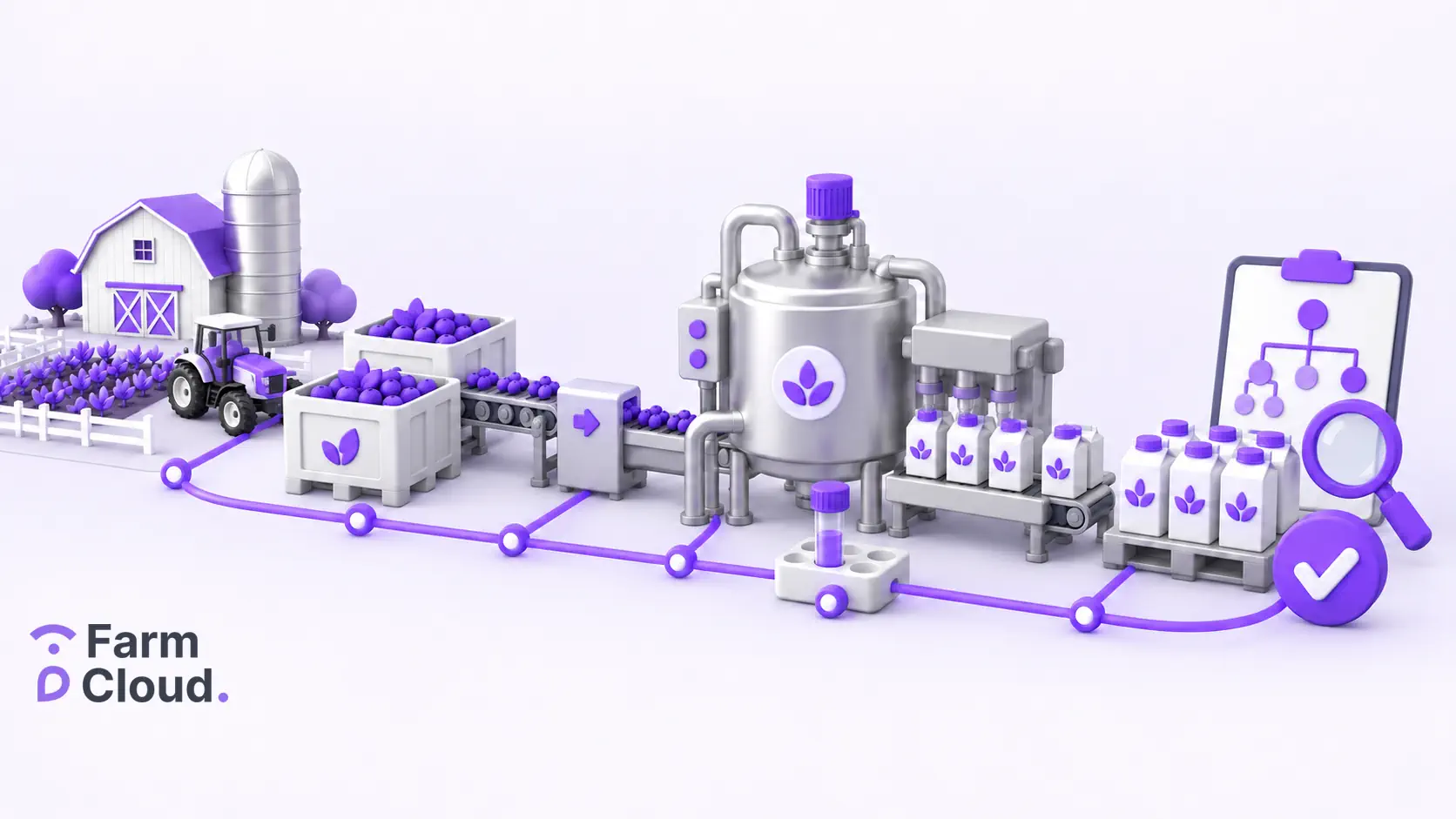
Farm-to-Fork research across the value chain
FarmPortal supports farm records; FoodPass connects producer relationships, deliveries, quality and traceability; AgroSell supports sales and commercial relationships. Agri Insights adds an analytical perspective.
Connecting farms, producers, processors, distributors and buyers enables interdisciplinary questions about traceability, environmental MRV, Scope 3 data, nutrient management, water footprints and circular bioeconomy. A project still needs appropriate calculation methods and verification procedures.
Six possible research scenarios
These are proposed applications, not completed reference deployments:
- Crop disease prediction: combine weather and crop observations through FarmCloud; develop an AI model and evaluate warning accuracy and usefulness.
- Smart irrigation: link soil moisture, irrigation records and weather to water-demand models; validate decision support against field observations.
- Satellite intelligence: connect imagery, field boundaries and ground observations; test vegetation or stress indicators across locations.
- Environmental MRV: organise crop, fertiliser and resource-use records; assess the reliability of environmental indicators and their supporting evidence.
- Farm-to-Fork traceability: link production, batches, quality and deliveries; evaluate completeness of product tracking during a pilot.
- Machinery interoperability: connect telemetry with field records using scoped adapters; assess data consistency and exchange quality.
Frequently asked questions
What is digital infrastructure for agricultural R&D?
It is a connected environment of data, integrations and applications that supports research activities, technology evaluation and sharing results with participants.
How can FarmCloud support Horizon Europe projects?
It can provide a technology foundation for data collection, pilots and demonstration. The consortium agrees which existing capabilities to use and which extensions to develop.
How can a consortium combine IoT, satellite and farm data?
Use agreed APIs and adapters with common identifiers, units and timestamps. Assess source availability and data rights before implementing the connections.
How can an existing platform accelerate agricultural R&D?
Reusing operational functions can reduce repeated implementation work and let teams focus on experiments and algorithms. The benefit depends on the integration scope.
How can research results be commercialised through FarmCloud?
Integrate them into applications or dedicated modules, supported by agreements on IP, licensing, maintenance and the business model. Adoption must still be demonstrated.
Continuing the conversation after Brussels
The brokerage event opened discussions about future research partnerships. Agri Solutions welcomes consortium coordinators, research institutes, AgTech, FoodTech and ClimateTech companies, Living Labs and innovation networks interested in a shared technology foundation.
The approach can also inform national and international demonstration projects. For Polish initiatives, see AGROSTRATEG context and the official NCBR programme materials, in Polish. Funding eligibility must be assessed against the particular call.
Planning an agricultural R&D project? Explore how FarmCloud can support data integration, research activities, pilot validation and commercialisation. Let's discuss how FarmCloud could become the digital foundation of your consortium.
Follow us!
Preview what we are doing and be inspired by positive changes.