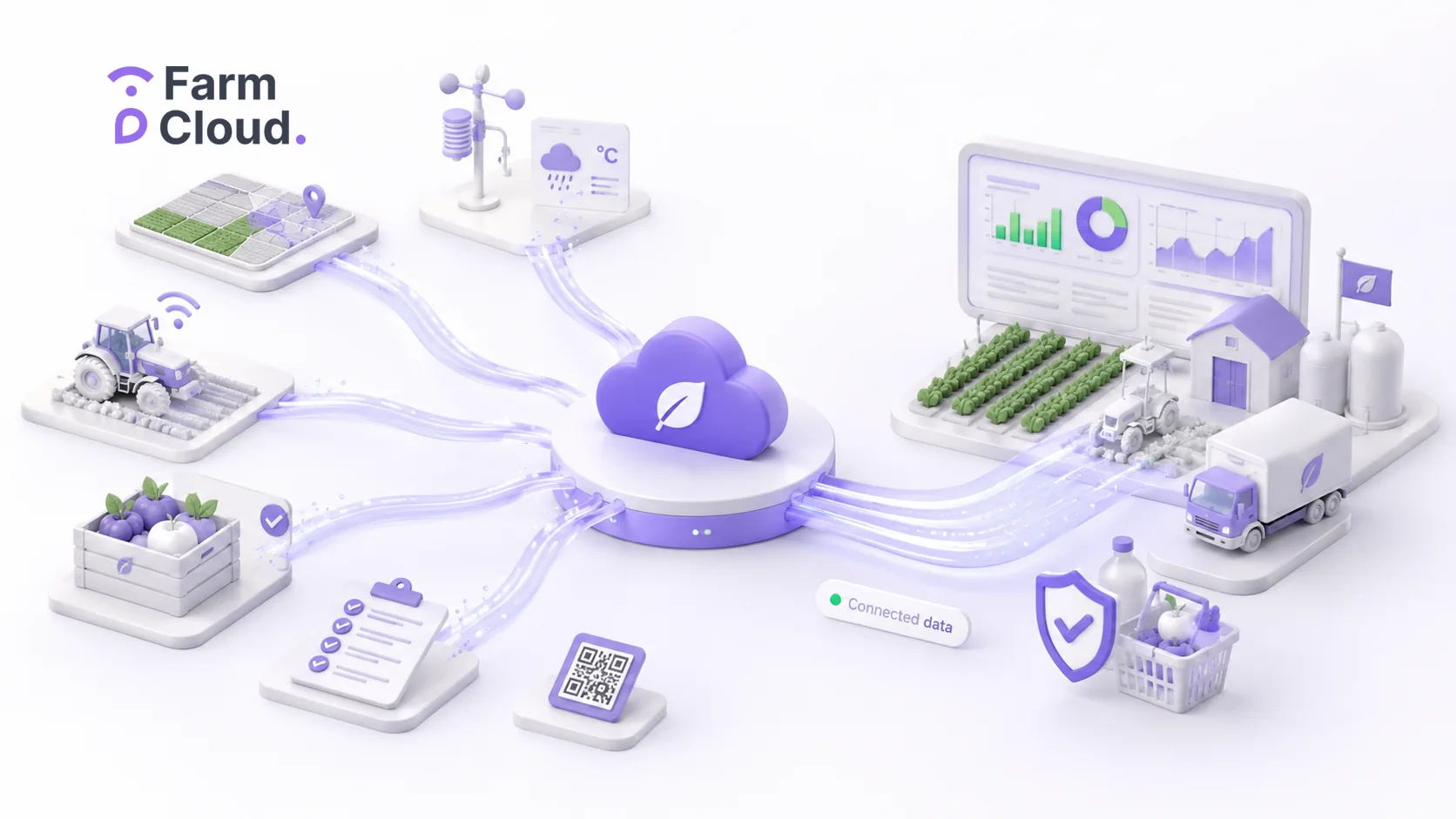
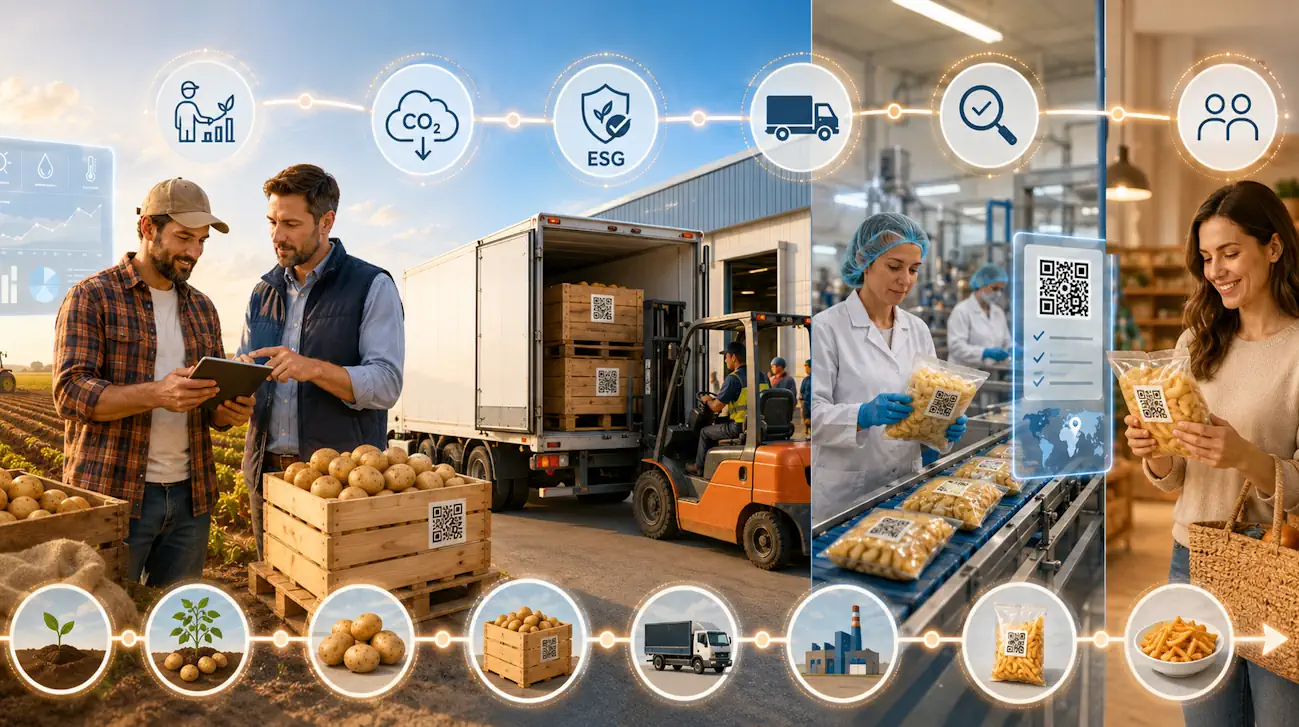
Talk to Your Data in agriculture asks a practical question: what connects crop production, delivery quality and sales performance? FarmCloud collects data across 62 processes, creating a foundation for analysing the entire field-to-fork chain. [1]
Published:
Last updated:
Author: Julian Ćmikiewicz, Digital Product Owner & Solutions Architect at Agri Solutions.
Publisher:
FarmCloud / Agri Solutions.
Julian Ćmikiewicz works on the development of Agri Solutions’ digital products for the agri-food sector.
Conversational analytics is an approach to analysis that translates a natural-language question into data retrieval or a calculation while preserving business context. Related terms include Conversational Analytics, Natural-Language Analytics and Talk to Your Data. [4]
In brief
FarmCloud connects data from agricultural production, advisory services, contracting, quality, trade and sales. The ecosystem covers 62 processes, integrations with 17 types of machinery and devices, 8 public registers and 9 specialist data and service providers. This breadth gives artificial intelligence (AI) a strong basis for cross-domain analysis. Reliable answers, however, depend on shared definitions, relationships between records and access controls. The conversational scenarios described below require separate preparation and confirmation of the implementation scope.
- FoodPass contributes delivery, lot and quality data; FarmPortal contributes field history.
- AI does not replace missing evidence.
- Forecasting and automated actions require separate implementation.
What does Talk to Your Data in agriculture mean?
A user asks about suppliers, fields or lots, and the system selects the permitted data and calculations. It can ask for clarification about the season or the definition of a metric. The answer relates to the organisation’s own information, not the model’s general knowledge. A question such as “Which suppliers had the most rejections?” can therefore be extended to: “Compare rejected weight, then show the history of the related fields.” [4]
We recommend starting a pilot by defining what counts as a rejected delivery, not by choosing the AI model. A faster wrong answer is still wrong. Conversation complements a good report rather than making it redundant.
| Task | Dashboard | Document chatbot | Conversational analytics |
|---|---|---|---|
| Monitoring | Predefined metrics | Document content | Investigation of deviations |
| New question | May require a report change | Content retrieval | Controlled calculation |
| Evidence behind the result | Definition and data | Document and version | Sources, rules and calculation |
What do the market and research show?
In 2025, AI was used by 19.95% of EU enterprises covered by the Eurostat survey, rising to 55.03% among large enterprises. The survey covered organisations with at least 10 people employed in selected sectors and excluded primary agricultural production. These are not statistics on AI adoption by farms. [2]
The 2025 JRC report on the digitalisation of agriculture was based on 1,444 respondents from 9 countries, including Poland, surveyed between June and October 2024. The authors describe data collection as still largely manual and note continued caution around data sharing. An AI interface does not remove these barriers. [3]
On 29 July 2026, Google Cloud announced the general availability of Conversational Analytics for BigQuery and its associated interface, highlighting semantics and access control. Meanwhile, the Spider 2.0 benchmark, presented at ICLR 2025, contains 632 enterprise tasks requiring work with metadata and multi-step queries. This supports the case for testing analytics on a customer’s own data; it is not a FarmCloud benchmark result or a declaration that FarmCloud uses Google technology. [4], [5]
62 processes and data beyond a single system
Agri Solutions’ own data, supplied for this article, show the breadth of the FarmCloud ecosystem as at 21 September 2026. [1]
- 62 business and operational processes
- Data sources spanning farm management, advisory services, contracting, quality, trade and sales.
- 17 types of machinery and devices
- The scope of hardware integrations, not the number of manufacturers.
- 8 external public registers
- Reference and administrative data.
- 9 external data and service providers
- Specialist sources that enrich analysis.
These figures do not represent record counts, terabytes or the resources of a single customer. A field can be linked to treatments, measurements, machinery, costs and harvests; a delivery can be linked to weight, quality, samples and settlements. The value lies in these relationships. A farm data platform does not require one physical database, but it does require coherent access to data and a shared understanding of what those data mean. We discuss this challenge in our article on connecting field history, machinery and documentation.
How do FoodPass and FarmPortal build context?
FoodPass links suppliers, contracts, deliveries, lots and quality data. FarmPortal adds the history of agricultural production. FarmCloud connects these areas with external integrations. As a result, a question about raw material can reach back to its production source rather than ending at goods receipt. This existing data foundation is the starting point; the conversational and agent-based scenarios described below are development scenarios whose implementation scope must be confirmed. [9]
FoodPass for grower collaboration and quality control also covers audits, sample workflows, testing and settlements. FarmPortal is a Farm Management System (FMS) covering fields, crops, treatments, fertilisation, machinery, employees, warehouses, harvests and costs. Weather, satellite data and the Internet of Things (IoT) add further context. [9]
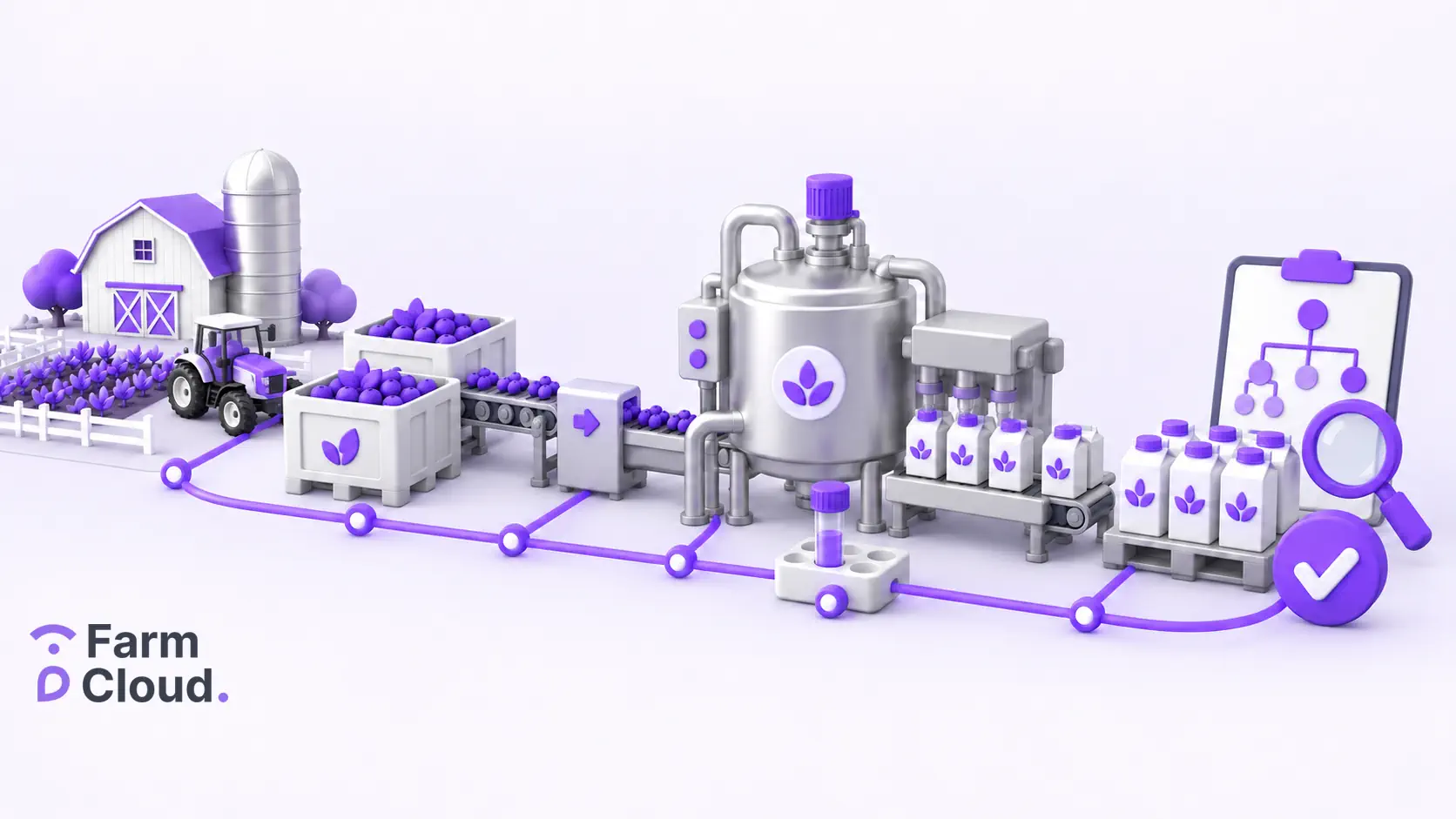
Field → crop and season → harvest → delivery → raw-material lot → product → customer and sale. One lot may be created from several deliveries, while one delivery may feed multiple lots. What is needed is a record of splits, merges and weight, not merely a shared identifier.
Integrations with Enterprise Resource Planning (ERP) and Customer Relationship Management (CRM) systems can add commercial data. Margin requires costs, discounts and allocation rules, not just price. Warehouse and production data depend on event capture and integrations; they do not appear simply because FoodPass has been deployed.
Why is a language model alone not enough?
A Large Language Model (LLM) interprets the question, but it should not define settlement rules. It needs a semantic layer: definitions of concepts, relationships, units and calculations. In FarmCloud, such a layer should distinguish between a field, a crop in a specific season, a delivery, a sample and a lot. Only then can an answer retain its business meaning. [4]
“Rejection” may mean the number of deliveries, the weight of raw material or financial deductions. “Nitrogen use” requires a distinction between kilograms of fertiliser and kilograms of nutrient per hectare. These rules should come from an approved glossary, not from an LLM’s guess.
There is also a technical trap. If one delivery in FoodPass has three samples, joining the tables may duplicate its weight across three rows. The total is wrong even though the query runs correctly. In FarmPortal data, field boundaries and the crop season require similar care. Agricultural data analytics starts with controlling these relationships.
How do you connect questions, documents and calculations?
The proposed FarmCloud architecture starts with the user’s identity, the question and the data sources they are authorised to access. It then retrieves the data, performs the calculation and checks the result. The model writes the answer only at the end. We do not recommend sending an entire database to an LLM or using a single retrieval mechanism for every task. Delivery data, a customer specification and a forecast require different tools. [4], [6], [7]
The data engine should calculate records
Text-to-SQL translates a question into a Structured Query Language (SQL) database query. For FoodPass, we recommend approved views or functions rather than unrestricted queries against production tables. An application programming interface (API) is another option. Totals and ratios should be calculated by the data engine, with filters and units clearly visible. [4], [5]
Documents provide evidence
Retrieval-Augmented Generation (RAG) enriches an answer with content retrieved from sources such as specifications stored in FoodPass. Semantic search can identify similar meanings, but a sample number requires an exact match. The document version and date must be retained. RAG does not replace aggregation across all deliveries. [6]
Forecasts need validation
Predicting the risk of under-delivery against a contract requires a separate forecasting method. In a FarmCloud project, a Machine Learning (ML) model or agronomic model could use delivery and crop-production data. We recommend testing on new seasons or farms and comparing performance with a simple baseline forecast.
Which questions create business value?
The most valuable questions connect production with quality and commercial performance. Management assesses profitability, while Research and Development (R&D) teams compare production practices. For a CTO, repeatable integrations matter. These are FarmCloud use cases that require data preparation and business rules; they are not a ready-made catalogue of conversational functions.
| Audience | Question | Data required |
|---|---|---|
| Management | Which raw-material sources generate the highest margin? | Costs, quality, yield and sales |
| Procurement and quality | Where are rejection rates and the risk of supply shortfalls increasing? | Contracts, deliveries, tests, forecasts |
| Agronomy and R&D | How does irrigation relate to yield and quality? | Water, weather, variety, treatments, harvests |
| Environmental team | Where does a product’s carbon footprint come from? | Origin, production, emission factors |
| Sales and marketing | Who buys products with documented provenance? | Lots, documentation, transactions |
| Machinery manufacturer | How can telemetry be linked to the execution of a field operation? | Device, time, field, operation |
A CTO gains reusable integrations, R&D gains a reproducible research dataset, and an adviser gains a history that links recommendations to delivery quality. Environmental analysis must disclose calculation boundaries and the versions of emission factors used. With crop-production practices, correlation does not prove causation: a rejection following heavy rainfall is a hypothesis, not a diagnosis.
From answers to action
In the proposed FarmCloud pathway, descriptive analytics identifies rejected deliveries, diagnostics compares the reasons, prediction estimates risk, and recommendations prioritise interventions. An AI agent can then use tools to carry out an approved task. These levels do not appear automatically simply because a conversational interface has been added. [4], [6]
“Prepare field inspections for farms with elevated risk and show the plan for approval” is a sensible scenario. An autonomous contract change, lot release or instruction sent to a machine requires separate permissions and approval. We also discuss this distinction in our article on moving from lot records to quality decisions. [8]
How do you verify an answer and protect the data?
An answer should identify its sources, period, filters, metric definition, unit, completeness and freshness. Data lineage describes the origin and transformations of data. In FoodPass analysis, delivery identifiers and the calculation version are needed; in FarmPortal, the crop season and spatial scope also matter. The user should be able to reproduce the result, not inspect the model’s internal reasoning. [4], [6]
The absence of a recorded treatment does not prove that no treatment took place. A null value is not zero. The system must be able to identify missing data. Completeness should not be confused with forecast accuracy: that should be assessed by error on test data, not by an LLM’s declared “confidence”.
Permissions should be enforced before data are passed to the model. Microsoft describes a document-filtering pattern for Azure AI Search. In a FarmCloud project, controls should cover the organisation, role, farm, rows and documents, as well as conversation history, exports and cache. A prompt is not a security control. [7]
OWASP warns about prompt injection: malicious or misleading instructions can also arrive through a supplier document. We recommend minimal tool permissions, validation and approval for high-risk actions. Data retention, processing and use for model training must be agreed separately; the model itself does not determine those rules. [8]
Model example: strawberry rejections at a processing plant
This model example was prepared for the purposes of the article. The figures illustrate the process and must be verified before being used as the result of a real implementation.
Consider a processing plant working with 60 growers and 180 fields. Over eight weeks, it assesses 1,200 deliveries with a total weight of 8,000 tonnes. The procurement manager wants to prioritise adviser visits, but two departments produce different supplier rankings. The FarmCloud scenario combines weights, statuses and rejection reasons from FoodPass with field histories from FarmPortal.
| Supplier | Rejected / all deliveries | Share by number | Rejected / total weight | Share by weight |
|---|---|---|---|---|
| A | 12 / 100 | 12% | 30 t / 500 t | 6% |
| B | 16 / 200 | 8% | 288 t / 2,400 t | 12% |
By share of rejected deliveries, A performs worse. By share of rejected weight, B performs worse. That is arithmetic, not an AI opinion. The system should show both metrics and relate the priority to the purpose of the decision.
Now assume that 1,080 deliveries have a confirmed link to fields and 120 do not. Coverage is 90%. All 1,200 deliveries can be included in the quality ranking, but any analysis of crop treatments should be limited to the linked subset. The missing 10% may change the interpretation.
The outcome of the scenario is an agreed basis for prioritisation and a list of data gaps, not a proven saving. The next questions concern the reasons for non-conformities, varieties and harvest conditions. Weather remains a hypothesis to investigate, not an automatically established cause.
How should you start a pilot, and when should you postpone it?
We recommend starting with one process, such as delivery rejections in FoodPass, with a business owner and verifiable reference answers. Assess the convenience of conversation only after correctness has been established. If a delivery cannot be linked to a test result, fix the data first. A model cannot reconstruct a missing identifier from a persuasive description. This limitation should be included in acceptance criteria. [6]
- Agree the questions, metric and decision.
- Check identifiers, units, versions and access.
- Enable read access with query cost and time limits.
- Test calculations and refusal behaviour when data are missing.
- Only then consider forecasting and automated actions.
Proposed test: 50 questions, including 30 calculation questions, 10 document questions and 10 that should trigger refusal or a request for clarification. This is a proposal, not a FarmCloud benchmark. Measure accuracy, time to an accepted answer, cost and reproducibility; repeat the tests after changing the model. [6]
For a fixed metric, a dashboard may be sufficient. If data rights are unclear, units are mixed or lot provenance is unknown, conversation will not solve the underlying problem. In R&D, it is also necessary to prevent information from the future leaking into the training data for a forecasting model.
Frequently asked questions
How is Talk to Your Data in agriculture different from a standard chatbot?
Talk to Your Data in agriculture grounds the conversation in farm and enterprise data. A chatbot may answer from general knowledge or documents, whereas conversational analytics should also be able to run controlled calculations. In the FarmCloud scenario, a question about rejections requires FoodPass data, a metric definition and permissions, not a general description of strawberry quality. [4]
Are all of the AI functions described already available in FarmCloud?
The article distinguishes FarmCloud’s existing process and integration foundation from conversational, predictive and agent-based scenarios. It does not claim that every customer already has access to all of these functions. The scope of conversational access to data must be confirmed within a project, together with data sources, metric definitions, the permission model and acceptance criteria for answers.
What data does a processor need for the first analysis?
For a pilot focused on rejection analysis, we propose the delivery identifier, supplier, date, weight, quality status and reason for the decision. FoodPass structures this context. A link to the field and season in FarmPortal is needed when the question concerns agricultural production. If that link is missing, it should be shown as missing rather than inferred from the grower’s name.
Does the integration cover every machine and every customer system?
No. The figure of 17 refers to types of integrated machinery and devices, not every make and model. For a specific machine, the available interface, format, identifiers, data frequency and rights to use the data must be checked. Similarly, ERP or CRM integration requires agreement on how transactions and counterparties map to objects in FarmCloud. [1]
What determines the cost of implementing conversational analytics?
Project cost should be assessed against the scope of questions, data availability, integrations, business rules, security and ongoing test maintenance. Model usage alone does not describe the full effort. For FarmCloud, we recommend pricing a specific pilot, such as rejection control in FoodPass, and measuring the cost of a correct answer rather than valuing the project by the number of conversations.
Does AI in farm management replace an agronomist?
In the proposed use case, AI in farm management supports the agronomist by bringing together field history, weather, treatments and harvest quality. It does not replace field observation or responsibility for an agronomic recommendation. FarmPortal supplies the context for advisory work; a model can organise hypotheses, but a decline in a crop-condition indicator alone does not establish disease or nutrient deficiency.
Can one customer see another farm’s data?
A FarmCloud analytics implementation should preserve separation between organisations and access based on agreed permissions. A technical connection does not constitute consent for unrestricted data sharing. Restrictions must also be enforced when retrieving documents, using conversation history and exporting answers. The conditions for using data to train models should be agreed separately in the contract and configuration. [7], [8]
How can R&D use the data without confusing correlation with causation?
An R&D team can compare FarmPortal harvest data with quality results in FoodPass while controlling for season, variety and production conditions. Any observed relationship is a starting point for a hypothesis. The proposed project should retain the dataset version, describe exclusions and plan validation on new data or through an experiment before making a causal recommendation.
Glossary
- Conversational analytics
- Asking questions of data in natural language, for example about FoodPass delivery quality.
- Semantic layer
- Definitions and rules, for example how a rejection rate by weight is calculated.
- Text-to-SQL
- Translating a question into a controlled database query.
- RAG
- Enriching an answer with source material, for example a customer specification.
- Data lineage
- A record of sources and transformations needed to reproduce a result.
- Traceability
- The ability to identify the origin and onward journey of a raw material or product.
- IoT
- Devices that transmit measurements, for example data describing crop-growing conditions.
- AI agent
- A system that carries out tasks through tools within defined permissions.
Working definitions for use in FarmCloud, based on [4], [6]–[9].
Talk to the data, not an illusion of it
FarmCloud’s 62 processes and integrations covering 17 types of devices, 8 registers and 9 providers create a foundation for food supply chain data analytics from field to sale. We refer to this direction internally as Conversational Agriculture Intelligence. Talk to Your Data is the interface; underneath it sit definitions, calculations and access control. [1]
Bring a question that currently requires data from several departments, a sample dataset and a definition of the metric. That is the starting point for a pilot in the FarmCloud ecosystem for agriculture, food processing and trade. The future may be a conversation with the entire supply chain. Not instead of evidence. Because of it.
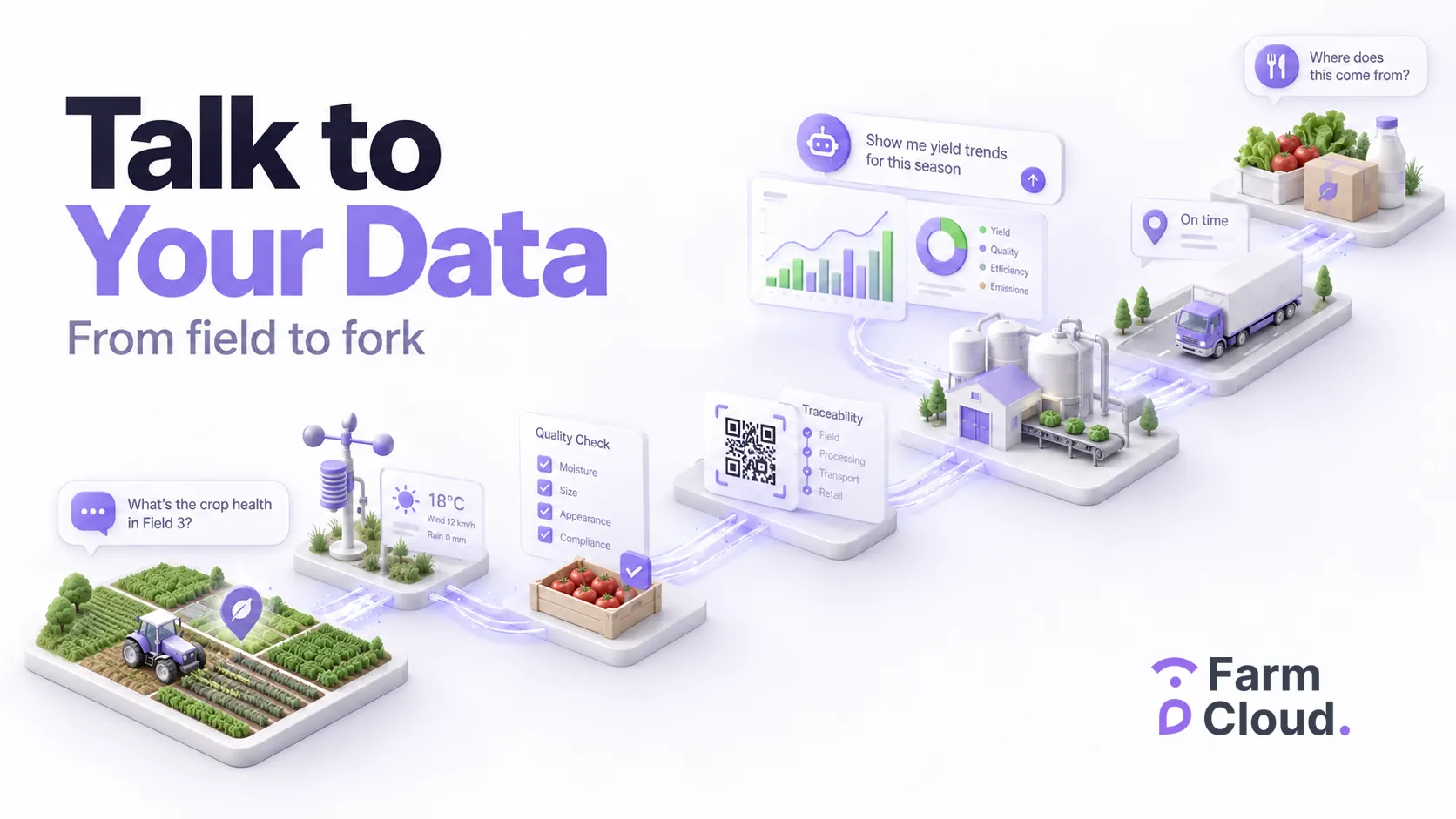
Main image
Sources and data currency
Information current as at 21 September 2026. FarmCloud figures are Agri Solutions’ own data, while the processing-plant scenario and pilot test are model examples.
- Agri Solutions, internal data supplied for this article: 62 processes and integrations covering 17 / 8 / 9; September 2026.
- Eurostat, Use of artificial intelligence in enterprises, data for 2025; isoc_eb_ai.
- Tur Cardona J. et al., JRC, The state of digitalisation in EU agriculture: Insights from farm surveys, 2025; JRC141259.
- Google Cloud: Chat with your data from anywhere: Announcing Google’s Conversational Analytics API, 26 August 2025; Bringing Conversational Analytics to your entire data ecosystem, 29 July 2026.
- Lei F. et al., Spider 2.0: Evaluating Language Models on Real-World Enterprise Text-to-SQL Workflows, ICLR 2025; arXiv:2411.07763v2.
- Microsoft, Design and develop a RAG solution, updated 30 June 2026.
- Microsoft, Document-level access control in Azure AI Search, accessed 21 September 2026.
- OWASP, LLM01:2025 Prompt Injection, 2025.
- Agri Solutions / FarmCloud, FoodPass, FarmPortal, integration descriptions and related articles; accessed 21 September 2026.
Follow us!
Preview what we are doing and be inspired by positive changes.