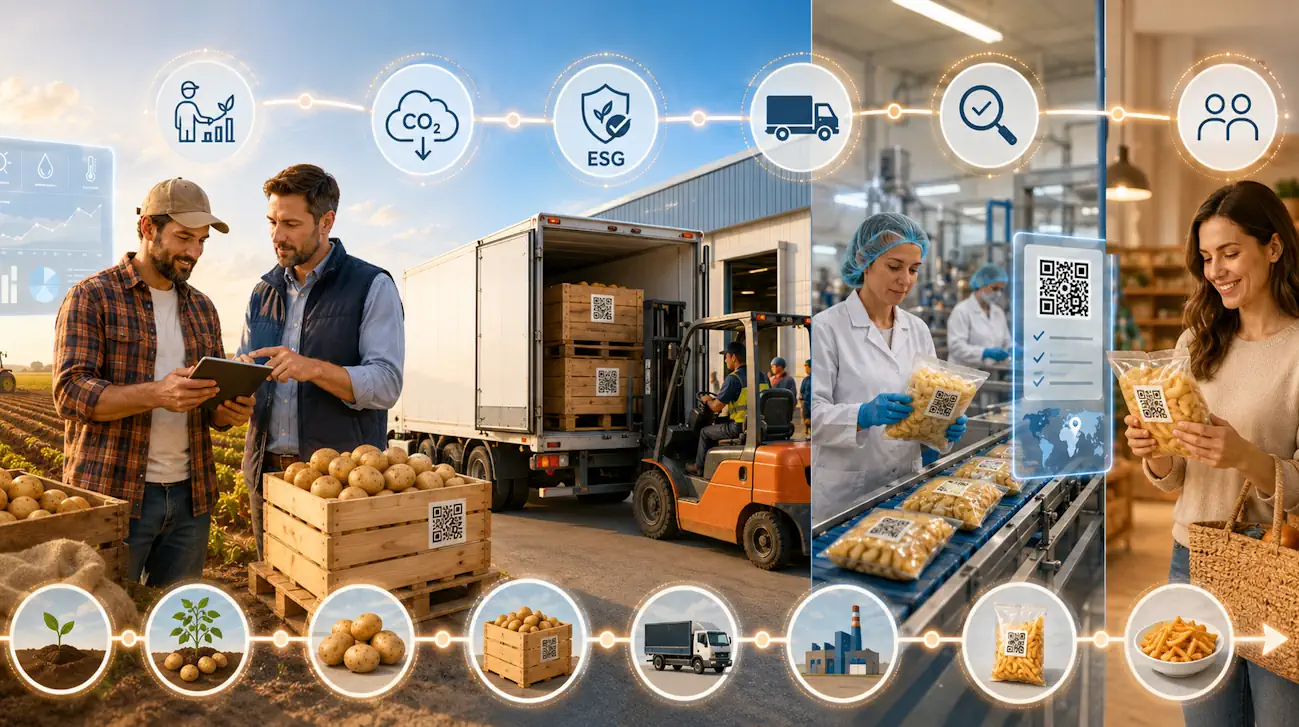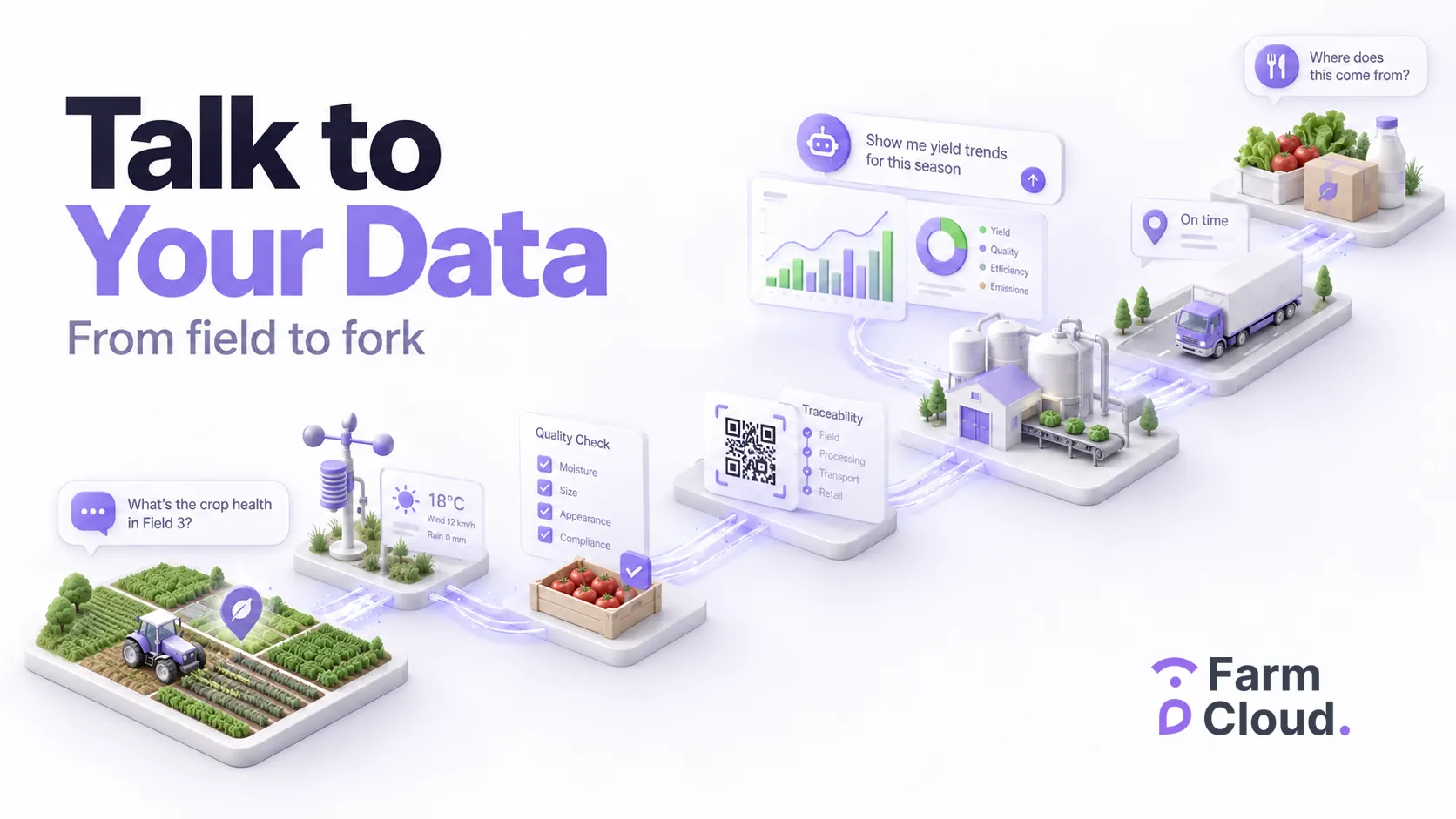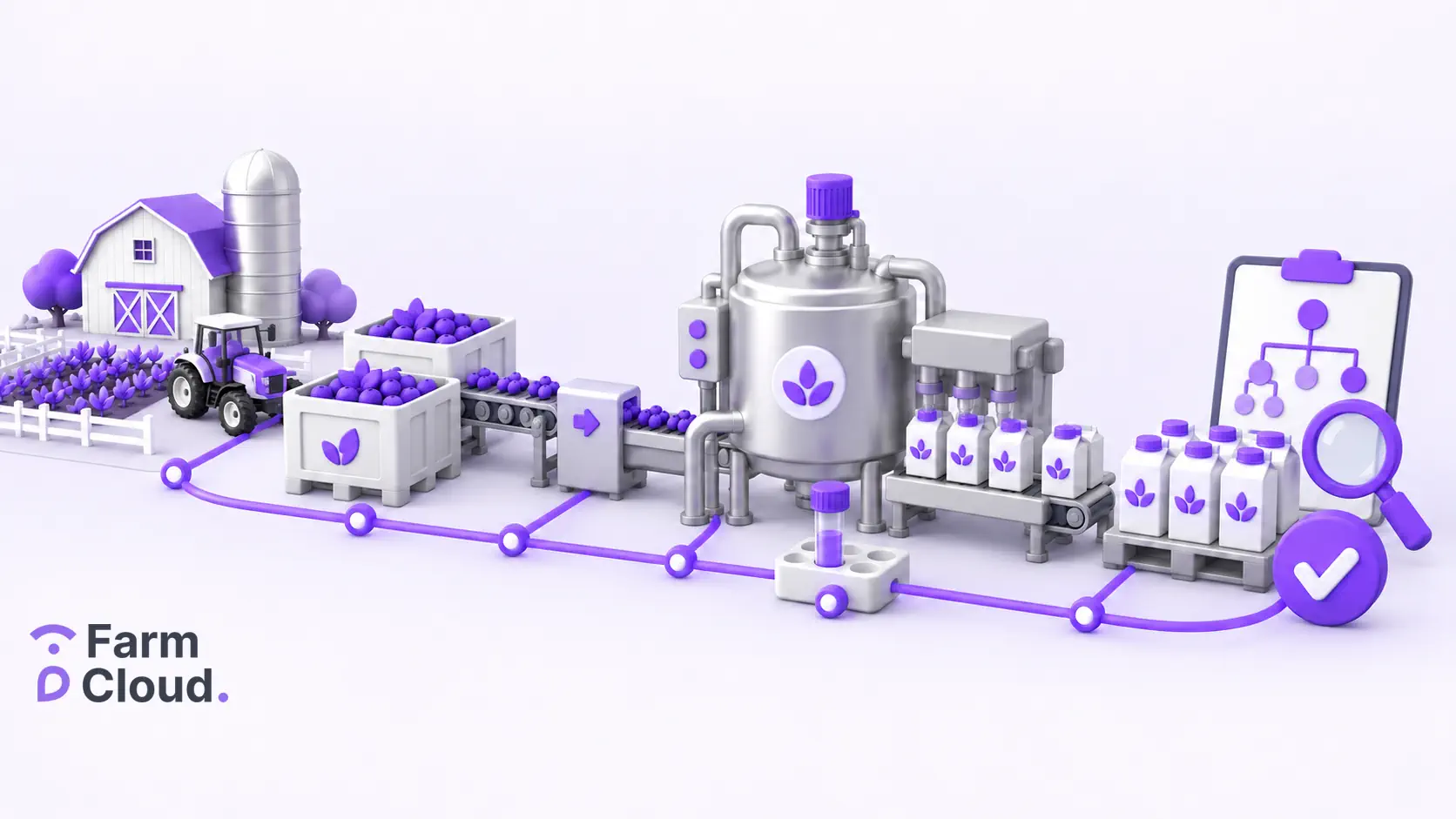
A good system goes beyond asking ‘what happened?’. It helps explain a non-conformity, establish its scope and document the response.
About the author: Kamil Korne develops Agri Solutions’ digital products for the agri-food sector.
10,490 notifications were exchanged through the EU’s Alert and Cooperation Network in 2025, an increase of 11% on the previous year. Of the 1,572 notifications concerning fruit and vegetables, 67% involved a potential health risk. The European Commission’s 2025 ACN report illustrates the volume of signals requiring prompt assessment. It does not establish the number of confirmed incidents, the quality of companies’ systems or the effectiveness of intelligent food traceability.
Intelligent food traceability is a system for managing data and responses that links batch origins to quality events, detects inconsistencies, identifies possible causes and records the company’s actions. It is not a formal legal category.
This article at a glance
Intelligent traceability turns a digital batch passport into an operational tool. It connects data from fields, deliveries, warehouses, production, laboratories and distribution, then checks their completeness and consistency. When a deviation occurs, the system does not pass judgement. It narrows the investigation, ranks hypotheses and initiates a controlled decision-making workflow. The person responsible for the decision can see the evidence, the deadline for action and a change history that the auditor does not have to reconstruct.
- A batch register answers ‘what?’, but does not explain the cause.
- Consistent identifiers and rules must come before artificial intelligence (AI) models.
- An analytical finding is a hypothesis for the quality team, not an automatic verdict.
- A system should be judged by the time taken to reach a verified decision and how precisely it identifies the stock to place on hold.
From a batch register to an active system
A traditional register stores the batch number, supplier, date and customer, but waits for a member of staff to ask a question. An active system checks the sequence of events, mass balance, sample assignment and whether the hold covers every product derived from the affected material.
Traceability that only starts when someone opens a ring binder or spreadsheet is an archive, not a safety system. Its quality depends on how quickly the team can move from a signal to a verified assessment of what is at risk.
| Area | Passive register | Active system | Operational value |
|---|---|---|---|
| Data quality | Errors emerge during an audit or incident | Validation of records and relationships | Corrections before goods move further through the chain |
| Analysis | Manual reconciliation of multiple sources | A graph of batches, deliveries, samples and processes | Faster trace-back and trace-forward |
| Cause | A description of the outcome | Hypotheses supported by data | A more focused investigation |
| Response | A phone call, email and separate note | A task, owner, deadline and evidence | A complete audit trail |
Why is batch history alone not enough?
A non-conformity rarely fits within a single record. A sample may have been taken at intake, the raw material may combine several deliveries, and the finished product may have gone through several splits. Numbers without relationships between them create a false sense of control. The screen then fails to reflect the actual flow of material through the plant.
Article 18 of Regulation (EC) No 178/2002 requires traceability at all stages and identification of the immediate supplier and business customer. Article 19 requires operators to initiate withdrawal and notify the competent authority immediately if they have reason to believe that food does not meet food safety requirements and has left their immediate control. The current consolidated text of Regulation 178/2002 does not prescribe a technology or full internal batch genealogy. That more detailed relationship determines whether a hold covers 12 pallets or an entire shift’s output.
How does intelligent food traceability work?
It works in six steps: identify the object, record the event, validate the data, build the relationships, assess the signal and initiate a response. Each step leaves a record so that the quality team understands the basis for action. Without it, an alert is simply a signal with no stated rationale and no one in the quality team assigned to respond.
- Identification. The supplier, field, delivery, raw material batch, sample, production batch, logistics unit and customer are assigned unambiguous identifiers.
- Events. The system records receipt, sampling, transformation, merging, splitting, repacking, dispatch, returns and quality decisions.
- Validation. Rules check completeness, chronological order, permissions, duplicates, code consistency and quantity reconciliation.
- Genealogy. Relationships form a graph that can be followed back to the field and forwards to the customer.
- Assessment. Rules and analytical models rank deviations by risk and identify the data that need checking.
- Response. Depending on its configuration, FoodPass can link a hold, task, owner and decision outcome to a specific batch.
The 2025 ACN report describes TraceMap, launched for supervisory authorities in early 2026. According to the Commission, it is intended to connect data and help detect weak signals. It is not an equivalent of FoodPass. Our editorial interpretation is limited to the broader trend: data analysis is supplementing record searches.
How does the system detect an error and investigate the cause of a non-conformity?
It starts with simple rules, then moves on to pattern analysis. A missing sample identifier, a negative mass balance or the dispatch of a batch on hold does not require artificial intelligence. Statistical models are useful when the signal is less obvious: an unusual combination of supplier, harvest timing, temperature, quality parameters and complaint history.
| Signal | Possible cause | What to check | Initial response |
|---|---|---|---|
| Out-of-specification result | A delivery, crop treatment, sample or assignment error | The sample–delivery–field chain and laboratory report | Place derived products on hold pending assessment |
| Mass balance discrepancy | An unrecorded transfer or return, or an incorrect unit | Weight records, unit conversions and warehouse operations | Prevent the batch from being closed |
| A gap in temperature records | A missing reading, sensor failure or break in the cold chain | Telemetry, stationary periods and transport records | Assign a task to quality and logistics |
| Recurring complaints | A shared field, supplier, line or shift | Common nodes in the batch genealogy and process characteristics | An audit focused on the hypothesis |
What does research tell us about automated diagnosis?
In ‘A Machine Learning-Based Anomaly Detection Method and Blockchain-Based Secure Protection Technology in Collaborative Food Supply Chain’ (International Journal of e-Collaboration, 2023, DOI: 10.4018/IJeC.315789), Chen, Chen and Li described two separate tests: Random Forest applied to synthetic BankSim transactions, and a Long Short-Term Memory (LSTM) network applied to engine data containing anomalies.
The reported recall values were 0.866, 0.882 and 0.9768. This was not a test of a real food supply chain, and the study did not include causal analysis. The results support early warning systems, not autonomous diagnosis.
An analysis of the causes of non-conformities must not be presented as proof of causation. The system should show the rule, input data, related batches, missing information and confidence level. An authorised person decides whether to release, hold or withdraw the batch under the food safety procedure.
What data does the system need?
The minimum model should cover who, what, when, where, how much and why. For a fruit or vegetable delivery, this means at least the supplier, farm and field, crop, harvest date, delivery number, weight, intake location, sample, inspection result, decision and subsequent use of the raw material.
The voluntary GS1 Global Traceability Standard 2.0 (2017) and the EPCIS 2.0.1 event data exchange standard (1 July 2025) provide a framework for interoperability: Critical Tracking Events (CTEs) are described by Key Data Elements (KDEs). A Global Trade Item Number (GTIN) or pallet code does not create genealogy without relationships between events, objects and locations.
Data should identify their source. An operator entry, ERP import, sensor reading and laboratory document carry different levels of reliability. Without a source, timestamp and change history, an alert cannot be explained.
FoodPass as an active traceability layer
FoodPass brings structure to farm-to-fork traceability: supplier profiles, deliveries, samples, test results, quality decisions and audits. FarmPortal contributes field, crop, treatment, observation and grower documentation data.
FarmCloud acts as the integration layer. Depending on the deployment, it can connect FoodPass and FarmPortal with an enterprise resource planning (ERP) system, warehouse management system (WMS), laboratory information management system (LIMS), weighing equipment or telemetry.
In a suitably configured deployment, a rule can detect a missing result, invalid certificate or mass balance error, and an alert can create a task with an owner and deadline. A hold in FoodPass will only prevent goods from physically leaving the site once it is integrated with the ERP or WMS that enforces it; the scope depends on the data, permissions and agreed configuration.
This model builds on the farm-to-fork strategy. Field data help narrow down the cause before the problem affects further batches.
Benefits for teams and partners
The system structures decisions across the company: quality assesses the signal, procurement sees what is missing, logistics knows which stock is on hold, and management measures response times.
- Processors: narrow trace-back and trace-forward to specific deliveries, processes and dispatches.
- Suppliers or growers: receive a question about a specific field, treatment, document or sample.
- Agronomists and advisers: see patterns of problems in relation to the crop, weather and observation history.
- Sales and customer service: communicate the scope of an incident using a verified batch list.
- Agricultural input distributors: link documents, samples and complaints to a delivery batch and corrective action.
- Agri-food marketing teams: use approved data without turning a hypothesis into a consumer claim.
- Machinery manufacturers: provide agreed service records and operating parameters for an incident audit.
- Management: monitor time to decision, the proportion of complete batch genealogies and the number of open corrective actions.
A model scenario at a frozen fruit processing plant
This model example was developed for the article based on the processes used by FoodPass and FarmPortal users. The figures illustrate the process and must be verified before being used as results from an actual deployment.
The model raspberry processing plant works with 92 growers, covers 164 fields and receives 1,780 deliveries totalling 7,200 t. After 48 hours, a test result for a hypothetical substance S is 0.018 mg/kg against an internal limit of 0.010 mg/kg. The raw material has been combined with another delivery and split into several finished product batches.
In the passive scenario, the quality team reconciles the weighbridge record, intake spreadsheet, laboratory email, process sheet and dispatch data. A missing transfer relationship leads to 48 pallets from five batches being placed on hold. Verification takes 3 hours and 45 minutes.
In the active scenario, the result is assigned to the sample and delivery. The graph identifies two batches and 16 pallets, and the missing transfer was detected when the data were entered. A suitably configured FoodPass deployment initiates a hold and a task for the quality team. The scope is verified after 29 minutes.
| Metric | Passive approach | Active approach | Interpretation |
|---|---|---|---|
| Time to verify the scope | 3 hours 45 minutes | 29 minutes | A model result, not a deployment guarantee |
| Pallets placed on hold | 48 | 16 | The difference comes from complete batch genealogy |
| Systems or files opened manually | 5 | 1 | A single interface does not remove the need for verification |
| Documented response steps | 2 | 6 | Each step has an owner and timestamp |
The algorithm did not ‘save’ 32 pallets. The difference came from relationships, validation and a single response workflow. Incorrect data can still lead to the wrong hypothesis.
Implementing intelligent traceability without a multi-year project
Start with one raw material, one plant and one scenario, such as an out-of-specification result. The pilot is not intended to digitise everything. It should demonstrate that the team can move from a signal to a verified decision within an agreed time.
- Map the physical flow and the points where batches are merged, split, repacked or returned.
- Define identifiers, CTEs, required KDEs and the owner of each record.
- Link the delivery, sample, result, decision and derived products in a single genealogy model.
- Introduce five to ten high-value rules before training an anomaly detection model.
- Assign alerts a risk level, responsible person, deadline and permitted decisions.
- Run a mock withdrawal exercise covering both trace-back and trace-forward, and measure time, completeness and the scope of the hold.
- Only add risk scoring and recurring pattern analysis once the data are stable.
Measure the time taken to verify the scope, genealogy completeness, inconsistencies detected before dispatch, false alarms and time to close actions. A fall in alert numbers alone proves nothing: the process may have improved, or a rule may have been silenced.
The limitations of intelligent traceability
The system will fail if its model does not reflect the physical flow. A pallet code cannot fix an unrecorded mixing operation, and a dashboard cannot recreate a missing document. Automation can also spread an incorrect assumption.
Common implementation mistakes
- AI before reliable data. The model looks for patterns among duplicates, gaps and changing batch definitions.
- No support for transformations. The system records receipt and dispatch but loses track of merges, splits and returns.
- Alerts without action. Notifications have no owner, deadline or closure criteria.
- No version control. A corrected record overwrites the history, preventing the auditor from reconstructing the decision.
- Unclear accountability. The algorithm makes a suggestion, but nobody formally approves the hold or release.
The system does not replace Hazard Analysis and Critical Control Points (HACCP), the requirements of IFS Food and BRCGS Food Safety, or the procedures implemented to meet them. Its role is to link evidence to a batch and document the response. If there is no agreed batch definition or decision-making procedure, these must be the starting point.
Frequently asked questions about intelligent traceability
What is intelligent food traceability?
It combines batch genealogy, data quality checks, deviation detection and response workflows. The system tracks raw materials and derived products, checks that events are consistent, identifies possible sources of a problem and records decisions. It does not replace a quality specialist; it provides structured evidence and a list of points that need verification.
How does traceability differ from a digital batch passport?
Traceability is the process of retracing a product’s journey backwards and forwards. A digital batch passport is a structured set of data on origins, events, quality and documents. The passport only becomes operationally useful when it preserves the relationships between transformations and can trigger a hold, task or check.
Does this type of system replace HACCP, IFS or BRCGS?
No. HACCP sets out hazard analysis and control points, while audit standards define requirements for processes and evidence. Intelligent traceability links the execution of those processes to the product batch. It can flag a missing check, bring documents together and show the response history, but responsibility remains with the business.
What data should be collected first?
Start with identifiers for the supplier, field, delivery, raw material batch, sample, production batch and dispatch, along with records of merging and splitting events. Every record should have a timestamp, location and author or source system. In a pilot, it is better to collect fewer data fields while retaining complete genealogy.
Is artificial intelligence needed to detect non-conformities?
Not at the outset. Rules covering completeness, sequence, mass balance, document status and holds often deliver the greatest value. AI or statistical models are worth adding when the company has stable historical data and wants to detect less obvious patterns. The model should show its reasoning, not just a score.
How does the system establish the cause of a non-conformity?
The system should not declare a cause without verification. It connects characteristics shared by affected batches, such as supplier, field, line, shift, temperature or a missing document, then ranks hypotheses. A member of staff checks the source data, test results and physical process before confirming the cause or rejecting the suggestion.
How long does an intelligent traceability pilot take?
A sensible pilot should cover one product, one flow and one type of incident. A provisional allowance of 8–12 weeks can cover mapping, integration of the minimum data, rules, the response workflow and a mock withdrawal, but the schedule must be confirmed once the integrations have been mapped. Timing depends on data quality and the team’s readiness.
How should the benefits of implementation be measured?
Measure the time taken to verify the scope, the number of units placed on hold, genealogy completeness, inconsistencies detected before dispatch and time to close actions. For management, the value lies in reducing uncertainty when making decisions. Do not attribute savings to the system without a comparison using the same scenario and process scope.
What if a grower does not use an app?
That need not hold up implementation. Data can be submitted through an agreed portal, an import or a controlled form completed by a member of staff, while FarmPortal is introduced gradually among selected suppliers. The source and quality of the information must still be recorded. Manual entries can be accurate, but require validation and carry a greater risk of delay.
Who decides whether to place a batch on hold or withdraw it?
An authorised person named in the company’s procedure, usually the quality manager or incident management team. Where an operator has reason to believe that food does not meet food safety requirements and has left their immediate control, Article 19 requires action. In a suitably integrated deployment, FoodPass can initiate a system hold and record the grounds, scope, tasks and approved outcome, together with the time of execution.
Glossary
- Traceability
- The ability to follow the journey of raw materials and products; it helps establish a reliable scope for a hold.
- Batch
- A quantity of product handled under shared conditions; its definition determines the scope of a hold.
- Digital batch passport
- A set of batch identifiers, events, results and documents; without relationships, it remains an information sheet.
- CTE
- A Critical Tracking Event, such as a transformation; omitting it breaks the genealogy.
- KDE
- A Key Data Element describing an event, such as time, place or quantity; its absence makes validation harder.
- Trace-back
- Tracing backwards to the raw material, supplier and field; it helps identify the source of a problem.
- Trace-forward
- Tracing onwards to derived products and customers; it identifies the units requiring assessment.
- Batch genealogy
- A network of relationships covering origin, processing and dispatch; it determines how precisely a hold can be targeted.
- Anomaly
- A deviation from a rule or historical pattern; it triggers verification but does not prove a non-conformity.
Conclusion: traceability should lead to action
Traceability should detect inconsistencies, narrow down the products at risk, identify hypotheses and document the response. It does not remove human responsibility; it provides better data for decisions.
Select a random batch and a model incident. Set an internal target of 30 minutes to identify the source deliveries, derived products, customers, tests, decision owner and evidence of action. This is neither a legal requirement nor an industry benchmark. Any need to make a call or open a spreadsheet helps define the scope of the first pilot.
Let’s discuss a FoodPass pilot and data integration in FarmCloud, starting with one quality process and a measurable mock withdrawal exercise.
Data and regulatory information as at 7 September 2026. The figures describe a model scenario.
Follow us!
Preview what we are doing and be inspired by positive changes.