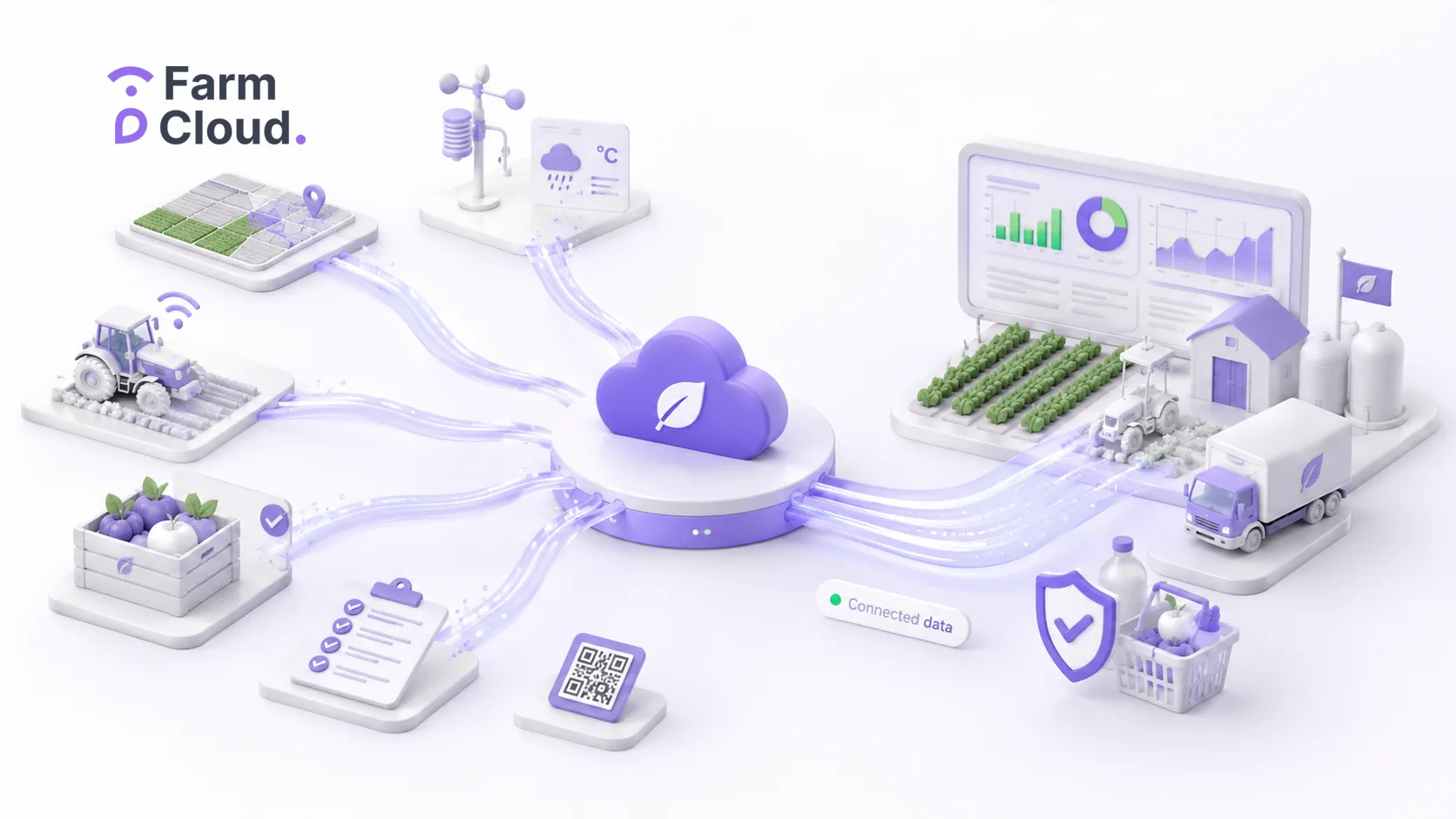
Integrating sprayer controllers with the FarmCloud platform is at the heart of the partnership between Agri Solutions and Rootsey. It brings together machine control electronics and farm data. The offering is aimed at machinery engineers, OEMs and the machinery retrofit market, covering the entire process from prescription maps to records of completed field operations.
At a glance
Agri Solutions and Rootsey are developing two-way integration between sprayer controllers and FarmPortal for Agriculture 4.0 and precision farming. According to the partners' figures as at 22 October 2026, the work covered 26 machines, 352 hours of field testing, seven solutions and 211 variable-rate spraying maps. The principal business customer is the OEM, which can build its own digital offering on an established platform without having to develop an entire farm management system (FMS), telemetry infrastructure and user portal from scratch.
- The architecture connects job planning, machine control, application data and digital field records.
- In selected configurations, map-based variable-rate spraying can operate without an additional guidance terminal.
- The offering covers new OEM machinery and retrofits for technically compatible sprayers.
Why should machinery manufacturers consider an established digital platform?
A sprayer manufacturer has a choice: develop its own machine management system, mobile application, service portal and farm integration, or use existing components. Our position is clear: for most small and medium-sized OEMs, buying or integrating an established platform makes more sense than building the entire infrastructure from scratch.
An in-house project can look attractive at the prototype stage. A team launches an application showing GPS location and a few controller parameters. The harder work begins once the first batch of machines has been sold: device identification, firmware versions, warranty claims, dealer access permissions, offline data, API updates, changes of machine ownership and maintaining the application over successive seasons.
Machinery engineers should invest primarily in what sets their equipment apart: hydraulics, the liquid application system, boom characteristics, rate-control algorithms and ergonomics. Developing a separate field database, spraying records and an entire FMS environment from the ground up for every manufacturer rarely strengthens that competitive advantage.
There is an exception: a large OEM with its own global data ecosystem and a multi-year software budget may have good reasons to maintain a proprietary product. Everyone else should start by assessing total lifecycle cost, rather than just the cost of building the first application.
What exactly do Agri Solutions and Rootsey bring together?
The partnership combines Rootsey's expertise in agricultural electronics, controllers, guidance systems and sensors with the FarmCloud and FarmPortal software developed by Agri Solutions. It covers integration and R&D, retrofit products, OEM projects, distribution and after-sales services. This is an ecosystem under development, not a claim that every feature is already available on every machine.
Rootsey, which has been developing agricultural electronics since 2010, offers products including the Quartmann GP-05, GP-07 and GP-13 controllers, designed for sprayer configurations with five, seven and thirteen sections respectively. Agri Solutions, operating since 2017, develops FarmPortal as an FMS for farms and agricultural production, alongside infrastructure for exchanging data with equipment.
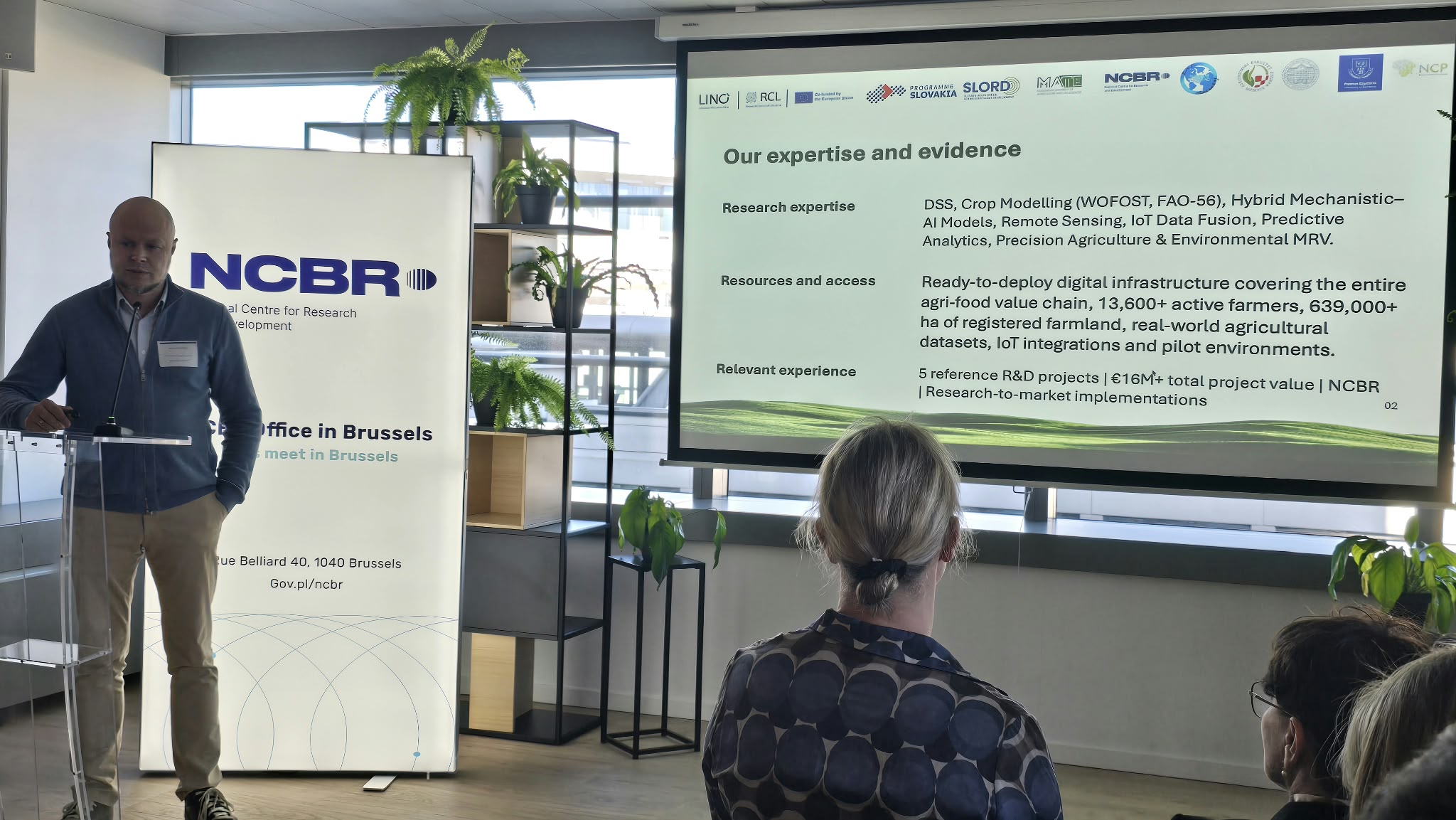
According to Agri Solutions' own figures from 22 October 2026, FarmPortal had more than 14,000 users and records covering over 639,000 ha of farmland. Approximately 3,000–4,000 field operations were recorded each week. For a machinery manufacturer, that means an existing operational environment in which fields, crops, inputs, treatments, costs and work history already have a place in the data model.
The platform's own statistics also show 10,682 reports generated in 2024 and 42,303 in 2025. The number of variable-rate spraying maps reached 1,533 in 2025 and exceeded 3,100 between the start of 2026 and mid-October. These figures describe activity across the platform as a whole, not sales or performance of the joint Rootsey solution.
How does integration between sprayer controllers and FarmCloud work?
The integration creates a data flow between planning in FarmPortal and job execution by a compatible Rootsey controller. The platform prepares a job or prescription map, the controller operates the machine, and available as-applied data can be returned to field history and reports. The degree of automation depends on the hardware version, sensors, communications module and implemented interfaces.
- Job identification: the farm selects the field, crop, date, product and target application rate, or a zone-based prescription map.
- Transfer preparation: the system matches the job identifier, field boundaries, zone geometry, units and permitted parameters to the controller's capabilities.
- Execution: the sprayer controller regulates the application rate and, in supported configurations, section operation and parameters during the pass.
- Recording: available GPS, speed, application-rate and operating-status signals are linked to the specific machine and job.
- Reporting: actual application data (as-applied) can feed into digital field records, cost analysis and treatment documentation.
A practical pitfall: sending a prescription map to a terminal does not prove that the treatment was carried out in accordance with it. That requires actual operating data: position and time, section status, target and measured application rates, flowmeter readings and information about interruptions. If even the job identifier or application-rate unit is missing, an apparently successful import can produce an inaccurate report.
In one scenario described in the project documentation, the Quartmann GP-07 controller works with a telemetry modem and FarmPortal to perform map-based VRA without a separate guidance terminal. That does not mean the system can operate without positioning information: the configuration still requires a suitable GNSS source and validation of the rate-control algorithm.
ISOBUS, CAN and VRA: which standards must an OEM platform support?
ISOBUS is a family of agricultural machinery communication standards based on ISO 11783. CAN is a communications bus used in machinery electronics, while ISOXML enables the exchange of job and as-applied data between compatible ISOBUS systems. Having a physical CAN interface, or making a general claim of 'ISOBUS support', does not in itself establish compatibility with a particular Task Controller function.
The Agricultural Industry Electronics Foundation (AEF) distinguishes between TC-BAS, TC-GEO and TC-SC functionalities. These differ in whether a system records totals, handles georeferenced data and prescription maps, or automatically controls sections. The comparison is based on the ISOBUS functionality descriptions published by AEF.
| Function | Technical role | Input data | Output for the FMS |
|---|---|---|---|
| TC-BAS | Documentation of completed work | Job and cumulative values | Area, time and consumption, as reported by available counters |
| TC-GEO | Handling georeferenced data and prescription maps | Zone map, position and target values | Spatial data and potentially an as-applied map |
| TC-SC | Automatic section switching | Position, boundaries, coverage and machine parameters | Reduced overlap and section-operation data |
| CAN / DDI | Reading equipment parameters and identifying process variables | Messages and definitions of supported signals | Telemetry, diagnostics and job reporting |
Source: AEF descriptions of TC-BAS, TC-GEO and TC-SC functionalities; comparison compiled by Agri Solutions. A DDI (Data Dictionary Identifier) identifies a process variable, but its availability depends on the equipment. The integration brief identifies 42 DDI identifiers within the project scope; the complete list and level of support must be confirmed in the relevant controller specification.
In practice, an integrator should test the terminal–implement combination, rather than each component in isolation. Validation of TC-BAS, TC-GEO and TC-SC functions remains part of the partnership roadmap. We do not claim AEF certification for the complete configuration without documentation confirming it.
A platform for OEMs: develop your own software or integrate FarmCloud?
For machinery manufacturers, the advantage of an established platform is access to an existing farm and user data model. FarmCloud can provide the data, API and after-sales service layer; FarmPortal serves as the farmer's working interface, while Rootsey electronics handle machine control. Any comparison, however, should cover the same functionality and maintenance period.
| Criterion | Build from scratch | FarmCloud + Rootsey | What should the contract specify? |
|---|---|---|---|
| FMS and agronomic data | Develop field, operation, user and reporting modules | Use the existing FarmPortal platform | Module scope and data access rights |
| Control systems and electronics | Develop ECUs and firmware, test and manufacture hardware | Select Rootsey devices and integrate them with OEM machinery | Supported models and functions |
| Telemetry and servicing | Develop a backend and application; provide SLAs and monitoring | Telemetry and service portal capabilities under development | Production readiness and the SLA |
| Branding and deployment | Full control over the product and source code | White-label model / OEM environment, subject to agreement | Licensing, API, hosting and data portability |
| Risk and product lifecycle cost | Full responsibility for maintenance and updates | Shared infrastructure and dependency on a partner | Exit rights, data migration and change support |
Source: editorial qualitative comparison based on the partnership scope. One-off integration costs should be separated from per-machine licence fees, connectivity, hosting, updates, data storage, training and warranty support.
Under an OEM model, the platform could be extended with a manufacturer-branded portal, machine serial numbers, warranty records, manuals, parts catalogues, repair histories, scheduled servicing, support tickets and utilisation reports. ERP and production workflow integrations are also possible. The overview of FarmCloud's architecture and integration capabilities outlines the approach to building API connections with external systems.
White-label delivery and deployment on customer-controlled infrastructure (BYOC) are envisaged as implementation options, but their terms must be agreed contractually: licensing model, data ownership, administrator roles, access to telemetry, responsibility for outages and exit arrangements. An established platform reduces the amount of development an OEM must undertake; it does not remove the need for integration, testing or maintenance.
How many sprayers could be upgraded, and how large is Poland's retrofit market?
The retrofit market involves upgrading existing sprayers by replacing or adding controllers, sensors, guidance equipment, communications modules and ancillary hardware. Not every functioning machine is suitable for an upgrade. Eligibility depends on factors such as the liquid delivery system, solenoid valves, flowmeter, sensors, electrical installation and available interfaces.
According to Statistics Poland (GUS), the 2020 Agricultural Census recorded 462,354 field sprayers and 51,842 orchard sprayers in Poland, a total of 514,196 machines. Source: GUS, 'Characteristics of Agricultural Holdings in 2020', Table 5. This is a historical equipment count, not a current measure of the market for controller sales.
Hypothetically upgrading 1% of that historical installed base would mean approximately 5,142 machines. This is a simple market-sizing scenario, not a demand forecast or a count of technically compatible units. For OEMs and dealers, segmenting specific machine families by specification, age, installation cost and user profile is more useful than the headline volume alone.
A retrofit kit may include a Quartmann controller, GNSS antenna, communications module, suitable wiring and actuators. An external guidance system is added only where required by the architecture. Hydraulic and electrical testing and calibration are essential; installing a phone application alone is not sufficient.
What have the tests demonstrated, and what is the status of the OEM implementation with Bury?
Integration work has already progressed to field trials and the pre-commercial stage. According to data supplied by Agri Solutions and Rootsey, as at 22 October 2026 the work involved 26 machines, 352 hours of testing, seven solutions and 211 variable-rate spraying maps.
| Metric | Value | What does it demonstrate? | What does it not yet demonstrate? |
|---|---|---|---|
| Machines tested | 26 | Scope of field verification | Compatibility with all models |
| Field testing | 352 hours | Total time spent testing in the field | In-season reliability |
| Solutions | 7 | Number of variants included in trials | Certification of each variant |
| VRA maps in testing | 211 | Scale of map preparation within the project | Accuracy of as-applied application rates |
| VRA zones | 2–5 | Level of differentiation in some test jobs | Agronomic benefits for every crop |
Source: the partners' own data — Agri Solutions and Rootsey field trials.
OEM case study: Bury Maszyny Rolnicze
Bury Maszyny Rolnicze is the first named OEM implementation partner. The aim is to equip selected machines with Rootsey electronics and the FarmPortal environment, then connect machine operation with customer support, servicing and the manufacturer's product offering. FarmCloud previously announced the start of its collaboration with Bury on digital services for machinery.
The joint model envisages factory-integrated capabilities for map-based spraying, servicing and communication with farmers. Integration and testing began in 2026.
How can integration performance be measured instead of simply claiming savings?
Integration performance should be assessed using data from individual field operations and the total cost of ownership. The number of maps transferred says nothing about whether the controller delivered the prescribed rate. Equally, GPS operating time does not automatically demonstrate reduced fuel or chemical consumption. An OEM project needs a set of technical, agronomic and service-related metrics.
- Job quality: proportion of jobs transferred and accepted successfully, unit errors, and completeness of field and map data.
- Application accuracy: deviation between target and measured application rates, control-system response, zone coverage and section-switching delay.
- Reporting reliability: proportion of treatments with complete as-applied datasets, missing samples and synchronisation after offline operation.
- OEM support: installation time, activation after machine handover, support cases per 100 devices, diagnosis time and support costs.
An illustrative calculation is possible for a 300 ha farm. Assuming crop protection expenditure of PLN 600/ha, a 3.5% saving from section control, followed by a further 5% reduction in the remaining cost through VRA, the hypothetical benefit is PLN 49.95/ha per year. Adding PLN 500 for time saved and deducting PLN 1,000 in annual costs gives PLN 14,485 per year. With an investment of PLN 16,000, the simple payback period is approximately 1.1 years.
How should a machinery manufacturer plan a FarmCloud integration?
An OEM integration should begin with one precisely defined machine configuration, not the entire product catalogue. The best initial objective is to demonstrate a complete, repeatable job workflow: map preparation, field operation, data recording, synchronisation and service readiness to handle an issue.
- Select a test platform: a specific sprayer model, controller, sensors, ECU, antenna and firmware versions.
- Agree a feature matrix: rate control, section control, ISOXML exchange, telemetry, DDI data and offline operation, separately for each variant.
- Map the identifiers: machine serial number, device, farm account, field, job, operator and service permissions.
- Test the operating cycle: job export, execution, loss of connectivity, subsequent synchronisation and as-applied reporting.
- Test failure handling and safety: GNSS loss, ECU restart, application-rate discrepancy, an incorrect map, modem disconnection and remote-diagnostics permissions.
- Prepare the production offering: part numbering, dealer manuals, update procedures, warranty terms, SLAs and allocation of responsibilities.
The technical agreement should set acceptance criteria: maximum number of synchronisation errors, application-rate tolerances, control response time, data formats, API versioning rules and the process for resolving non-conformities. It is also worth agreeing whether, and to what extent, vehicle data will be visible to the OEM, dealer, farmer and external integrator.
2027–2029 roadmap: from sprayers to an OEM services platform
The partnership plan envisages phased commercialisation. The first integrated products are expected to reach sales channels in early November 2026; this is a stated intention and should not be taken as confirmation that a particular variant is available. The 2027 objectives are development targets, not orders or guaranteed sales forecasts.
- Q1 2027: production-ready integration of selected Quartmann controllers with VRA maps, telemetry and reporting; target of 15–30 installations.
- Q2 2027: development of the factory integration project with Bury, a second OEM pilot, retrofit packages and validation of selected ISOBUS functions; cumulative target of 50–60 installations.
- Q3 2027: fertiliser spreaders, variable-rate NPK application maps, rate-control and as-applied reporting tests; target of ten spreader pilots and 80–90 integrated machines in total.
- Q4 2027: a pilot in Spain for orchard and vegetable crops, a variable-rate seeding prototype and an OEM offering combining hardware and services; target of 180–200 installations and at least one series-production agreement.
- 2028–2029: further development of remote diagnostics, fleet utilisation analytics, potential predictive maintenance and AI applications; expansion of OEM distribution across European markets.
What are the technical limitations, and when does integration make little sense?
An established platform cannot solve a sprayer's mechanical problems. If the control system is unstable, nozzles are worn, the flow sensor gives incorrect readings or the boom operates outside its calibrated range, a digital prescription map cannot guarantee the correct application rate. In such cases, the first step is to restore the machine to proper working order, and only then digitise its operation.
ISOBUS data exchange does not guarantee support for every function. Compatibility must be verified for the specific ECU, terminal, software version and tractor configuration. Similarly, centimetre-level RTK positioning accuracy, where available, does not automatically translate into centimetre-level spraying accuracy. Controller delays, spray distribution, boom movement, wind and nozzle characteristics all affect the outcome.
An OEM solution must separate safety-critical control, which remains on the machine, from cloud services responsible for planning and analysis. A loss of internet connectivity must not leave the operator without a safe way to use the machine. Offline-first capabilities and remote diagnostics need to be verified for the configuration being deployed.
Manufacturers should also check responsibilities for data and licensing. The phrase 'open API' is not enough. What matters includes data export after contract termination, service access controls, measurement data retention, accurate technical documentation, security updates, CE documentation and any applicable ISOBUS functionality certificates.
Frequently asked questions
Does integrating sprayer controllers with FarmCloud require ISOBUS?
Not in every case. Depending on the controller, integration may use manufacturer-specific interfaces, a telemetry modem and suitably documented CAN messages. ISO 11783 and ISOXML are relevant to interoperability with other terminals and FMS job exchange. Support must be verified for the specific device, rather than assuming that every sprayer fitted with CAN can handle VRA maps.
Is a separate guidance system needed for variable-rate spraying?
Not always. The Agri Solutions × Rootsey brief describes a Quartmann GP-07 configuration with a modem and FarmPortal in which the sprayer controller can carry out map-based variable-rate spraying without an additional guidance terminal. Suitable GNSS positioning data and hardware verification are still required. This is a capability of a selected configuration, not a universal feature of all controllers and sprayers.
Can FarmCloud serve as a white-label platform for an OEM?
The proposed project offering includes this option. An OEM could consider a branded interface, user portal, service history, access to operational data and API integrations. The details remain subject to agreement: per-machine licensing, data rights, branding, hosting, configuration scope and SLAs. Existing platform features must be distinguished from work required for a specific OEM project.
Does CAN-BUS integration mean full ISOBUS compatibility?
No. CAN defines the communications layer, whereas ISOBUS also specifies rules, formats, functions and interoperability requirements. A configuration may exchange certain parameters over CAN without supporting TC-GEO, TC-SC or ISOXML job export. For machinery engineers, the relevant document is a supported-function matrix for the controller, terminal and firmware version.
How can an OEM use telemetry data after selling a machine?
Under an agreed access model, an OEM can analyse operating history, machine utilisation, diagnostic messages and service requests. These data help plan servicing, diagnose recurring faults and design subsequent equipment versions. Manufacturer access should not be unrestricted by default: the legal basis, user roles, consent requirements and data retention period must be defined.
How much does a sprayer retrofit cost, and when does it pay for itself?
The price depends on the controller, sensors, antenna, wiring, modem, installation and subscription fees. The cost of the controller alone is not the cost of a complete retrofit. In the 300 ha farm scenario presented in this article, the indicative investment is PLN 16,000 and the simple payback period is approximately 1.1 years, but only under the modelled savings assumptions. Actual payback must be measured on the farm.
Is a claim of ISOBUS support equivalent to AEF certification?
No. A declaration of ISO 11783 support sets out the intended communications capabilities but does not prove that interoperability tests have been completed for a particular configuration. AEF distinguishes between functionalities and conducts conformity testing. Before series production, an OEM should examine the documentation for the controller, terminal and implemented TC-BAS, TC-GEO and TC-SC functions, and check that any certificates apply to the specified equipment versions.
Glossary
- FMS (Farm Management System)
- Software for managing a farm's fields, crops, operations, costs, people and machinery. FarmPortal fulfils this role within the partnership.
- OEM (Original Equipment Manufacturer)
- A manufacturer of original machinery that can fit electronics, software and its own digital services during production.
- ISOBUS / ISO 11783
- An electronic communications standard for agricultural machinery, covering interactions between tractors, implements and terminals, among other things.
- CAN-BUS
- A bus for exchanging data between a machine's electronic devices; the presence of CAN alone does not establish support for all ISOBUS functions.
- VRA (Variable Rate Application)
- Applying different rates of crop protection products, fertiliser or seed according to field zones and controller capabilities.
- ISOXML
- A format for exchanging job and as-applied data in the ISOBUS environment, used between compatible FMS platforms and terminals.
- As-applied
- Data describing what was actually applied, rather than what was prescribed; it may include position, time, application rate and section status.
- Retrofit
- Upgrading an existing machine by adding or replacing components rather than buying a new one.
- DDI (Data Dictionary Identifier)
- An identifier for a specific process variable in ISOBUS data, useful when mapping machine parameters to an analytics system.
Conclusions: OEM advantage comes from connecting machinery with the farmer's workflow
Agri Solutions and Rootsey are developing a joint offering covering agricultural electronics, sprayer control, agronomic data, spraying records and further digital services. For an OEM, the value goes well beyond transferring a map file. It lies in an established model for supporting a machine after sale, connecting the farm, dealer and service provider.
FarmPortal's scale and the results of testing to date provide a useful starting point. Readiness for series production will, however, depend on the compatibility matrix, application-rate verification reports, synchronisation reliability and clearly defined licensing terms. These four issues should be central to the first technical discussion with an OEM.
Follow us!
Preview what we are doing and be inspired by positive changes.