Summary: An agricultural adviser app can organise farm data, speed up communication and reduce documentation chaos, but it cannot replace an adviser who knows the field, the farm’s history and the way the farmer works. The best model for the next few years is not “person or app”, but an adviser supported by FoodPass, FarmCloud and data from FarmPortal.
An agricultural adviser app is a digital tool that organises farm data, recommendations, crop inspections, documents and communication so that advisers can make decisions faster, more consistently and with a fuller picture of the situation.
At a glance
Agricultural apps are increasingly effective at supporting crop monitoring, field treatment planning, documentation and data exchange between farmers, advisers, distributors and processors. They do not, however, replace conversation, local experience or the adviser’s responsibility. In practice, the hybrid model wins: FoodPass organises collaboration and recommendations, FarmCloud connects data, and FarmPortal provides information from the field.
- An app cannot see the full context of a farm if the data is incomplete or delayed.
- An adviser without a digital tool loses time rewriting notes, text messages and recommendations.
- FoodPass can become the adviser’s working centre for multiple farms, especially in quality, audits and deliveries.
- Agri Solutions’ own data shows that advisers account for 1.8% of FarmCloud users, and that number is growing.
Can an agricultural app replace an agricultural adviser?
No. At least not on farms where agronomic decisions have a real impact on yield, raw material quality, plant protection product residues, delivery timing and commercial relationships. An app can calculate, remind, organise and warn. The adviser still has to interpret.
This position is deliberately firm: no app for farmers will replace, in the next few years, an adviser working with the farmer in the field. Farmers still want to call someone they trust. They want to hear: “wait until tomorrow with that treatment”, “there is disease pressure here”, “do not use that tank mix while the plants are under this level of stress”.
Technology is changing the adviser’s working methods, though. Without digital tools, the adviser increasingly becomes a dispatcher in the middle of chaos: phone calls, WhatsApp photos, text messages, scouting notes, PDF files, field maps, variety lists, analysis results and questions about treatments from the last two seasons. The problem is not a lack of knowledge. The problem is the loss of context.
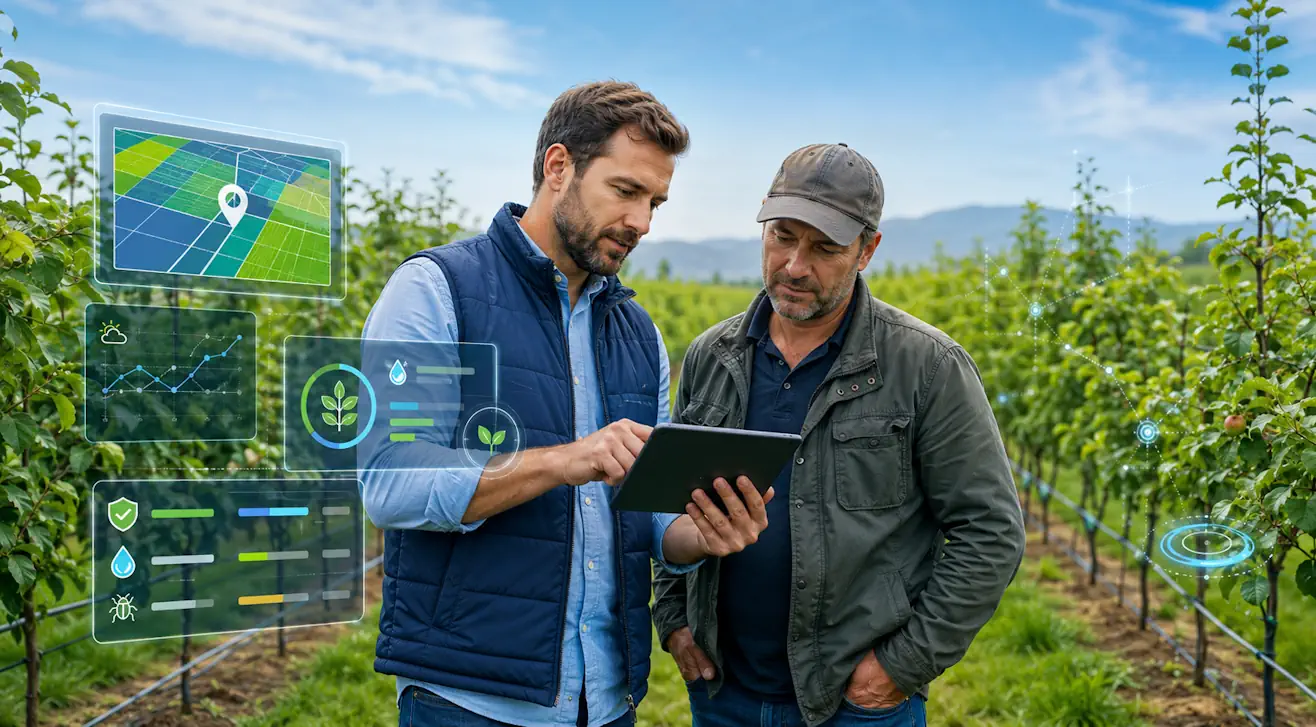
This is exactly where FoodPass as a tool for advisory work, farm collaboration and supplier monitoring fits in. The app is not there to tell the adviser how to think. It is there to help the adviser see more, return faster to field history and leave a clear decision trail.
| Model | Strength | Risk | Best use case |
|---|---|---|---|
| App alone | Fast reminders, simple alerts, data archive | No full interpretation of local conditions or data quality | Simple registers, documentation, repeatable messages |
| Adviser without a system | Experience, relationship, understanding of the farm | Knowledge stays in the adviser’s head, phone and notebook | Small number of farms, intensive field work |
| Adviser with FoodPass and FarmCloud | Relationship plus field history, recommendations, documents and delivery data | Requires discipline in data entry and farmer consent | Support for multiple farms, processors, producer groups and agri-distribution |
Why has digital agricultural advisory accelerated?
Digital agricultural advisory has accelerated because today’s adviser has to support more fields, more quality requirements and more documentation than a few years ago. There are also the requirements of processors, retailers, quality audits, farm-to-fork strategies and environmental data reporting.
The European Commission describes agricultural advisory as part of the Agricultural Knowledge and Innovation System (AKIS), meaning the flow of knowledge between farmers, advisers, science, administration and other market participants. Under the Common Agricultural Policy 2023–2027, advisory services should cover economic, environmental and social dimensions, while EU Member States should integrate public and private adviser networks. Source: European Commission, Farm advisory services.
This matters for the Polish market because the adviser is no longer just the person who gives fertilisation or crop protection recommendations. Increasingly, the adviser is the link between the farmer, the raw material buyer, the crop input distributor, the quality department and the purchasing department. One communication error can return as a batch complaint, a missed treatment window, an incomplete register or missing data during an audit.
FAO notes that artificial intelligence and digital tools can reduce the cost of delivering advice to farmers, while also stressing the importance of local data, field testing, user skills and responsible use of AI. The global example of Digital Green cited by FAO shows the cost of advice falling from around USD 30 to USD 3 with digital tools and potentially to USD 0.30 with AI, but that does not mean advisers will be automatically replaced on commercial farms. Source: FAO, 2025.
In practice, the cost of advice is only one part of the equation. In fruit, vegetables, potatoes, quality cereals or contracted raw materials, the accuracy of the decision, response time and documentation matter more. A chatbot alone will not solve that. What does solve it is a process in which the adviser has data, the farmer has a simple contact channel, and the company has a decision trail.
What does an app do better than a person?
An app is better than a person at remembering details, keeping track of deadlines, organising history and connecting data from many places. It does not get tired after the thirtieth call of the season. It does not lose a crop inspection photo if the process is set up properly.
The greatest value appears in repeatable tasks: the list of farms, fields, varieties, treatment dates, recommendation history, status of completed recommendations, geotagged photos, samples, analysis results, quality checks and messages to a group of suppliers. These are the areas where FoodPass supports supplier monitoring, advisory work and quality across the supply chain.
The app also works well when the adviser needs to return to history. For example, a processor asks why a batch of raspberries from a specific day had a lower quality parameter. Without a system, the search begins across phones, spreadsheets and binders. In a digital model, the adviser checks the farm, fields, variety, crop inspections, recommendations, harvest date and related documents.
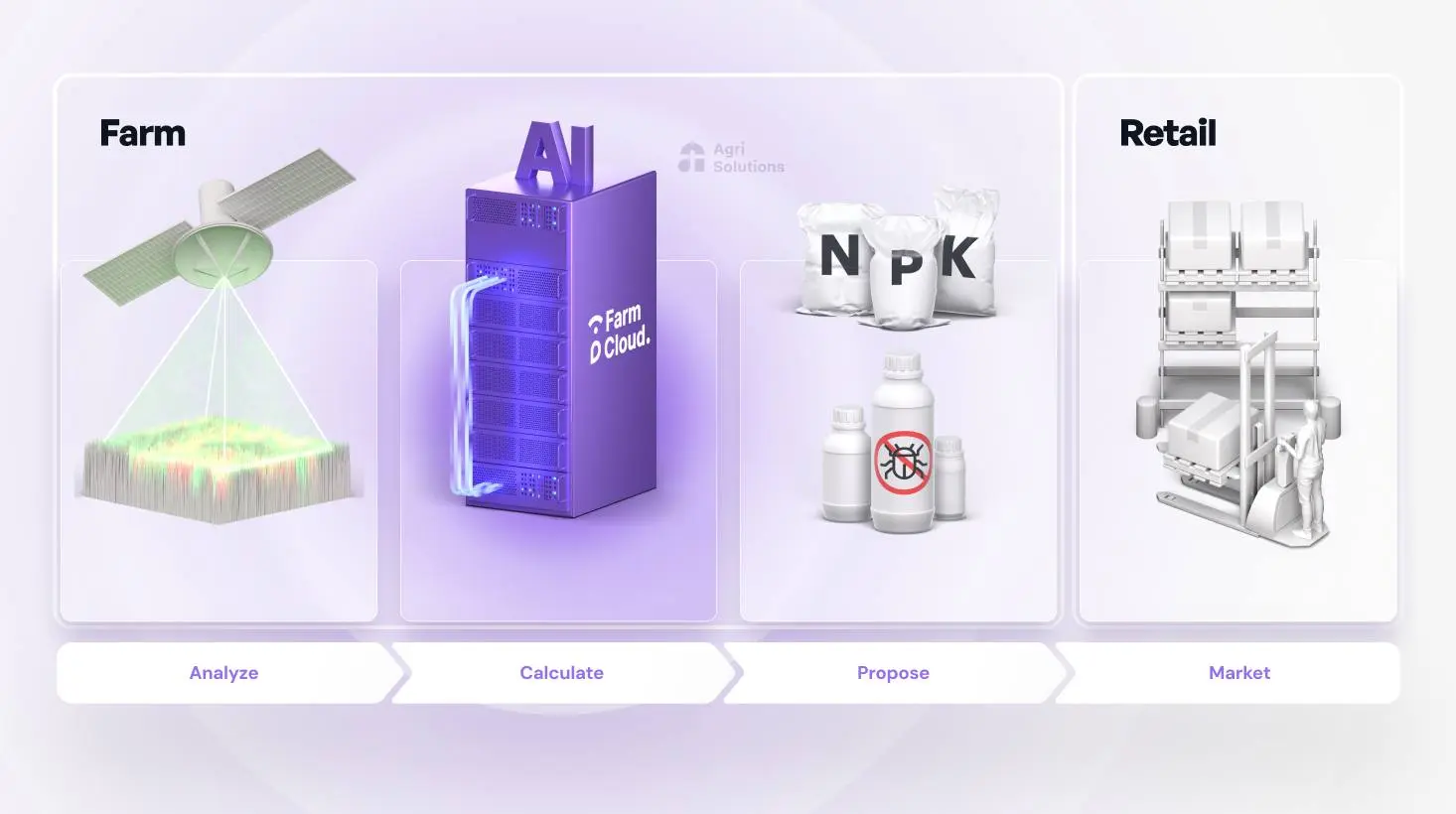
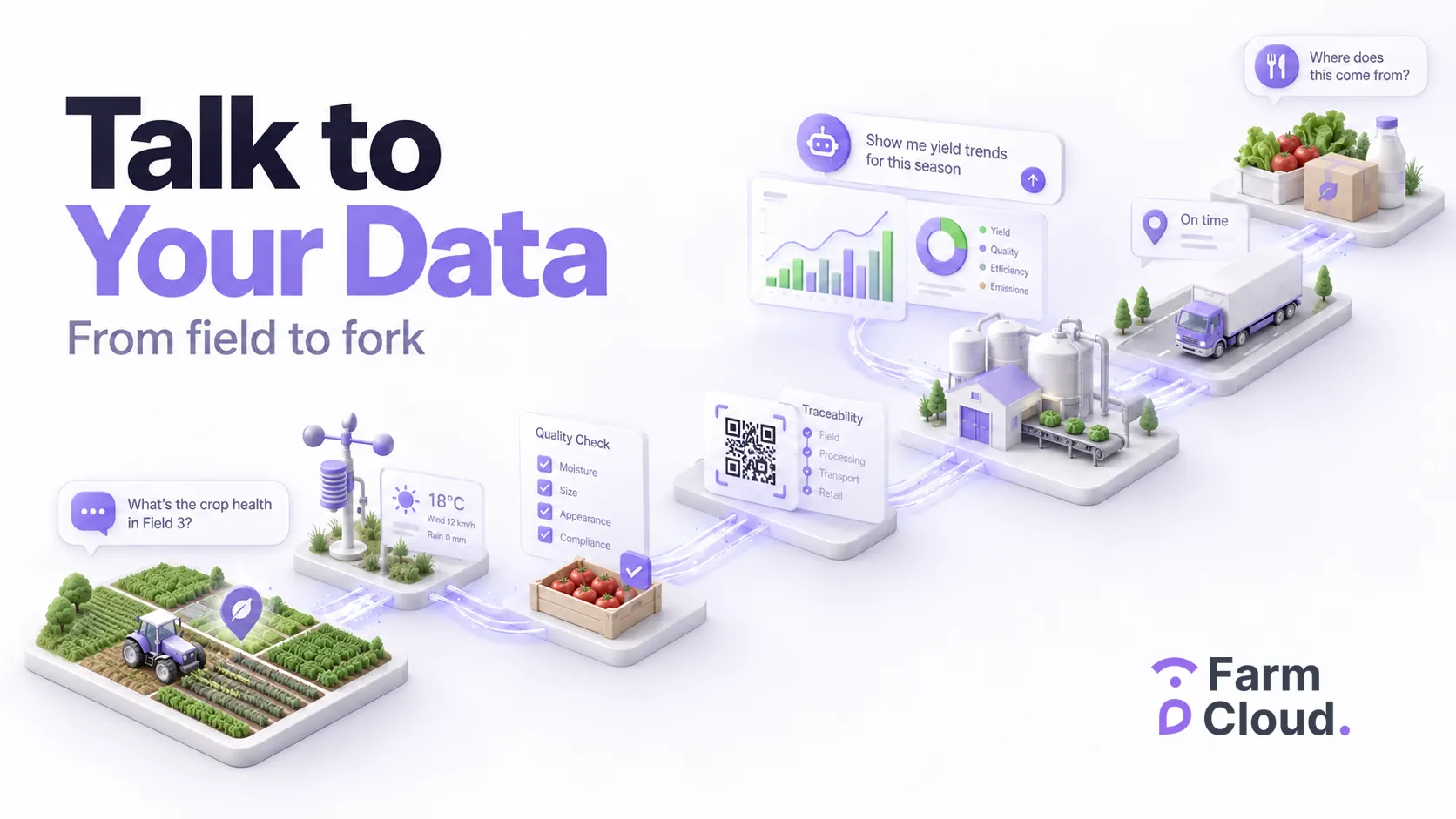
An FMS system such as FarmPortal complements this picture from the farm side. The farmer can keep records of fields, treatments, crops, machinery, employees and observations. FoodPass can use data shared by the farmer, while FarmCloud acts as the layer connecting field, quality, delivery and advisory data.
| Data type | Source | Advisory use | Risk when data is missing |
|---|---|---|---|
| Field and crop history | FarmPortal | Assessment of rotation, disease pressure and the effects of previous treatments | The adviser assesses the field based on the farmer’s memory |
| Recommendations and completion status | FoodPass | Checking whether the recommendation was issued and carried out | No decision trail in the event of a complaint or audit |
| Photos and location-based notes | FarmPortal / mobile applications | Comparing symptoms over time and locating the problem in the field | Photos remain on the phone, disconnected from the plot |
| Quality and delivery data | FoodPass | Linking agronomic decisions with raw material quality | Quality is analysed only at collection or at the processing site |
| Weather alerts and risk models | FarmCloud / integrations | Field treatment planning and prioritisation of crop inspections | Reaction after the event, especially with disease pressure and plant stress |
Where is an adviser still needed?
An adviser is needed where data is incomplete, symptoms are ambiguous and the decision has financial or quality consequences. The app can suggest a risk. The adviser is responsible for interpretation and for the conversation with the farmer.
The hardest decisions are rarely purely technical. Should the treatment be carried out now if the forecast gives only a few hours of workable weather? Is the plant under stress after frost and better left without another burden? Is the problem in the photo a disease, a deficiency, herbicide injury, salinity, drought, phytotoxicity or several issues at once?
The farmer often asks for more than the product, dose and timing. They ask whether it is worth taking the risk. They ask what neighbouring farms are doing. They ask whether the processor will accept the raw material if the parameters are close to the limit. This is where an app does not replace trust.
There is also a psychological layer to advisory work. A farmer who lost yield after a poor decision in the previous season may avoid risk even when the data suggests action. A farmer with a good relationship with the adviser will share photos faster, report a problem sooner and follow the recommendation more readily. A digital system should strengthen that relationship, not pretend to be it.
How does an agricultural adviser app work in FoodPass?
In the FoodPass model, an agricultural adviser app works as a collaboration centre for farms: it organises the supplier list, recommendations, documentation, crop inspections, samples, statuses and communication. As a result, the adviser does not start the season from a blank page.
FoodPass is particularly useful for advisers working with contracted raw materials, producer groups, fruit and vegetable processors, crop input distributors and companies that want to connect advisory work with delivery quality. The platform can support remote advice, checks, document exchange and monitoring of multiple farms.
In practice, it is straightforward. The adviser creates or receives access to partner farms, sees basic production data with the farmer’s consent, assigns recommendations, records notes and monitors status. If the company works with a processor, advisory data can be linked to raw material quality and deliveries. This is the difference between “I sent the recommendation” and “we have a record of who received it, when, what it concerned and what the outcome was”.
An agronomic adviser in the supply chain no longer works only for a single farm. Increasingly, they support the whole production standard: quality, consistency, safety, documents and audit readiness.
Is FoodPass only for processors?
No. FoodPass can work as a tool for a processor, distributor, producer group, adviser or quality department. The difference lies in which processes come first: agronomic recommendations, deliveries, documents, samples, audits or batch traceability.
What role does FarmPortal play?
FarmPortal is the operational FMS system on the farm side. This is where part of the field data is created: treatments, crops, notes, employees, machinery and documentation. FoodPass uses this layer when the farmer wants to work with an adviser, processor or agri-business in a more organised way.
What does FarmCloud data show?
Agri Solutions’ own data shows that digital advisory is still a young segment, but it is beginning to grow. In the FarmCloud system, advisers currently account for 1.8% of all users, with a total base of around 10,000 users in Poland. Status as of May 2026.
This is not mass adoption yet. And it is better not to pretend otherwise. The adviser segment is still building its digital habits, and the biggest barrier is not the technology itself. It is the organisation of work: who creates the farms, who invites the farmers, who manages consent, who updates the data and who is responsible for the quality of recommendations.
FarmCloud observations show a clear pattern, however: more advisers are creating FoodPass accounts themselves, adding partner farms and sending recommendations. We also see this in client enquiries. According to Agri Solutions analyses, one adviser currently supports around 19–48 farms, depending on crop profile, region, seasonality and scope of service.
This number explains why an ordinary phone is no longer enough. With 19 farms, an adviser can still remember most of the context. With 48 farms, risk starts to build: similar surnames, similar varieties, different treatment dates, different buyer requirements and different levels of documentation accuracy. One mistake in the season can cost more than implementing a simple digital process.
| Indicator | Value | Scope / date | Practical meaning |
|---|---|---|---|
| Share of advisers among users | 1.8% | Own data, May 2026 | The segment is growing, but is still at an early stage of adoption |
| Total user base in Poland | around 10,000 | Own data, May 2026 | A sufficient base to observe the trend, not to generalise to the entire market |
| Number of farms per adviser | 19–48 | Agri Solutions analysis | At this scale, field history and centralised communication become more valuable |
Benefits for advisers, processors and distributors
The greatest benefit of digital advisory is not that the farmer has yet another app. The benefit is that knowledge stops disappearing at the end of the season, when an adviser changes, or when a sales representative leaves a territory.
For many crop input distributors, knowledge about a client’s fields lives in three places at once: in the sales representative’s head, in text messages to the farmer and in a notebook in the car. When the representative leaves, the relationship with the farm often leaves with them. The company loses recommendation history, the farmer’s preferences and knowledge of purchasing potential.
For the processor, the problem is different. The purchasing department wants predictable deliveries, the quality department wants documents, and the adviser wants to influence production practice before harvest, not only after a complaint. FoodPass connects these perspectives because it enables work on farms, recommendations and deliveries in one workflow.
For the adviser, scale matters most. If they support several dozen farms, they need a way to prioritise work. Not every field requires a visit on the same day. Not every message requires a phone call. Not every problem should be solved from scratch.
For the agri-food marketing department, digital advisory is a source of better communication. Instead of sending general content to everyone, the company can build segments by crop, problem, season and need. This must be done responsibly: advisory work cannot become disguised product advertising if it is to retain the farmer’s trust.
How to implement digital advisory without losing the farmer relationship
Digital advisory should be implemented from the simplest process that gives value to the farmer and the adviser in the first season. The worst option is to start with a large database that nobody updates after two weeks.
A good starting point is a list of farms, fields, crops, advisers and recommendation types. Next, it is worth agreeing which events must always be recorded: crop inspection, photo of a problem, treatment recommendation, change of timing, sample, document, group message, confirmation of completion. Without this discipline, the app becomes just another place for notes.
The farmer has to understand why they are sharing data. The argument “because the company is implementing a system” is not enough. A better argument is: you will receive recommendations faster, we will return to field history more easily, we will reduce the number of phone calls in the season, and you will have documentation if the processor, auditor or buyer asks for it.
It is also worth separating advisory work from control. If the farmer feels that every note is used only for assessment and blocking deliveries, they will limit the information they share. FoodPass should organise collaboration, but the relationship still needs clear rules: who sees the data, for what purpose, for how long, and what happens to a recommendation.
In projects for larger organisations, FarmCloud can act as the integration layer between farm data, FoodPass, FarmPortal, ERP systems, CRM systems, quality and reporting. At that point, the agricultural adviser app stops being a separate tool and becomes part of the data infrastructure. We write more about this approach in the article FarmCloud as digital infrastructure for the agri-food sector.
Case study: an adviser supporting 36 farms
Imagine an adviser working with a group of vegetable suppliers for a processor. The adviser supports 36 farms, covering a total of 620 ha of contracted crops. During the season, they receive around 25–40 messages per week with photos, questions about treatments, requests to confirm timing and information about quality problems.
Before FoodPass is implemented, most communication is fragmented. Some recommendations are in text messages, some in a spreadsheet, some on the adviser’s phone. The quality department sees the problem only at delivery, and the purchasing department has no full information about which farms carry a risk of delay.
After implementation, the adviser creates the farm structure, assigns crops, adds recommendations, records crop inspections and marks the completion status of recommendations. Farmers send photos assigned to a farm or field, while the adviser can filter cases by crop, timing, risk and raw material buyer.
| KPI | Before implementation | After implementation | Interpretation |
|---|---|---|---|
| Recommendations recorded in one place | around 35% | 90–100% | Model value; depends on the adviser’s working discipline |
| Time to find field history | 15–40 minutes | 2–5 minutes | Operational saving, not a guarantee of agronomic outcome |
| Number of undescribed problem photos | high, no consistent classification | low, photos assigned to a farm | Better material for season analysis |
| Visibility of risks for the purchasing department | after a phone call to the adviser | in statuses and reports | Requires agreed permissions and data scope |
The most important conclusion is not: “the app shortened working time”. What matters more is that the organisation stopped losing the season’s memory. After harvest, it is possible to check which recommendations were most frequent, which farms had recurring problems and which risks returned before delivery.
Limitations and implementation mistakes
Digital advisory makes no sense if a company simply wants to “have an app”. It makes sense when it changes the way people work: who collects data, who recommends, who sees statuses and who draws conclusions after the season.
The first mistake is moving chaos from the phone into the system. If there is no standard for field names, recommendation types and statuses, FoodPass becomes a digital notebook rather than an operational tool. The data will exist, but it will be difficult to compare.
The second mistake is the lack of consent and clear communication with the farmer. Advisory work is built on trust. The farmer must know whether the data is used only for recommendations, or also for supplier assessment, quality control, settlement, audit or purchasing analysis.
The third mistake is starting too ambitiously. There is no need to integrate every system, disease model, sensor, ERP and management report immediately. It is better to start with 20 farms, two crops and five event types, and then expand the process.
The fourth mistake is treating AI as an agronomic authority. An algorithm can help detect a pattern, but it does not know all the trade-offs on the farm: sprayer availability, time pressure, relationship history, contract risk, local weather and the farmer’s experience.
FAQ
Will an agricultural adviser app replace the adviser?
No. The app organises data, recommendations, photos, documents and communication, but it does not replace the adviser’s experience. On commercial farms, decisions depend on weather, field history, disease pressure, raw material quality and the farmer’s readiness to act.
What do advisers most often need FoodPass for?
FoodPass helps advisers support multiple farms, record recommendations, plan activities, monitor documents and communicate with farmers. It is particularly well suited to advisory work linked to processing, raw material quality, suppliers and farm-to-fork strategies.
How is FoodPass different from an FMS system?
An FMS system such as FarmPortal supports day-to-day farm management: fields, crops, treatments, machinery, employees and documentation. FoodPass works more broadly: it connects the adviser, farms, deliveries, quality, traceability, audits and supply chain communication.
Does the farmer have to manage all the data themselves?
Not always. The data scope depends on the collaboration model. The farmer may manage part of the information in FarmPortal, while the adviser can work in FoodPass on data shared with the farm’s consent. The key is to define which data is needed for recommendations, quality and documentation.
Which data is most important for agronomic decisions?
The most important data covers the field, crop, variety, treatment history, observations, weather, disease pressure, symptom photos, analyses and the completion status of recommendations. Without history, the adviser often works on a fragment of information rather than a full view of the farm.
Is online agricultural advice safe?
It can be safe if it has clear rules for data access, farmer consent, user roles and activity history. The online channel alone is not enough. A process is needed to define who sees the data, who adds recommendations and how long the information is stored.
Does the app help with quality audits?
Yes, but it does not replace audit or certification requirements. FoodPass can organise documents, recommendations, checks, deliveries and the history of cooperation with farms. This helps the company show faster where the raw material came from and what actions were taken before delivery.
What is the biggest problem when implementing an app for advisers?
The biggest problem is not technology, but working discipline. If advisers record recommendations only occasionally, farmers do not understand why they are sharing data, and the company fails to set standards, the system quickly loses value. Implementation should begin with a simple process.
Can AI issue agricultural recommendations on its own?
AI can support data analysis, pattern detection, image classification and the drafting of messages. In practical advisory work, however, the decision should remain with a human, especially when it concerns treatments, costs, residues, raw material quality and responsibility for yield.
Who benefits most from an agricultural adviser app?
It makes most sense for advisers supporting many farms, processors working with suppliers, producer groups, crop input distributors and companies that want to combine advisory work with quality, deliveries, documentation and long-term farmer relationships.
Glossary
Agricultural adviser app
A digital tool supporting advisers in their work with farms. It usually includes client lists, fields, recommendations, notes, photos, documents, communication and activity history.
Online agricultural advice
A form of advisory work in which part of the contact, documentation and recommendations takes place remotely. It does not mean giving up field visits, but rather preparing for them better and responding faster between visits.
FMS system
Farm Management System, meaning a system for farm management. In the FarmCloud ecosystem, this role is played by FarmPortal, which supports records for fields, crops, treatments, machinery, employees and documents.
FoodPass
A FarmCloud solution for advisory work, traceability, quality, supplier collaboration and supply chain data. In an advisory context, it organises work with multiple farms and recommendations.
FarmCloud
The digital ecosystem from Agri Solutions that connects data from farms, advisory work, processing, distribution, quality, reporting and integrations. It acts as the layer linking products such as FoodPass and FarmPortal.
Field treatment planning
The process of setting the timing, type and conditions for an agronomic treatment. It requires combining data on the crop, weather, development stage, pest and disease pressure, and buyer requirements.
Agronomic decisions
Decisions concerning crop management, such as fertilisation, crop protection, irrigation, harvest timing or response to stress. Their quality depends on data, experience and local context.
Traceability
The ability to identify and follow a product or raw material through the supply chain. In practice, it means being able to reconstruct which farm, field, batch and delivery the raw material came from.
AKIS
Agricultural Knowledge and Innovation System, meaning the system through which knowledge and innovation flow in agriculture. It includes farmers, advisers, science, administration, companies, education and industry organisations.
Summary and next step
An agricultural adviser app should not replace the adviser. It should take away from the adviser’s desk and phone the tasks that do not require intuition: searching for field history, rewriting recommendations, reconstructing conversations, monitoring documents and checking who received a message.
The most realistic model for 2026–2028 is the adviser supported by data. FoodPass organises collaboration with farms and suppliers, FarmPortal provides operational data from the farm, and FarmCloud connects this information with quality, traceability, reports and agri-food business processes.
A practical next step: choose one group of farms, one crop and three processes to organise in FoodPass, for example recommendations, crop inspection photos and quality documents. Only once this process has worked through a season is it worth expanding it with more data, integrations and reports.
See how FoodPass supports digital agricultural advisory and collaboration with farms.
Follow us!
Preview what we are doing and be inspired by positive changes.